eBook - ePub
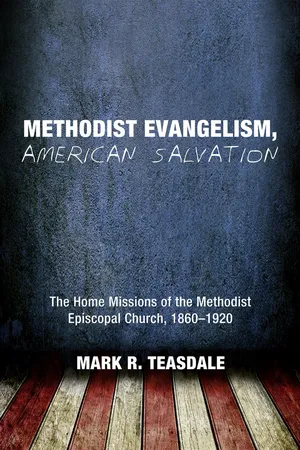
Methodist Evangelism, American Salvation
The Home Missions of the Methodist Episcopal Church, 1860–1920
- 292 pages
- English
- ePUB (mobile friendly)
- Available on iOS & Android
eBook - ePub
Methodist Evangelism, American Salvation
The Home Missions of the Methodist Episcopal Church, 1860–1920
About this book
Powerful ideas have the capacity to inspire great good. They also have the capacity to prompt unspeakable acts of evil. The ideas of "America" and "the gospel" have been used for both. The situation was no different when the Methodist Episcopal Church (MEC) brought these two ideas together in its evangelistic work from 1860 to 1920, including during the Civil War and the First World War. Methodist Evangelism, American Salvation traces the MEC's home missions among African Americans and whites in the South; among Native Americans, Mexicans, and white settlers in the West; and among newly arrived immigrants, their children, the poor, and the rich in the East's burgeoning cities. It shows the innovative and courageous work of the MEC to improve the quality of life for these most marginalized populations in the United States. It also shows the fear the MEC had that these populations would overthrow American civilization if they did not conform to the values held by white, middle-class, native-born Americans.
Information
Topic
Theology & ReligionSubtopic
Christian Ministry1
For God and Liberty
“I was born September 1st, 1785, in Amherst County, on James River, in the State of Virginia. My parents were poor. My father was a soldier in the great struggle for liberty, in the Revolutionary war with Great Britain.”10 So begins the Autobiography of Peter Cartwright (published 1856). Cartwright focused the bulk of his autobiography on sharing anecdotes about his years as a frontier circuit rider and opining about the state of the Methodist Episcopal Church throughout the fifty years he served the denomination as a presiding elder. By the end of the memoir, it is clear that Cartwright was a “croaker,” a term given to those Methodists who harkened back to what they saw as the heroic days of Methodist ministry marked by camp meetings, frontier living, revivalism, highly emotional conversions, an unfettered itinerancy, and a deep piety evidenced in Methodist worship, Methodist family devotions and Methodist morality against what they perceived to be the laxity of Methodists in the middle and late nineteenth century.
Cartwright and his fellow croakers sounded a chorus against the growing respectability of the Methodists and the ways that the members of their beloved denomination seemed bewitched by the innovations that the culture made available for churches to adopt in their daily operations (e.g., the technology and wealth that made the installation of pipe organs possible). Nowhere is this clearer than in Cartwright’s resigned-yet-condemning comments about worshiping in 1852 in a Methodist congregation in Boston, which had adopted all the paraphernalia of denominational and cultural success:
I shall not attempt a labored argument here against these evils, for I suppose, where these practices have become the order of the day, it would be exceedingly hard to overcome the prejudice in favor of them, though I am sure, from every observation I have been able to make, that their tendencies are to formality, and often engender pride, and destroy the spirituality of Divine worship; it gives precedence to the rich, proud, and fashionable part of our hearers, and unavoidably blocks up the way of the poor; and no stumbling-block should be put in the way of one of these little ones that believe in Christ.11
Yet, as Cartwright’s opening lines show, he was no stranger to identifying with American culture. Launching his career in the denomination in 1803, Cartwright was quick to appropriate the core values of the American Revolution, particularly the value of “liberty,” as sympathetic to the ministry of the Methodist Episcopal Church. In doing this Cartwright, along with the circuit riders of his era, helped lay the foundation for the denomination to merge Methodist values with the cultural values of the United States over the coming years. In many ways, these early circuit riders established the ability of the denomination to undertake the very changes that they bemoaned later.12
This introduction of national values into the message of the circuit riders suggests that during the first half of the nineteenth century the Methodist Episcopal Church was already well on its way to developing an American gospel. Additionally, since the Methodist practice of evangelism sought not only to call people to repentance, but to form people’s identities around the core values of Methodism, the Methodist Episcopal Church was creating a structure that would be well-suited to pure American evangelism later in the century.
An Evangelistic Organization
Prior to describing how cultural values began to influence the gospel preached by Methodists, it will be helpful to provide a brief overview of organization of the Methodist Episcopal Church since this greatly facilitated the denomination’s practice of evangelism.
American Methodists structured their denomination around a circuit and conference system they adapted from John Wesley’s use of itinerant preachers who gathered to meet once a year. In the American adaptation, the “circuits” were geographical areas to which Methodist bishops appointed itinerant preachers known as “circuit riders.” On these circuits the preachers rode from one preaching site to the next to encourage the faithfulness of those already organized into Methodist societies, and to evangelize non-Methodists in the hopes either of drawing them into existing societies or of organizing them into new societies. The “conferences” were regular meetings in which the preachers gathered, worked out administrative, doctrinal, and legal issues for the denomination, and received their new appointments from the bishops. The combination of the circuit and the conferences formed a remarkably flexible-yet-centralized system that was ideal for relating to as many people as possible along the expanding American frontier, while also retaining the uniqueness of the Methodist identity through the accountability of regular meetings among the preachers.
This organizational structure uniquely suited evangelism in several ways. First, it all but guaranteed that the circuit riders understood their primary job to be evangelistic. The denomination deployed them to proclaim the gospel and draw people into both the Christian faith and the Methodist Episcopal Church. That the Methodists who participated in this system during the early nineteenth century understood this evangelistic focus can be seen in the language they used to describe their work. In his history of Methodism, for example, Abel Stevens (1868) often used the words “evangelists,” “great evangelists,” and “missionaries,” interchangeably with such words as “itinerant” and “preacher.”13 It is clear that Stevens understood the itinerant Methodist preacher as involved in evangelistic activity as a matter of course. The Methodist preacher was an evangelist and a missionary precisely because he was a Methodist preacher.
The second way this organizational structure supported Methodist evangelism was by providing the Methodist Episcopal Church the freedom to relate to the American people in a relevant and meaningful way while also allowing the denomination to avoid having its identity become defined as nothing more than a reflection of cultural tastes. In doing this, the Methodists avoided the twin pitfalls of either being so ecclesiastically rigid that they could not be relevant and attractive to potential converts or being so concerned about being relevant that they lost sight of their denominational identity as handed down in their Wesleyan heritage. The Methodist Episcopal Church’s intentional desire to craft a careful balance between preserving identity and forging relevant connections to the American people is seen in 1791 when, even before mass camp meetings began to take place in the United States, the Methodists modified their circuit and conference structure by creating a three-tier system of conferences in order to establish both a greater means of promoting revival on the circuits and a means of providing stronger denominational oversight for those circuits.14
The first tier was the General Conference at which preachers and bishops would meet every four years to consider the business of the entire denomination. The second tier was composed of multiple annual conferences in which Methodist preachers appointed to circuits within specific geographical regions would gather to conduct business necessary to the Methodists in their region once a year. The third tier was composed of quarterly conferences that met once every three months. Quarterly conferences would draw together all the Methodists on a specific circuit, providing the opportunity for a religious meeting while also guaranteeing the presiding elder, a preacher who oversaw the preachers on many circuits, an opportunity to ensure good Methodist discipline was maintained.15 This was a masterful move in the Methodist organization that allowed the Methodists a way to relate to the American people at large while also ensuring that Methodist discipline would not be broached.
A third way the Methodist organizational structure supported Methodist evangelism was by emphasizing evangelistic activity on the local level, including through the work of the laity. Since it would take between four and six weeks for circuit riders to visit all the preaching sites on their circuits, Methodists depended on the laity within their societies to maintain Methodist order and instruction. This most frequently happened within the Methodist class, a subset of the Methodist societies. Methodist classes were small groups in which Methodists would gather for the purpose of reflecting on how they had been living in light of their commitment to Christ through the Methodist Episcopal Church. Without a Methodist preacher in atten...
Table of contents
- Title Page
- Foreword - Ted A. Campbell
- Acknowledgments
- Abbreviations
- Introduction
- Chapter 1: For God and Liberty
- Chapter 2: Forging an American Gospel
- Chapter 3: The South
- Chapter 4: The West
- Chapter 5: The Cities
- Chapter 6: The First World War and the Centenary Campaign
- Conclusion
- Bibliography
Trusted by 375,005 students
Access to over 1.5 million titles for a fair monthly price.
Study more efficiently using our study tools.
Frequently asked questions
Yes, you can cancel anytime from the Subscription tab in your account settings on the Perlego website. Your subscription will stay active until the end of your current billing period. Learn how to cancel your subscription
No, books cannot be downloaded as external files, such as PDFs, for use outside of Perlego. However, you can download books within the Perlego app for offline reading on mobile or tablet. Learn how to download books offline
Perlego offers two plans: Essential and Complete
- Essential is ideal for learners and professionals who enjoy exploring a wide range of subjects. Access the Essential Library with 800,000+ trusted titles and best-sellers across business, personal growth, and the humanities. Includes unlimited reading time and Standard Read Aloud voice.
- Complete: Perfect for advanced learners and researchers needing full, unrestricted access. Unlock 1.5M+ books across hundreds of subjects, including academic and specialized titles. The Complete Plan also includes advanced features like Premium Read Aloud and Research Assistant.
We are an online textbook subscription service, where you can get access to an entire online library for less than the price of a single book per month. With over 1.5 million books across 990+ topics, we’ve got you covered! Learn about our mission
Look out for the read-aloud symbol on your next book to see if you can listen to it. The read-aloud tool reads text aloud for you, highlighting the text as it is being read. You can pause it, speed it up and slow it down. Learn more about Read Aloud
Yes! You can use the Perlego app on both iOS and Android devices to read anytime, anywhere — even offline. Perfect for commutes or when you’re on the go.
Please note we cannot support devices running on iOS 13 and Android 7 or earlier. Learn more about using the app
Please note we cannot support devices running on iOS 13 and Android 7 or earlier. Learn more about using the app
Yes, you can access Methodist Evangelism, American Salvation by Mark R. Teasdale in PDF and/or ePUB format, as well as other popular books in Theology & Religion & Christian Ministry. We have over 1.5 million books available in our catalogue for you to explore.