eBook - ePub
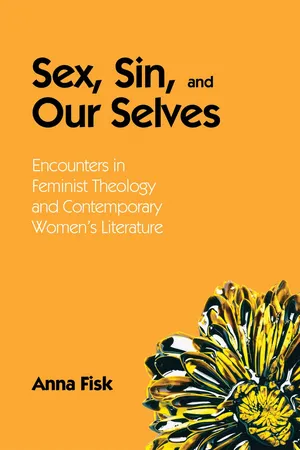
Sex, Sin, and Our Selves
Encounters in Feminist Theology and Contemporary Women’s Literature
- 220 pages
- English
- ePUB (mobile friendly)
- Available on iOS & Android
eBook - ePub
Sex, Sin, and Our Selves
Encounters in Feminist Theology and Contemporary Women’s Literature
About this book
Sex, Sin, and Our Selves brings together readings in feminist theological thought and the literature of the acclaimed contemporary writers Michele Roberts and Sara Maitland. Through placing theology in conversation with Roberts's and Maitland's literary engagement with issues of religion and gender, this book explores themes of selfhood, connection, sex, sin, and self-sacrifice. In doing so, it challenges a tendency of feminist theology to seek simple and idealized answers, rather than honor complexity and the need to continue to ask questions. In the encounters in feminist theology and contemporary women's writing, Anna Fisk employs autobiographical narrative, critically understood as "reading these stories beside my own."
Information
Topic
Theology & ReligionSubtopic
Christian Theology1
Annunciation
Autobiographical Fictions
Writing the Self
“The Waltz of the ‘As A’s”: Autobiography in Academic Writing
Feminist theology’s (not untroubled) faith in the authority of women’s experience is far from alone in feminist discourse in asserting that what we see depends on where we stand. A central aspect of academic feminist theory—be it in philosophy, sociology, political science, literary criticism, and so on—is the argument that abstract and universalized accounts of knowledge serve to obscure the perspective and interests of those of the dominant social classes. Early feminist theorists such as Carol Gilligan and Nancy Hartsock (who coined the term “standpoint epistemology”) claimed that women’s social circumstances entail that they see and know differently from men.1 This, in light of postmodern thought and the critiques of black and postcolonial criticism, led to an emphasis on the particular situation of the critic, researcher, or theorist. This is neatly summarized in the words of Margaretta Jolly: “[i]n today’s pluralist culture, individuals assert that knowledge is by definition conditioned by its context, embodied and relative to its speaker. For them, the job of an academic is not to argue until we arrive at some final objectivity, but to find ways of understanding and living with our differences.”2
Thus in the last three decades it has become standard, at least in certain academic discourses, for an author to open a piece of work with a statement of their own social location; for example “as a white, western, middle-class woman.” This convention, which Nancy Miller terms “the waltz of the ‘as a’s; the obligatory dance cards of representivity”3 does not always entail that the academic writer will continue throughout their work to discuss the ways in which their own circumstances have influenced its production. More often than not, it is a way of paying tribute to the “anxiety over speaking as and speaking for,”4 while avoiding full consideration of that very anxiety. Yet the academic culture of ‘as a ___’ has enabled the emergence of ‘personal criticism,’ in which the academic writer self-consciously reflects on their own experience.
Personal criticism—variously termed “engaged,” “autobiographical,” “confessional,” “testimonial,” “reflexive,” and so on—is a form that deliberately transgresses normative conventions of academic objectivity.5 It may highlight the process of the production of academic work, thus catching “intellectual authority . . . in the act of its own construction.”6 When scholarship is “self-conscious” about its own process, it points to “the fictional strategies inherent in all theory.”7 It is a move away from the academic culture of “books written by someone who, though appearing by name on the cover, endeavors with delight to argue for the unreality of his own existence.”8 In personal criticism the unique, embodied reality of the writer is not bracketed off, but given a central role in the text, with reference to their experiences, interests and desires. Personal criticism may use detailed or lengthy autobiographical material, but more significantly it involves “a certain intensity in the lending of oneself,” in the words of Mary Ann Caws.9 Anecdotes employed to illustrate a concept or argument are not necessarily personal in the same sense, even if drawn from real life experience, whereas personally engaged academic writing expresses a real sense of care towards the subject matter, saying ‘this is important to me, and here is why.’
Autobiography in Feminist Theology
The use of the personal voice has not been as widespread in feminist theology as one might have expected, with its emphasis on ‘women’s experience’ often not going hand in hand with detailed autobiographical reflection. It is more common for feminist theologians to give a perfunctory statement of their social location—ethnicity, nationality, class, and so on—and perhaps give some mention of their experience within the church or university, or involvement in a particular political struggle. There are some exceptions to this generalization, for example Carol Christ has written from an increasingly personal standpoint—something she considers in the preface to the second edition of Diving Deep and Surfacing—and in Rebirth of the Goddess she entwines her systematic thealogy with autobiographical reflection. Carter Heyward’s When Boundaries Betray Us explores issues of intimacy and integrity in friendship and love through an account of her troubled relationship with her therapist. Rita Nakashima Brock and Rebecca Parker wrote together Proverbs of Ashes, which relates their experience of suffering and how this has affected their theology. They claim that “[o]ur theological questions emerged in our daily struggles to teach, minister, and work for social change, and from personal grappling with how violence had affected us. The mask of objectivity, with its academic, distanced tone, hid the lived character of our theological questions and our theological affirmations.”10
I have found Proverbs of Ashes somewhat disappointing as a representation of “the lived character of theological questions and affirmations.” This is partly a matter of taste—the writing style, as with Christ and Heyward, is sometimes akin to that of the popular books categorized in bookshops as either “self-help” or “painful lives”—but, more importantly, because it is not always successful at striking a balance between theology and life-writing. Rebecca Parker’s harrowing descriptions of recovered memories of child abuse do have much to say in addressing profound theological questions. Yet Rita Nakashima Brock does not fully develop how her experience of fragmented identity, growing up in the US with a Japanese mother, discovering late in life that her biological father was a Puerto Rican soldier, has affected her theology.
The same criticism can also be applied to a pseudonymous article in the journal Theology and Sexuality, “Anonymity Desirable, Bibliography Not Required,” published under the name Nema McCallum. She writes vividly and pow...
Table of contents
- Title Page
- Acknowledgments
- Abbreviations
- Introduction: "The Beauty of the Bones"
- 1. Annunciation: Autobiographical Fictions
- 2. Visitation: Reading and Writing Encounters
- 3. Selves
- 4. Suffering, Sacrifice, and Sin
- 5. Sex and the Sacred
- 6. Sea
- Bibliography
Trusted by 375,005 students
Access to over 1.5 million titles for a fair monthly price.
Study more efficiently using our study tools.
Frequently asked questions
Yes, you can cancel anytime from the Subscription tab in your account settings on the Perlego website. Your subscription will stay active until the end of your current billing period. Learn how to cancel your subscription
No, books cannot be downloaded as external files, such as PDFs, for use outside of Perlego. However, you can download books within the Perlego app for offline reading on mobile or tablet. Learn how to download books offline
Perlego offers two plans: Essential and Complete
- Essential is ideal for learners and professionals who enjoy exploring a wide range of subjects. Access the Essential Library with 800,000+ trusted titles and best-sellers across business, personal growth, and the humanities. Includes unlimited reading time and Standard Read Aloud voice.
- Complete: Perfect for advanced learners and researchers needing full, unrestricted access. Unlock 1.5M+ books across hundreds of subjects, including academic and specialized titles. The Complete Plan also includes advanced features like Premium Read Aloud and Research Assistant.
We are an online textbook subscription service, where you can get access to an entire online library for less than the price of a single book per month. With over 1.5 million books across 990+ topics, we’ve got you covered! Learn about our mission
Look out for the read-aloud symbol on your next book to see if you can listen to it. The read-aloud tool reads text aloud for you, highlighting the text as it is being read. You can pause it, speed it up and slow it down. Learn more about Read Aloud
Yes! You can use the Perlego app on both iOS and Android devices to read anytime, anywhere — even offline. Perfect for commutes or when you’re on the go.
Please note we cannot support devices running on iOS 13 and Android 7 or earlier. Learn more about using the app
Please note we cannot support devices running on iOS 13 and Android 7 or earlier. Learn more about using the app
Yes, you can access Sex, Sin, and Our Selves by Anna Fisk in PDF and/or ePUB format, as well as other popular books in Theology & Religion & Christian Theology. We have over 1.5 million books available in our catalogue for you to explore.