eBook - ePub
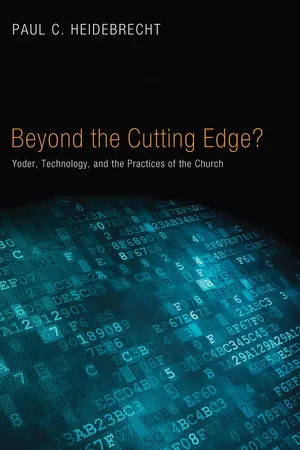
Beyond Cutting Edge?
Yoder, Technology, and the Practices of the Church
- 252 pages
- English
- ePUB (mobile friendly)
- Available on iOS & Android
eBook - ePub
About this book
A quick scan of any newsstand is enough to confirm the widespread preoccupation with technological change. As a myriad of articles and advertisements demonstrate, not only are we preoccupied with technology, but we are bombarded with numerous reminders that the cutting edge is in constant motion. Most often the underlying assumption of Christians is that we have no choice but to find ways to cope with the latest and greatest. Indeed, it is often assumed that the church has no choice but to find ways to cope with its new technological context.
This book does not make the same assumptions. Building on the work of Mennonite theologian John Howard Yoder, it argues that the practices of the church make it possible for Christians to conscientiously engage technology. This happens when we recognize that marks of the church such as patience, vulnerability, and servanthood can put technological ideals such as speed, control, and efficiency in their proper place. In the course of grappling with three examples of morally formative technologies--automobiles, genetically modified food, and the Internet--this book goes beyond Yoder's thought by emphasizing that the church also plays a crucial role in our moral formation.
Information
Subtopic
Théologie chrétienne1
The Theological Significance of Technology
The primary aim of this chapter is to make a convincing case that theologians have something relevant to say about technology. It is an attempt to answer the basic question: Why would someone focus on the topic of technology in a project in theology? At first glance, it might appear the more difficult challenge would be convincing a broader, non-theological audience this is a worthwhile project. However, as will become clear in what follows, the biggest hurdle may actually be convincing theologians it is important for them to reflect on technology. These are the first steps toward demonstrating that theological reflection on technology is important because a theological perspective provides insights into technology that would not otherwise be possible.
This chapter begins by highlighting shortcomings in attempts to grapple theologically with technology as found in fields such as religion and science and bioethics. It then argues that technology is theologically significant because it is not morally neutral—it does not simply meet human needs and desires, but comes to shape us in profound ways by determining our needs and desires. Thus, as demonstrated by prominent philosophers and historians of technology, the analysis of technology compels theological consideration. This chapter then concludes with two illustrations that provide further evidence for this latter point: an overview of official Catholic teaching on technology, and attempts to appropriate the Amish approach to technology.
Recent Attempts to Grapple Theologically with Technology Fall Short
The word “technology” can be found sprinkled throughout the works of several of the most prominent twentieth-century philosophers and theologians, including Martin Heidegger and Paul Tillich.1 Although Heidegger can be credited with inspiring a new philosophical specialty or sub-discipline devoted to technology, for Tillich technology was of secondary importance to his larger concern with science and culture. Other prominent contemporary theologians who touch on the topic of technology but also see it as symptomatic of more significant underlying methodological issues include James Gustafson, Douglas John Hall, Bernard Lonergan, Oliver O’Donovan, and Stanley Hauerwas.2 Perhaps then it should not be surprising that, in contrast to the many self-identified philosophers of technology who have emerged over the past forty years (not to mention the related associations, conferences, and publications), the expression “theology of technology” is rarely found in theological discourse. In fact, one is much more likely to find philosophers or even historians discussing moral and theological issues raised by technology in general.
To be sure, there have been a handful of anthologies over the past few decades that serve as reminders of attempts to spark theological discussion in this area. For example, a conference in Europe on technology in the early 1960s led to the publication of one collection of essays.3 In addition, one of the leading American philosophers of technology, Carl Mitcham, included a section on religious critiques of technology in a widely-used anthology on philosophy and technology.4 After Mitcham became convinced that the central questions about technology were ultimately theological in nature, a few years later he helped to assemble another collection of essays that were explicitly theological. This second anthology, Technology and Theology: Essays in Christian Analysis and Exegesis, was the outgrowth of a symposium on “Philosophy, Technology, and Theology” at a meeting of the fledgling Society of Philosophy and Technology held in conjunction with the American Catholic Philosophical Association annual meeting in 1979.5 Given this context, it should come as no surprise, however, that only a third of the contributions came from theologians.6 It is also interesting to note that most of the recent monographs on religion and technology have been written by philosophers, not theologians, and they all reference the now rather dated essays in the above collections when they are looking for what theologians have to say about technology.7
When technology is discussed in contemporary theological discourse, it is most often encountered in the relatively new interdisciplinary fields of religion and science and bioethics. These fields contain a significant and growing body of literature that reflects upon the impact of recent advances in technology on scientific or medical practice, and on the significance of this impact for theology. In my view, however, there are significant shortcomings in these reflections.
Religion and Science
Examples of those touching on issues raised by technology in the interface between theology and the natural sciences include Ian Barbour, Willem Drees, and Philip Hefner. Barbour, one of the formative figures in this field, even devoted half of his Gifford lectures to the topic of technology and ethics.8 Drees, the past president of the European Society for the Study of Science and Theology (ESSSAT), provided two significant contributions to an issue of Zygon, the preeminent journal in the field, devoted to “Human Meaning in a Technological Culture.”9 He underlined the way that issues raised by technology are fundamentally different from the issues that arise in attempts to relate religion and science—the latter are concerned with understanding reality, while the former are concerned with the transformation of reality. And a recent book by Hefner, the long-time editor of Zygon and past president of the Zygon Center for Religion and Science, demonstrates his interest in helping theologians keep pace with the ever-changing technological reality that surrounds them.10
However, the list does not stop with these three. Robert John Russell, the founder of the Center for Theology and the Natural Sciences, has enriched Barbour’s threefold typology of Christian attitudes towards technology by adding two more distinct approaches.11 In contrast to either a positive attitude which views technology as a liberator or a negative attitude which views technology as a threat, Barbour proposed that we adopt a middle-of-the-way or contextualist attitude that views technology as a powerful instrument that can be used for either good or evil. To these Russell adds Hefner’s proposal to re-imagine humankind as “created co-creators,”12 which assumes that technology is not something we can clearly distinguish from ourselves and thus adopt an attitude toward. For Hefner, technology is much more than an instrument, it is an extension of our very being, and thus is itself neither liberating or threatening. Finally, as a fifth alternative Russell proposes the attitude of an “eschatological companion.” This attitude is based upon the assumption that God is at work transforming the world into a new creation, and technology “must ultimately serve as a means to express and help achieve this future, even in a rudimentary way.” Technology itself is not a liberator, although it can contribute to liberation when we “mold technology in the service of Christ-like love: self-sacrificial, inclusive, and transformative.”13
Other thinkers have covered similar terrain as Drees. For example, Ursula Goodenough, a biologist and past president of the Institute on Religion in an Age of Science, insists that science is all about “asking a question of Nature,” while technology is all about “using an answer from Nature to develop a new way of doing things.”14 The point she wants to emphasize is that the domain of technology is inherently ethical: “whereas science brings us information that we have little choice but to absorb and reflect upon, technology is somet...
Table of contents
- Title Page
- Acknowledgments
- Introduction
- Chapter 1: The Theological Significance of Technology
- Chapter 2: Using the Work of John Howard Yoder as a Resource for Engaging Technology
- Chapter 3: The Moral Vision Embodied and Encouraged by Three Particular Technologies
- Chapter 4: Conscientiously Engaging Technology Through the Practices of the Church
- Chapter 5: Not Engineering, but Doxology?
- Chapter 6: Continuing to Test Yoder with Technology
- Bibliography
Trusted by 375,005 students
Access to over 1.5 million titles for a fair monthly price.
Study more efficiently using our study tools.
Frequently asked questions
Yes, you can cancel anytime from the Subscription tab in your account settings on the Perlego website. Your subscription will stay active until the end of your current billing period. Learn how to cancel your subscription
No, books cannot be downloaded as external files, such as PDFs, for use outside of Perlego. However, you can download books within the Perlego app for offline reading on mobile or tablet. Learn how to download books offline
Perlego offers two plans: Essential and Complete
- Essential is ideal for learners and professionals who enjoy exploring a wide range of subjects. Access the Essential Library with 800,000+ trusted titles and best-sellers across business, personal growth, and the humanities. Includes unlimited reading time and Standard Read Aloud voice.
- Complete: Perfect for advanced learners and researchers needing full, unrestricted access. Unlock 1.5M+ books across hundreds of subjects, including academic and specialized titles. The Complete Plan also includes advanced features like Premium Read Aloud and Research Assistant.
We are an online textbook subscription service, where you can get access to an entire online library for less than the price of a single book per month. With over 1.5 million books across 990+ topics, we’ve got you covered! Learn about our mission
Look out for the read-aloud symbol on your next book to see if you can listen to it. The read-aloud tool reads text aloud for you, highlighting the text as it is being read. You can pause it, speed it up and slow it down. Learn more about Read Aloud
Yes! You can use the Perlego app on both iOS and Android devices to read anytime, anywhere — even offline. Perfect for commutes or when you’re on the go.
Please note we cannot support devices running on iOS 13 and Android 7 or earlier. Learn more about using the app
Please note we cannot support devices running on iOS 13 and Android 7 or earlier. Learn more about using the app
Yes, you can access Beyond Cutting Edge? by Paul C. Heidebrecht in PDF and/or ePUB format, as well as other popular books in Théologie et religion & Théologie chrétienne. We have over 1.5 million books available in our catalogue for you to explore.