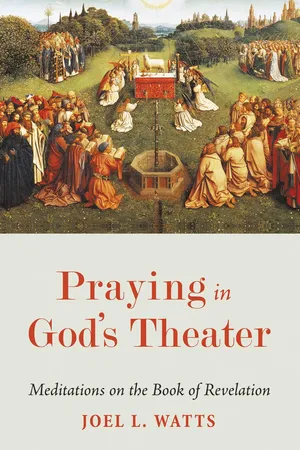
- 238 pages
- English
- ePUB (mobile friendly)
- Available on iOS & Android
eBook - ePub
About this book
Much like the book of Revelation, Joel L. Watts' Praying in God's Theater aims to pull readers into a deeper spirituality to confront the daily struggles of Christian life. Drawing from the rich well of Christian mystics and theologians from across the ecumenical experience, Watts uses the Apocalypse to build a series of prayers and devotions aimed at increasing what he identifies as the contemplative unity and the certain unity between the individual and Christ. He urges a radical vision of the prayer and the sacrament of the Eucharist.
Each chapter of Revelation is considered, explored, and finally used as a basis to draft prayers. Added to this is an application commentary that explores ancient liturgical practices similar to the scenes in Revelation while looking at Revelation in a mystical manner. Watts offers Revelation as an early liturgy, using this proposition as a catalyst for building prayers and a vision of life based on the Eucharist as the emblem of how we are to approach God. What emerges is a profound view on how we envision Scripture, prayer, and the book of Revelation.
Information
Subtopic
Études bibliques1
The Introit
“Three times in the day you should pray.”7
Our prayers in this chapter serve as a prologue to the entire book. Regardless of John’s reason, either the Roman Empire or something more distressing, inspired Scripture provides for us a continued application. In the Epistle to the Hebrews, the author tells us several times the Holy Spirit is speaking through the ancient text. Therefore, regardless of John’s writing, we can still hear the Spirit of God speaking through the text today, to us in such a way as to reinvigorate this book.
We hear the connections to other books of the canon, including the Psalms, Ecclesiastes, Daniel and Zechariah as well as Romans. These books were a part of the author’s library, serving to sustain him in his time of need as well as to bolster the confidence of the suffering audience.
I use the familiar term sustain here. Scripture is John’s repast. He feasts on Scripture. It becomes to him a sacrament, communicating grace to him in his time of need. Origen, a third century theologian, writes “His flesh and blood . . . are the divine Scriptures, eating which, we have Christ; the words becoming his bones, the flesh becoming the meaning from the texts, following which meaning, as it were, we see in a mirror dimly the things which are to come.”8 It is not a coincidence John later eats the words of the book (Revelation 10:10), for they themselves become to him the same sacrament he has found in ancient writings.
What drove John to write? We really do not know. Revelation may have several levels of meaning to it. If it is purely a historical, albeit poetic, account of the Jewish War, we are left with the amazement as to why it was canonized. As I discussed above, John is writing a liturgical drama. He has turned to the worship of God during whatever situation he was experiencing. In doing so, he draws from his distinctly Jewish-Christian liturgy to produce a poem in the classical sense dedicated to proclaiming Jesus as King according to Psalm 2, professing a Eucharistic adoration, and in securing to his readers the proper mind for seeking the peace of God.
First Prayer: Revelation 1:1–6
We see the oppression across the world.
We see the tears of the oppressed
We see no comforter.
The oppressors are powerful, but their victims helpless.9
Where is the King of Glory?10
Let us hear the revelation from Jesus Christ,
Show us what is taking place.
Send us your angel to present to your faithful servant
This is the word of God.
Let us hear the testimony of Jesus Christ.
When in Egypt your people groaned as slaves and cried for help,
You, oh God, are who heard their groaning.
You remembered your covenant to Abraham, Isaac, and Jacob
And looked down on the people of Israel to act.
Bless us, oh God, as we hear the words of this prophecy
Bless all who listen and obey its message.
Together with Christ we are heirs of God’s glory.
If we are to share his glory, let us also share his suffering.
Let us suffer this now for the glory to be revealed is too great to know.
Grace and peace to you
Grace and peace to you from the one who is,
The one who always was,
The one who is still to come.
We see the seven spirits before his throne and from Jesus Christ.
He is our faithful witness to these things,
He is the first to rise from the dead,
He is the ruler of all the kings of the world.
God has made him firstborn
He is higher than kings of the earth.
The heavens bear a faithful witness.
All glory to him who freed us from our sins by shedding his blood.
Wait just a little longer, O Creation
Wait for that day God will reveal us as children
Creation joins us in our curse
But we are hopeful
We hope for the day when we are freed from death
All creation longs for this
He has made us a Kingdom of priests
Hear creation groaning as in the pains of childbirth even now.
We groan with it as believers who through the Holy Spirit have foretasted glory
We long for our bodies to be released from sin and suffering.
We wait with hope
God will give us the rights of heirs
We will be given new bodies by his promise.
He has made us a Kingdom of priests for God his Father.
All glory and power to him forever and ever!
Amen
Introit
In liturgical celebrations, the introit is the beginning of the service used to signify “the entrance of the Lord into the world in the Incarnation.”11 One Anglican theologian saw the entirety of the liturgical service from the Introit to the Offertory as a dramatic representation of the traditional Christian view of the Old Testament as a foreshad...
Table of contents
- Title Page
- Introduction
- Chapter 1: The Introit
- Chapter 2: The Penitential Prayer
- Chapter 3: The Beatific Vision
- Chapter 4: The Presentation of the Gospel, Part I
- Chapter 5: The Presentation of the Gospel, Part II
- Chapter 6: The Triumphal Hymn
- Chapter 7: The Prayers of the Faithful
- Chapter 8: The Preparation for the Great Entrance
- Chapter 9: The Cherubic Hymn
- Chapter 10: The Great Entrance
- Chapter 11: The Presentation of Israel, the Church, and Mary
- Chapter 12: The Presentation of the Church Triumphant
- Chapter 13: The Presentation of Jesus
- Chapter 14: The Heavenly Choir
- Chapter 15: To End God’s Wrath
- Chapter 16: Prayers of Confession
- Chapter 17: The Table of the Lord
- Chapter 18: A Homily—The Eucharistic Vision
- Chapter 19: The Prayer of Dismissal
- Afterword: Major Jeff Carter, Salvation Army
- Bibliography
Trusted by 375,005 students
Access to over 1.5 million titles for a fair monthly price.
Study more efficiently using our study tools.
Frequently asked questions
Yes, you can cancel anytime from the Subscription tab in your account settings on the Perlego website. Your subscription will stay active until the end of your current billing period. Learn how to cancel your subscription
No, books cannot be downloaded as external files, such as PDFs, for use outside of Perlego. However, you can download books within the Perlego app for offline reading on mobile or tablet. Learn how to download books offline
Perlego offers two plans: Essential and Complete
- Essential is ideal for learners and professionals who enjoy exploring a wide range of subjects. Access the Essential Library with 800,000+ trusted titles and best-sellers across business, personal growth, and the humanities. Includes unlimited reading time and Standard Read Aloud voice.
- Complete: Perfect for advanced learners and researchers needing full, unrestricted access. Unlock 1.5M+ books across hundreds of subjects, including academic and specialized titles. The Complete Plan also includes advanced features like Premium Read Aloud and Research Assistant.
We are an online textbook subscription service, where you can get access to an entire online library for less than the price of a single book per month. With over 1.5 million books across 990+ topics, we’ve got you covered! Learn about our mission
Look out for the read-aloud symbol on your next book to see if you can listen to it. The read-aloud tool reads text aloud for you, highlighting the text as it is being read. You can pause it, speed it up and slow it down. Learn more about Read Aloud
Yes! You can use the Perlego app on both iOS and Android devices to read anytime, anywhere — even offline. Perfect for commutes or when you’re on the go.
Please note we cannot support devices running on iOS 13 and Android 7 or earlier. Learn more about using the app
Please note we cannot support devices running on iOS 13 and Android 7 or earlier. Learn more about using the app
Yes, you can access Praying in God’s Theater by Joel L. Watts in PDF and/or ePUB format, as well as other popular books in Théologie et religion & Études bibliques. We have over 1.5 million books available in our catalogue for you to explore.