eBook - ePub
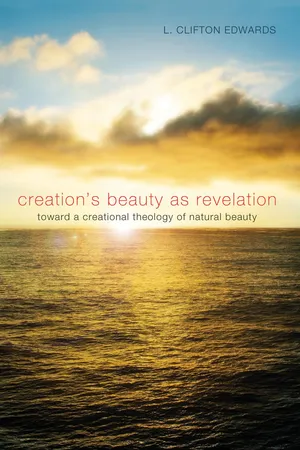
Creation's Beauty as Revelation
Toward a Creational Theology of Natural Beauty
- 212 pages
- English
- ePUB (mobile friendly)
- Available on iOS & Android
eBook - ePub
About this book
With an interdisciplinary approach, Edwards utilizes literature, aesthetics, world religions, and continental philosophy as avenues into the theology of natural beauty. This is an epistemological look at our aesthetically charged knowing of God through nature. Emphasizing our embodied experience of the world, Edwards examines the phenomenon of perceptual beauty, while questioning traditional notions of God's metaphysical "beauty." Drawing upon Michael Polanyi's philosophy of science, Edwards explores the human aesthetic and religious interface with the natural world. This philosophical approach is then linked to the poetic: Polanyi's "tacit knowledge" and Jean-Luc Marion's "saturated phenomena" give support to Wordsworth's "pregnant vision" of the natural world. This approach culminates in a re-envisaging of John Ruskin's typology of natural beauty: Ruskin's vision of the world can be adapted toward an understanding of natural revelation. Edwards brings this Romantic theology back across the Atlantic in dialogue with American nature writers and the uniquely American experience of wilderness and "frontier."
Information
Subtopic
Théologie chrétienne1
Creational Theology
Artful Creation and Aesthetic Rationality
Despite biblical texts discussing the beauty and revelatory function of the natural world, (e.g., Ps 19:1–4, Acts 14:17, and Rom 1:20), and despite a contemporary culture that values the natural world so highly, contemporary Protestant theology has not emphasized a natural revelation through beauty.1 But a more “creational” theology is surely in order—a theology engaging the natural world as a potential theological “source” akin to Scripture, tradition, reason, and religious experience.2 Toward this end, I present a preliminary and formative account of how human beings might gain a better understanding of God through an examination of the world’s beauty—that is, an account of how God is revealed in, and understood through, creation, especially through natural beauty.
Such an account is appropriate, because our knowledge of God is creationally mediated. That is, creatures know God through the medium of creation—a created transmission of knowledge that has for its pinnacle the incarnate body of Christ. Creation’s mediation of all knowledge becomes apparent when creation is understood in the broadest sense. In this broad sense, creation encompasses not only what we think of as “nature”—that is, the non-human—but also the part of “nature” that is human: the mind-body, with its various capacities. As the conduit for our knowledge, this aesthetically rich creation mediates any understanding we have of God. And we might expect, given the arresting, even “saturated,” character of many experiences of beauty, that such experience could point to God in some intelligible way. The beauty of the world is, after all, an aspect of God’s creation—an ontology that is (at least partly) addressed to God’s ends, and in which God is intimately involved. A rich understanding of created beauty,3 then, might reveal something of God, especially considering how human knowledge functions through aesthetic modalities. By engaging our “aesthetic rationality,” the multifaceted phenomenon of beauty might even reveal various aspects of the divine nature, as well as aspects of humankind’s place within God’s reality.4 But, more modestly, my initial aim is simply to outline a methodological approach to a “creational theology” engaging a beautiful world.5
This development of creational theology and revelatory beauty is a full-blooded Christian picture of knowledge and revelation. But it is not therefore inappropriately metaphysical or theological, since every epistemology presupposes a metaphysics or a theology; we must at least begin with a metaphysical or theological framework for understanding knowers in a reality that can be known. I describe creational theology from a Christian standpoint, but I also understand it to be partially applicable, in various ways and to varying extents, to non-Christians and even atheists. In fact, I maintain that Christians and non-Christians come to know the world, and God through the world, in remarkably similar ways.
Part one of this chapter outlines my methodological approach to “creational” theology, as opposed to a more traditional “natural” theology. Part two refines this approach through interaction with Thomas Aquinas’s theory of knowledge. I draw from Aquinas the interrelational dynamic of knowing God, knowing the world, and knowing the beautiful. I begin to apply this understanding of creational theology in part three by considering beauty in relation to God’s nature, and by engagement with the doctrine of the incarnation. This theological framework for understanding revelatory beauty continues to develop with each chapter: the broadly analogical relationship between God and creation provides space for creation to function as a revelatory work of art—an artwork that invokes the beautiful as an image of God’s nature and intentions. The incarnation, as the paradigmatic instance of relationship between God and creation, incorporates beauty redemptively, pointing ahead to a beautiful images of creation’s redemption.
Aesthetic Creational Theology
Of course some will question the significance and feasibility of knowing God through creation’s beauty: beyond what Scripture or tradition might reveal, why should we pursue additional, and perhaps riskier, avenues into that which is ultimately incomprehensible? Are these time-tested theological sources insufficient for rendering knowledge of God? In contrast to more traditional theological sources, some might say of creation with Job, “Behold, these are the fringes of His ways; / And how faint a word we hear of Him!”—God’s later response regarding creation notwithstanding (Job 26:14, NASB). But Scripture, as in Job, and tradition do point us beyond themselves toward creation. Furthermore, these more conventional sources of religious knowledge do not offer us by themselves all that we would like to know about God, nor do they always offer knowledge in the most existentially compelling ways. Such knowledge, rather than simply dispelling God’s mystery, also deepens it, and bids us enter the depths.6 As that which both deepens and partially fathoms God’s depths, revelation need not be an expressly stated or unmistakable datum. Rather, revelation in the broadest sense can be anything that communicates something of God’s presence, nature, or actions to us, even if revelation is not the primary purpose of the medium that reveals.
Moreover, our mind-bodies are also a created “medium” through which we must access revelation. And such mediation of revelation deepens God’s mystery further, because our minds are uniquely personal vantage points on the world, often mysteriously shaped by our biology, culture, and language.7 We thus experience God and the world only through this “created subjectivity,”8 which also mediates even direct religious or mystical experience by means of the soul’s spiritual capacities. Thus, it is fair to say that creation “circumscribes” our knowledge of God, while at the same time making it possible. Creation also makes possible a subjectively colored but real knowledge of many other objectivities.
Given that all revelation is mediated, if Scripture affirms that we see God’s nature through what he has made (Rom 1:20),9 a reasonable question would be, “How, or in what ways, does creation (and specifically, natural beauty) reveal God?” If the natural world is recognized almost universally to be (at least in large part) beautiful, and many have affirmed that God is beautiful in some sense, what might be the connection?10 An examination of our epistemology should aid us in establishing a connection.
But if we undertake a theology of created beauty focusing on creation itself rather than on what Scripture or tradition say about creation (though we can certainly draw on both), we will not be able to say much without someone questioning the whole enterprise as a form of “natural theology.” Many different types of projects have been placed under this heading, and many have elicited negative responses from Protestant theologians. Some theologi...
Table of contents
- Title Page
- Foreword - David Brown
- Introduction
- 1. Creational Theology: Artful Creation and Aesthetic Rationality
- 2. The Phenomenon of Beauty, A Reflection of the Divine Nature
- 3. Making Sense of Natural Beauty: Tacit Knowledge and Saturated Phenomena
- 4. Making Sense of Natural Beauty: Nature as Text and Image
- 5. Re-envisaging Ruskin’s Types: Toward a Creational Theology of Natural Beauty
- 6. Concluding Thoughts
- Bibliography
Trusted by 375,005 students
Access to over 1.5 million titles for a fair monthly price.
Study more efficiently using our study tools.
Frequently asked questions
Yes, you can cancel anytime from the Subscription tab in your account settings on the Perlego website. Your subscription will stay active until the end of your current billing period. Learn how to cancel your subscription
No, books cannot be downloaded as external files, such as PDFs, for use outside of Perlego. However, you can download books within the Perlego app for offline reading on mobile or tablet. Learn how to download books offline
Perlego offers two plans: Essential and Complete
- Essential is ideal for learners and professionals who enjoy exploring a wide range of subjects. Access the Essential Library with 800,000+ trusted titles and best-sellers across business, personal growth, and the humanities. Includes unlimited reading time and Standard Read Aloud voice.
- Complete: Perfect for advanced learners and researchers needing full, unrestricted access. Unlock 1.5M+ books across hundreds of subjects, including academic and specialized titles. The Complete Plan also includes advanced features like Premium Read Aloud and Research Assistant.
We are an online textbook subscription service, where you can get access to an entire online library for less than the price of a single book per month. With over 1.5 million books across 990+ topics, we’ve got you covered! Learn about our mission
Look out for the read-aloud symbol on your next book to see if you can listen to it. The read-aloud tool reads text aloud for you, highlighting the text as it is being read. You can pause it, speed it up and slow it down. Learn more about Read Aloud
Yes! You can use the Perlego app on both iOS and Android devices to read anytime, anywhere — even offline. Perfect for commutes or when you’re on the go.
Please note we cannot support devices running on iOS 13 and Android 7 or earlier. Learn more about using the app
Please note we cannot support devices running on iOS 13 and Android 7 or earlier. Learn more about using the app
Yes, you can access Creation's Beauty as Revelation by L. Clifton Edwards in PDF and/or ePUB format, as well as other popular books in Théologie et religion & Théologie chrétienne. We have over 1.5 million books available in our catalogue for you to explore.