eBook - ePub
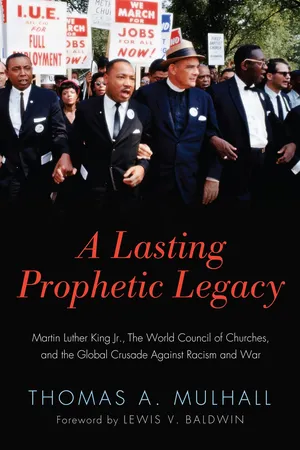
A Lasting Prophetic Legacy
Martin Luther King Jr., the World Council of Churches, and the Global Crusade Against Racism and War
- 262 pages
- English
- ePUB (mobile friendly)
- Available on iOS & Android
eBook - ePub
A Lasting Prophetic Legacy
Martin Luther King Jr., the World Council of Churches, and the Global Crusade Against Racism and War
About this book
Martin Luther King Jr. is widely viewed as an American civil rights leader who applied principled and situational nonviolence in efforts to eradicate racism, poverty, and violence in the United States in the 1950s and 60s. It is too often forgotten that he was also a self-proclaimed "world citizen" with a global vision, and that he envisioned the advance of globalization long before most of his contemporaries. This book exposes the global King who united in spirit and practice with other world leaders and representatives of the World Council of Churches to promulgate enduring peace and human community. It brings us to a new appreciation of the global King and explains how he continues to inform our understanding of what it means to live and function in the "world house."
Information
1
The Call to Service
Martin Luther King Jr. on the Purpose and Role of the Christian Church
Martin Luther King Jr. was first and foremost a Christian and a churchman who only later became politicized. His civil rights activism, his opposition to racism, and to the Vietnam War was guided by his religious convictions. His commitment to these convictions was clear from the start, when as the newly elected president of the Montgomery Improvement Association (MIA), he emphasized the Christian doctrine of love: “Our nation must be guided by the deepest principles of our Christian faith.”1 Although King gained national and international recognition as a civil rights leader, he was quite clear in how he saw himself: “I am many things to many people, but in the quiet recesses of my heart, I am fundamentally a clergyman, a Baptist preacher.”2
King was originally an advocate for the African American community, but when he saw the parallel effects of poverty on the white poor, he embraced their plight as well. King’s view of racism in the US developed to consider the interaction of economic interests and military power as he moved outside the confines of the black civil rights movement towards Christian Socialism. Then, as a Christian activist with a global platform, he felt obliged to speak out against the Vietnam War, the threat of nuclear proliferation, and the evils of racism in a global context.
King’s understanding of the Christian church was formed by the prophetic heritage of the Bible, his black church origins, his exposure to liberal and progressive-minded black ministers and academics at Morehouse College, Crozer Theological Seminary, and Boston University. Above all, King saw himself as a Christian minister with deep roots in the southern black Baptist Church.3 Lest there be any doubt about King’s influences, scholar James H. Cone answers the rhetorical question, “What traditions did he turn to in moments of crisis during his ministry?” without hesitation: “In moments of crisis when despair was about to destroy the possibility of making a new future for the poor, King turned to the faith contained in the tradition of the black church.”4
The success of the Montgomery Bus Boycott propelled King to national and international fame. The problem for him then was to capitalize on that success and on his status as a Baptist minister. As King said, “The church too must face its historic obligation in this crisis,” for in the final analysis, “the problem of race is not a political but a moral issue.”5 Lack of cooperation from the white church led King to remark, with some dismay, “One of the disappointing experiences of the Montgomery struggle was the fact that we could not get the white ministerial association to sit down with us and discuss the problem. With individual exceptions, the white ministers from whom I had naively expected so much, gave little.”6 Nevertheless, King envisioned the church playing a far greater role than it had yet entertained, saying, “I see the church as the conscience of the community, the conscience of the nation, and the conscience of the state, and consequently, the church must be involved in all of the vital issues of the day, whether it’s in the area of civil rights, whether it’s dealing with the whole question of war and peace.”7
“The Churches’ Influence on Secular Society,” an essay published by Time in 1967, cast the modern civil rights movement in an important light: “Beginning with the 1954 Supreme Court decision against school segregation, the civil rights movement was a major cause of the churches’ new activity. Most denominations already paid lip service at least to integration, but the growing national concern and the direct challenge to the Christian conscience brought a flurry of new resolutions and exhortations. In the 1960s the civil rights struggle moved the churches further along from talk to action.”8
King, however, saw the church as a staunch upholder of the status quo, for he observed, “Nowhere is the tragic tendency to conform more evident than in the church, an institution which has often served to crystallize, conserve, and even bless the patterns of majority opinion. The erstwhile sanction by the church of slavery, racial segregation, war, and economic exploitation is testimony to the fact that the church has hearkened more to the authority of the world than to the authority of God.”9 On April 19, 1961, King spoke about the introduction of slavery and the reasons why the white man deemed it necessary to justify the institution. To disguise an obvious wrong, slavery had to be rationalized and draped “in the beautiful garments of righteousness,” said King. Religion and the Bible, he argued, were used to perpetuate this deceit:
And so many argued that the Negro was inferior by nature because of Noah’s curse upon the children of Ham. The Apostle Paul’s dictum became a watchword, “Servants, be obedient to your master.” And then one of the brethren had probably read the logic of Aristotle and he could put his arguments in the framework of an Aristotelian syllogism. He could say that all men were made in the image of God, this was a major premise. Then came the minor premise, God, as everyone knows, is not a Negro. Then came the conclusion, therefore the Negro is not a man. He could put his argument in that logical framework.10
The conditions of slavery, and later, segregation, had a deleterious effect on the lives of black people, who only began to make substantial progress when the upheaval of two world wars, migration from rural plantations to the cities, and increasing education all combined to lead the “Negro masses” to “re-evaluate themselves.”11 To make matters worse, the white churches had a deliberate policy of excluding blacks from positions of power within their infrastructure. As King declared, “It is to their everlasting shame, that white Christians developed a system of racial segregation...
Table of contents
- Title Page
- Foreword - Lewis V. Baldwin
- Acknowledgments
- Introduction
- Abbreviations
- 1. The Call to Service: Martin Luther King Jr. on the Purpose and Role of the Christian Church
- 2. To Set the Captives Free: Martin Luther King Jr., Eugene Carson Blake, and the Social Mission of the WCC
- 3. Challenging the Color Line: Martin Luther King Jr., the WCC, and Racism
- 4. The Lessons of Apartheid: Martin Luther King Jr. Looks to South Africa and Its Struggle
- 5. Breaking the Conspiracy of Silence: Martin Luther King Jr., the WCC, and the Racial Implications of the Vietnam War
- 6. A Tribute to a Peaceful Crusader: The WCC, Martin Luther King Jr., and the Resolution at Uppsala
- 7. Keeping King’s Dream Alive: The WCC and the Notting Hill Consultation on Racism, 1969
- 8. Activism in the Kingian Mode: Implementing the WCC's Programme to Combat Racism
- 9. Remembering a Drum Major: Final Reflections on Aspects of King's Freedom and Social Justice Crusades
- Bibliography
Trusted by 375,005 students
Access to over 1.5 million titles for a fair monthly price.
Study more efficiently using our study tools.
Frequently asked questions
Yes, you can cancel anytime from the Subscription tab in your account settings on the Perlego website. Your subscription will stay active until the end of your current billing period. Learn how to cancel your subscription
No, books cannot be downloaded as external files, such as PDFs, for use outside of Perlego. However, you can download books within the Perlego app for offline reading on mobile or tablet. Learn how to download books offline
Perlego offers two plans: Essential and Complete
- Essential is ideal for learners and professionals who enjoy exploring a wide range of subjects. Access the Essential Library with 800,000+ trusted titles and best-sellers across business, personal growth, and the humanities. Includes unlimited reading time and Standard Read Aloud voice.
- Complete: Perfect for advanced learners and researchers needing full, unrestricted access. Unlock 1.5M+ books across hundreds of subjects, including academic and specialized titles. The Complete Plan also includes advanced features like Premium Read Aloud and Research Assistant.
We are an online textbook subscription service, where you can get access to an entire online library for less than the price of a single book per month. With over 1.5 million books across 990+ topics, we’ve got you covered! Learn about our mission
Look out for the read-aloud symbol on your next book to see if you can listen to it. The read-aloud tool reads text aloud for you, highlighting the text as it is being read. You can pause it, speed it up and slow it down. Learn more about Read Aloud
Yes! You can use the Perlego app on both iOS and Android devices to read anytime, anywhere — even offline. Perfect for commutes or when you’re on the go.
Please note we cannot support devices running on iOS 13 and Android 7 or earlier. Learn more about using the app
Please note we cannot support devices running on iOS 13 and Android 7 or earlier. Learn more about using the app
Yes, you can access A Lasting Prophetic Legacy by Thomas Mulhall in PDF and/or ePUB format, as well as other popular books in Social Sciences & World History. We have over 1.5 million books available in our catalogue for you to explore.