eBook - ePub
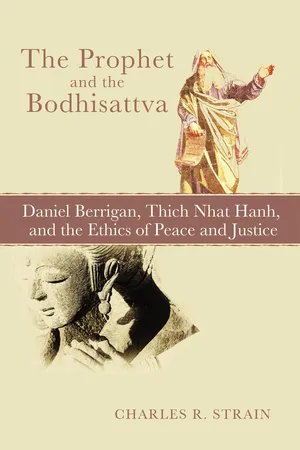
The Prophet and the Bodhisattva
Daniel Berrigan, Thich Nhat Hanh, and the Ethics of Peace and Justice
- 288 pages
- English
- ePUB (mobile friendly)
- Available on iOS & Android
eBook - ePub
The Prophet and the Bodhisattva
Daniel Berrigan, Thich Nhat Hanh, and the Ethics of Peace and Justice
About this book
Can religious individuals and communities learn from each other in ways that will lead them to collaborate in addressing the great ethical challenges of our time, including climate change and endless warfare? This is the central question underlying The Prophet and the Bodhisattva. It juxtaposes two figures emblematic of an ideal moral life: the prophet as it evolved in ancient Israel and the bodhisattva as it flowered in Mahayana Buddhism.
In particular, The Prophet and the Bodhisattva focuses on Daniel Berrigan and Thich Nhat Hanh, who in their lives embody and in their writings reflect upon their respective moral type. Berrigan, a Jesuit priest, pacifist, and poet, is best known for burning draft files in 1968 and for hammering and pouring blood on a nuclear warhead in 1980. His extensive writings on the Hebrew prophets reflect his life of nonviolent activism. Thich Nhat Hanh, Buddhist monk, Vietnamese exile, and poet struggled to end the conflict during the Vietnam War. Since then he has led the global movement that he named Engaged Buddhism and has written many commentaries on Mahayana scriptures. For fifty years both have been teaching us how to pursue peace and justice, a legacy we can draw upon to build a social ethics for our time.
Information
Topic
Teologia e religioneSubtopic
Teologia cristianaPart I
The Prophet and the Bodhisattva
1
The Prophet
God’s Agony Made Flesh and Word
The way I see the world is strictly illegal
to wit, through my eyes25
—Daniel Berrigan, “Prophecy”
In Isaiah: Spirit of Courage, Gift of Tears, Daniel Berrigan writes of his boyhood experience during the Great Depression, following in his father’s footsteps as he plowed a field. The whole world, the boy thought, must be like this, pregnant with new life. “I had,” the man reflects, “much to learn.” Before many more springs, four of his brothers went off to fight a World War and “life came to this. As long as swords were drawn, we humans lost our bearings. . . . The social fabric was torn; the war ended through abominable deeds, mass murder.” And then? “My lifetime was to be a perpetual war time.”26
The Life of the Prophet
Daniel Berrigan was born on May 9, 1921, the fifth of six sons born to Thomas and Frida Berrigan. Raised in rural Minnesota and upstate New York by a fearsome and frustrated father, and a nourishing and protective mother, Berrigan’s progress toward a calling to join the Society of Jesus was, for the times, conventionally Catholic—except, that is, for the presence of Dorothy Day’s Catholic Worker newspaper in their home and his mother’s hospitality to passing strangers in the midst of the Great Depression. In August of 1939, with Europe on the cliff edge of war, Berrigan joined the Society of Jesus. The Jesuits took Berrigan in hand, cultivated his sharp mind and bent his spirit to long discipline. Bright though he was, the young priest, ordained in 1952, still had much to learn. Reflecting on a stint as a chaplain to GIs in Germany in 1954, Berrigan confesses to being completely oblivious to the nuclear standoff, East and West poised for mass murder at that very place.27 “It is small comfort to dredge up one’s memories,” he writes in his autobiography, To Dwell in Peace, “and come on a moral blank screen. . . . What an unfinished human I was.”28
Introduction to the worker priests of France, eventually Vatican II, the civil rights movement but, above all, his friendship with the two icons of late twentieth-century Catholicism, Thomas Merton and Dorothy Day, along with the constant prodding of his younger brother Philip, would remold the young Jesuit. Like Saint Augustine, Berrigan would lament “how long, too, the clumsiness and groping, false starts and cowardice, the good, bad and indifferent in the human meld.” And yet: “I think my soul was moving in a contrary wind.”29
The war in Vietnam made of that wind a howling gale. But here, too, Berrigan moved in fits and starts: creating Clergy and Laity Concerned about the War in Vietnam with Rabbi Abraham Heschel and Reverend Richard Neuhaus; supporting student activists at LeMoyne College and later at Cornell University. “The damned war! It was a creeping miasma, an irresistible current; it swept along, in its filthy wake, nearly everyone and everything . . . and because I was objecting to the war, I must be treated like a deserter.”30 Running afoul of the arch-patriot, New York’s Cardinal Spellman, Berrigan was sent into Latin American exile in Autumn 1965.
Reflections that were published as Consequences, Truth And . . . show Berrigan struggling through a dark night and wrestling with the Church’s unjust exercise of its authority. This exile—“the wrong place, with the wrong work”—challenged him to surmount despair, “the point at which one can do nothing—the point of truth.” Finally, in a Lima slum Berrigan discovered that truth. “Understand . . . that you are led here for this purpose: to know in such a place as perhaps nowhere else that a future is being formed for you and others. In these people, in the few that share their fate, a new exodus is under way.”31 Berrigan was recalled to the States after a five-month exile. He continued his antiwar efforts by working with students as a chaplain at Cornell University and flying with Howard Zinn to Hanoi in February 1968 for the transfer of a few American prisoners.
As we saw in the introduction, the burning of draft files in May 1968 in Catonsville, Maryland, was the pivotal experience in Daniel Berrigan’s life. His earlier involvements were all rehearsals for the drama that lay ahead. Brother Philip had already burned draft files in Baltimore and he invited Daniel to repeat the action with others at Catonsville. “A sense . . . of immense freedom,” Daniel recalled of his decision, “as though in choosing, I could now breathe deep, and call my life my own. A sense, also, of the end of a road, or a fork, or a sudden turn and no telling what lay beyond. . . . And no looking back.”32
Burning files of the Selective Service System using a homemade concoction of napalm resonated because it was solemnly liturgical, even sacramental. The Catonsville Nine (Brother David Darst, John Hogan, Thomas Lewis, Marjorie Bradford Melville, Thomas Melville, George Mische, and Mary Moylan, as well as Daniel and Philip) had gone beyond words to convey a more visceral truth. “Our instructor in these [symbolic acts],” Daniel was to write much later, “is Jeremiah himself—beari...
Table of contents
- Title Page
- Acknowledgments
- Introduction: The Blessing of Elders
- Part I: The Prophet and the Bodhisattva
- Part II: The Social Ethics of the Prophet and the Bodhisattva—Three Approaches
- Part III: Applying the Social Ethics of the Prophet and the Bodhisattva
- Bibliography
- Permissions
Trusted by 375,005 students
Access to over 1.5 million titles for a fair monthly price.
Study more efficiently using our study tools.
Frequently asked questions
Yes, you can cancel anytime from the Subscription tab in your account settings on the Perlego website. Your subscription will stay active until the end of your current billing period. Learn how to cancel your subscription
No, books cannot be downloaded as external files, such as PDFs, for use outside of Perlego. However, you can download books within the Perlego app for offline reading on mobile or tablet. Learn how to download books offline
Perlego offers two plans: Essential and Complete
- Essential is ideal for learners and professionals who enjoy exploring a wide range of subjects. Access the Essential Library with 800,000+ trusted titles and best-sellers across business, personal growth, and the humanities. Includes unlimited reading time and Standard Read Aloud voice.
- Complete: Perfect for advanced learners and researchers needing full, unrestricted access. Unlock 1.5M+ books across hundreds of subjects, including academic and specialized titles. The Complete Plan also includes advanced features like Premium Read Aloud and Research Assistant.
We are an online textbook subscription service, where you can get access to an entire online library for less than the price of a single book per month. With over 1.5 million books across 990+ topics, we’ve got you covered! Learn about our mission
Look out for the read-aloud symbol on your next book to see if you can listen to it. The read-aloud tool reads text aloud for you, highlighting the text as it is being read. You can pause it, speed it up and slow it down. Learn more about Read Aloud
Yes! You can use the Perlego app on both iOS and Android devices to read anytime, anywhere — even offline. Perfect for commutes or when you’re on the go.
Please note we cannot support devices running on iOS 13 and Android 7 or earlier. Learn more about using the app
Please note we cannot support devices running on iOS 13 and Android 7 or earlier. Learn more about using the app
Yes, you can access The Prophet and the Bodhisattva by Charles R. Strain in PDF and/or ePUB format, as well as other popular books in Teologia e religione & Teologia cristiana. We have over 1.5 million books available in our catalogue for you to explore.