- 340 pages
- English
- ePUB (mobile friendly)
- Available on iOS & Android
eBook - ePub
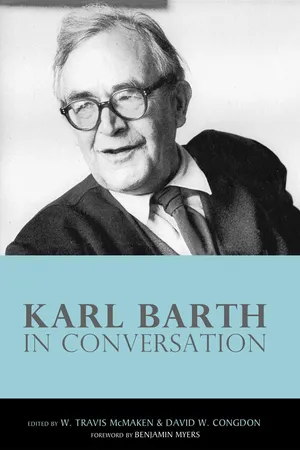
Karl Barth in Conversation
About this book
Karl Barth was an eminently conversational theologian, and with the Internet revolution, we live today in an eminently conversational age. Being the proceedings of the 2010 Karl Barth Blog Conference, Karl Barth in Conversation brings these two factors together in order to advance the dialogue about Barth's theology and extend the online conversation to new audiences. With conversation partners ranging from Wesley to Žižek, from Schleiermacher to Jenson, from Hauerwas to the Coen brothers, this volume opens up exciting new horizons for exploring Barth's immense contribution to church and world. The contributors, who represent a young new generation of academic theologians, bring a fresh perspective to a topic--the theology of Karl Barth--that often seems to have exhausted its range of possibilities. This book proves that there is still a great deal of uncharted territory in the field of Barth studies. Today, more than forty years since the Swiss theologian's death, the conversation is as lively as ever.
Information
Topic
Theology & ReligionSubtopic
Christian ChurchSection 1
Past Conversations
1
Promise and Command
Barth and Wesley on Matthew 5:48
In addition to the standard-issue metallic ones provided by my University, I have a pair of nice wooden shelves in my office. These two shelves are set aside to house texts from the two most important sources for my theological work: John Wesley and Karl Barth. Although the traditions that flow from these figures have shaped me deeply, I must admit that they are an odd couple indeed. I am repeatedly asked by Wesleyans and Barthians alike how it all fits together. My initial and admittedly cheeky answer is to say, “Just look at how I practice theology; if you like what you see, then that’s all the proof I need.” But a more systematic answer ought to be expected from a systematic theologian. So, here’s one small step toward making explicit the connections I perceive between these two great streams of theological reflection.
My central claim is that John Wesley and Karl Barth, for all their genuine differences, share a common orienting concern: overcoming culturally-captive Christianity. As such, they both participate—each in his own way, but with remarkable compatibility—in what I call the perpetual revolution for real Christianity. I will advance a series of four theses in order to substantiate this claim. To begin I offer a detailed exploration of Wesley and Barth’s strikingly similar interpretations of Matthew 5:48, “Be ye perfect as your heavenly Father is perfect.” The subsequent three theses try to make sense of this similarity, each of which identifies a deeper level of common concern between Barth and Wesley. In keeping with this “archaeological” pattern of thought, the latter theses are increasingly more exploratory in character. But taken as a whole my argument opens up a fresh way of reading both theologians that highlights their common cause—a cause I regard as worthy of participation.
1.
My first thesis is that Wesley and Barth both interpret Matthew 5:48 not only as a command but also and primarily as a promise. Such remarkable similarity from two such divergent thinkers deserves sustained comparative analysis. Out of chronological deference, I begin with Wesley. In his entry on Matthew 5:48, Wesley says,
Therefore ye shall be perfect; as your Father who is in heaven is perfect—So the original runs, referring to all that holiness which is described in the foregoing verses, which our Lord in the beginning of the chapter recommends as happiness, and in the close of it as perfection. And how wise and gracious is this, to sum up, and, as it were, seal all his commandments with a promise! Even the proper promise of the Gospel! That he will put those laws in our minds, and write them in our hearts! He well knew how ready our unbelief would be to cry out, this is impossible! And therefore stakes upon it all the power, truth, and faithfulness of him to whom all things are possible.1
At first, we should note what Wesley does not say about this verse. He does not say that Jesus is ratcheting up the demand of the law in order to evoke a sense of helplessness that leads to faith in him and his atoning work. Such an interpretation is common in both Lutheran and Reformed traditions. Wesley does not even consider this alternative, and setting it aside coheres with his collateral commitments. He shares in Pietism’s immanent criticism of the Reformation: that in its correct insistence on justification by grace through faith, it explains away the ethical teachings and example of Jesus. Wesley’s position is clear: Matthew 5:48 is not reducible to a law that kills in order to drive us to the cross.
On the other hand, Wesley also does not interpret this passage as a command per se. He sees it as a summative and sealing promise that the happiness and holiness described and commanded in the preceding verses are not out of reach. According to Wesley, Matthew 5:48 asserts the divine possibility promised to us that underlies the divine necessity commanded to us. He even identifies emphatically that this is “the proper promise of the gospel!”2 A command followed on the basis of a promise believed—that is what it means to have the law written in our hearts.
Where does Wesley get this? Is not Matthew 5:48 quite obviously an imperative? First of all, Wesley corrects the AV’s translation “be ye perfect,” replacing it with the future tense “ye shall be perfect.” “So the original runs,” he asserts. Although this translation is contestable, it at least shows that Wesley regards this interpretive move as exegetically warranted.3 But we need not hang too much on this grammatical observation, for Wesley does not directly deny the command character of this text. In fact, the coinherence of promise and command is a recurring theme in Wesley’s interpretation of the Sermon on the Mount. As he says in his comment on Matthew 5:2: “Observe the benevolent condescension of our Lord. He seems, as it were, to lay aside his supreme authority as our legislator, that he may the better act the part of: our friend and Saviour. Instead of using the lofty style, in positive commands, he, in a more gentle and engaging way, insinuates his will and our duty, by pronouncing those happy who comply with it.”4
So pitting promise and command against each other will get us nowhere with Wesley. The point is that the call to be perfect is not only a command, but also and primarily a promise. This fits with the general teleological pattern of Wesley’s thought.5 As can be seen in his comment on Matthew 5:48, Wesley treats happiness, holiness, and perfection as nearly interchangeable terms. This interchangeability only works because each is conceptualized teleologically, i.e., in terms of its end or goal.6 Happiness, holiness, perfection—this is what is promised us. This is where we are headed. And so happiness, holiness, and perfection are also commanded of us, as our way of living into our future with God.7
With Wesley’s interpretation of Matthew 5:48 before us, let us turn now to Karl Barth. In contrast to Wesley, Barth is firmly planted in the Reformed tradition. So we might expect an interpretation of Matthew 5:48 that follows his forebears. Surely he will say that this passage is an unreachable goal that drives us to confession and perhaps also inspires ...
Table of contents
- Title Page
- Preface - W. Travis McMaken
- Abbreviations
- Section 1: Past Conversations
- Section 2: Present Conversations
- Section 3: Expanding Conversations
- Afterword: The Future of Conversing with Barth - David W. Congdon
- Appendix: Become Conversant with Barth's Church Dogmatics: A Primer - David Guretzki
- Bibliography
- Contributors
Trusted by 375,005 students
Access to over 1.5 million titles for a fair monthly price.
Study more efficiently using our study tools.
Frequently asked questions
Yes, you can cancel anytime from the Subscription tab in your account settings on the Perlego website. Your subscription will stay active until the end of your current billing period. Learn how to cancel your subscription
No, books cannot be downloaded as external files, such as PDFs, for use outside of Perlego. However, you can download books within the Perlego app for offline reading on mobile or tablet. Learn how to download books offline
Perlego offers two plans: Essential and Complete
- Essential is ideal for learners and professionals who enjoy exploring a wide range of subjects. Access the Essential Library with 800,000+ trusted titles and best-sellers across business, personal growth, and the humanities. Includes unlimited reading time and Standard Read Aloud voice.
- Complete: Perfect for advanced learners and researchers needing full, unrestricted access. Unlock 1.5M+ books across hundreds of subjects, including academic and specialized titles. The Complete Plan also includes advanced features like Premium Read Aloud and Research Assistant.
We are an online textbook subscription service, where you can get access to an entire online library for less than the price of a single book per month. With over 1.5 million books across 990+ topics, we’ve got you covered! Learn about our mission
Look out for the read-aloud symbol on your next book to see if you can listen to it. The read-aloud tool reads text aloud for you, highlighting the text as it is being read. You can pause it, speed it up and slow it down. Learn more about Read Aloud
Yes! You can use the Perlego app on both iOS and Android devices to read anytime, anywhere — even offline. Perfect for commutes or when you’re on the go.
Please note we cannot support devices running on iOS 13 and Android 7 or earlier. Learn more about using the app
Please note we cannot support devices running on iOS 13 and Android 7 or earlier. Learn more about using the app
Yes, you can access Karl Barth in Conversation by W. Travis McMaken,David W. Congdon, McMaken, Congdon in PDF and/or ePUB format, as well as other popular books in Theology & Religion & Christian Church. We have over 1.5 million books available in our catalogue for you to explore.