eBook - ePub
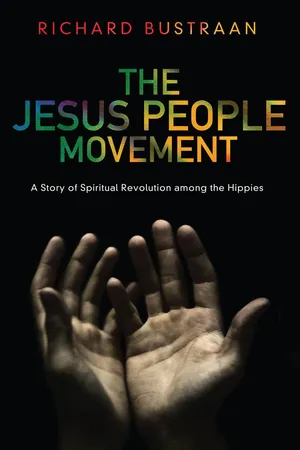
The Jesus People Movement
A Story of Spiritual Revolution among the Hippies
- 262 pages
- English
- ePUB (mobile friendly)
- Available on iOS & Android
eBook - ePub
About this book
Who would have imagined that the hippies, those long-haired, psychedelia-influenced youth of the 1960s, would have initiated a spiritual revolution that has transformed American Christianity? If you are unfamiliar with the 1960s, the counterculture, the hippie movement, and the Jesus People, then this book will transport you to that era and introduce you to the generation and the decade that turned American culture upside down. If you have read other books on the Jesus People, this account will take you by surprise.
A refreshingly different narrative that unveils a storyline and characters not commonly known to have been associated with the movement, this book argues that the Jesus People, though often trivialized and stigmatized as a group of lost and vulnerable youth who strayed from the Fundamentalism of their childhood, helped American Christianity negotiate a way forward in a post-1960s culture. It examines the narrative of the Holy Spirit and the phenomenon called Pentecostalism. Although utterly central, the Jesus People's Pentecostalism has never been examined and their story has been omitted from the historiography of Pentecostalism. This account uniquely redresses this omission.
Information
Topic
Theology & ReligionSubtopic
Christian TheologyChapter 1
The 1960s and the Hippies
The 1960s—The Decade of Change
When the dome of Alaskan volcano Novarupta exploded in 1912, it famously became the largest volcanic eruption of the twentieth century. The valley below was transformed by the pyroclastic ash flow and thereafter renamed the Valley of Ten Thousand Smokes. In much the same way, the cultural revolution of the 1960s and 1970s abruptly and violently tore large fissures across the landscape of American society, leaving behind what could be argued as a pre-sixties America and a post-sixties America.1 For if the period of the sixties and the seventies was the volcanic eruption, then the remainder of the century, the 1980s and 1990s, was the spreading and cooling of the pyroclastic ash flow and a period of resettling and rebuilding around this new feature in the landscape of American society. Metaphors aside, many scholars of American history have noted that the 1960s was the most significant decade of change in the twentieth century. It was during this era that alternative religious, political, and social movements that had been fermenting in the margins of American society moved into the mainstream and battled for legitimacy. By the eighties and nineties they were attaining increasingly acceptable positions as viable competitors for shaping American cultural values. Francis Fitzgerald summarized it in this way, “There were very few periods in American history in which the dominant sector—the white middle class—transformed itself as thoroughly as it did in the sixties and seventies; transformed itself quite deliberately, and from the inside out, changing its customs, its sexual mores, its family arrangements, and its religious patterns.”2
The following snippet from hippie forefather Allen Ginsberg underscores how deeply acrimonious the rift was between the marginalized and the mainstream in American society. His tone is unabashedly provocative, enunciated in the taunting, warfare-like language of an intruder who has dared to trespass and lay down the gauntlet for cultural transformation. He wrote, “I am in effect setting up moral codes and standards which include drugs, orgy, music and primitive magic as worship rituals—educational tools which are supposedly contrary to our cultural mores; and I am proposing these standards to you respectable ministers, once and for all, that you endorse publically the private desire and knowledge of mankind in America, so to inspire the young.”3 Many churches in the West felt the effects of the 1960s, especially in the erosion of their taken-for-granted place in the public arena and in the unabated attrition of membership. In Hugh McLeod’s bold appraisal, the sixties were comparable to a “rupture as profound as that brought about by the Reformation.”4 The JPM was birthed in 1967, in the midst of this tempestuous, historical season and was animated in particular by two important twentieth-century movements—American Pentecostalism and the hippies.
That there were antecedent and contextual factors at work within American culture from before the sixties is of little doubt, but divergent opinions exist among scholars over how far back to draw the boundary lines. Those like Robert Ellwood (Sixties) draw attention to the more immediate influences of the 1950s upon the 1960s, whereas others like Charles Taylor (Secular Age) argue for the long range societal changes that date back to the Protestant Reformation. Hugh McLeod (Religious Crisis) strikes a balance between the long-term evolutionary influences of the twentieth century and the immediate, revolutionary movements and key people of the 1960s. Agreeing with McLeod, it is necessary to consider the evolution of several trends afoot from the early part of the twentieth century to make more sense of the revolution of the sixties.
Twentieth-Century War and Economics
Twentieth-century America was a nation that had experienced two major world wars that claimed the lives of over half a million US military servicemen. World War II seamlessly transitioned into the Cold War era in which the new enemy was communism and especially communist Russia and China. The US government adopted a general strategy called “containment” that included large financial investments in the Marshall Plan for rebuilding Western Europe, the nuclear arms race, the space race, and the resistance to communism in Southeast Asia that culminated in the Vietnam War. Closer to American shores, the threat of the Cuban Missile Crisis gave further credence to the government’s anti-communist rhetoric. Though WWI and WWII had ended, a posture of war was aggressively maintained throughout much of the century.
Twentieth-century America was a nation that experienced extreme economic highs and lows. The post-WWI economic boom of the Roaring Twenties that resulted in America being classed as the world’s richest nation, was followed by the 1929 stock market crash and the Great Depression that brought financial deprivation to many. Recovery was slow until America’s entry into WWII in 1941, after which time the nation entered a period of unprecedented economic growth that lasted through the end of the century. The generation of children born in this post-WWII economic recovery has been labeled “Baby Boomers,” and this was the generation of the hippies and the JP. Growing up in this period of uninterrupted economic growth and prosperity, the Baby Boomer generation stood in stark contrast to the generation of their parents who had come through the deprivation of the Great Depression. Some optimistically envisaged the dawning of a utopian era of “post-scarcity” in which food and basic necessities would become in abundant supply and work would become more balanced with leisure.5 The result was a new generation of youth with money to spend, new blossoming youth markets in which to spend it, and an increase in youthful leisure time.
Six Marginal Movements of the Twentieth Century
Twentieth-century America was also a nation that experienced a transformation in conventional gender roles and gender identities. The Roaring Twenties initiated trends for women to sport less traditional fashions and short haircuts, to work in jobs outside the home and to enter university. In 1920 Congress had enacted the Nineteenth Amendment giving women the right to vote and run for elected office and during WWII unprecedented numbers of women went to work in factories to manufacture war supplies or to serve in various branches of the military. After the war, many women remained in the labor force and increased the acceptability of women in the workplace, but not without many pejorative stereotypes and inequalities. Beginning in 1966, women’s groups like the National Organization for Women were formed to battle for equal status against what they perceived to be the oppression of women. The 1972 Equal Rights Amendment and the Supreme Court’s 1973 decision in Roe v. Wade, which protected a woman’s right to have an abortion under the 14th Amendment, seemed at the time to be evidence that the wom...
Table of contents
- Title Page
- Preface
- Acknowledgments
- Introduction
- Abbreviations
- Chapter 1: The 1960s and the Hippies
- Chapter 2: A Historical Overview
- Chapter 3: A Story of American Pentecostalism
- Chapter 4: A Sociological Identity
- Chapter 5: A Theological Identity
- Chapter 6: Conclusions on the Jesus People Movement
- Bibliography
Trusted by 375,005 students
Access to over 1.5 million titles for a fair monthly price.
Study more efficiently using our study tools.
Frequently asked questions
Yes, you can cancel anytime from the Subscription tab in your account settings on the Perlego website. Your subscription will stay active until the end of your current billing period. Learn how to cancel your subscription
No, books cannot be downloaded as external files, such as PDFs, for use outside of Perlego. However, you can download books within the Perlego app for offline reading on mobile or tablet. Learn how to download books offline
Perlego offers two plans: Essential and Complete
- Essential is ideal for learners and professionals who enjoy exploring a wide range of subjects. Access the Essential Library with 800,000+ trusted titles and best-sellers across business, personal growth, and the humanities. Includes unlimited reading time and Standard Read Aloud voice.
- Complete: Perfect for advanced learners and researchers needing full, unrestricted access. Unlock 1.5M+ books across hundreds of subjects, including academic and specialized titles. The Complete Plan also includes advanced features like Premium Read Aloud and Research Assistant.
We are an online textbook subscription service, where you can get access to an entire online library for less than the price of a single book per month. With over 1.5 million books across 990+ topics, we’ve got you covered! Learn about our mission
Look out for the read-aloud symbol on your next book to see if you can listen to it. The read-aloud tool reads text aloud for you, highlighting the text as it is being read. You can pause it, speed it up and slow it down. Learn more about Read Aloud
Yes! You can use the Perlego app on both iOS and Android devices to read anytime, anywhere — even offline. Perfect for commutes or when you’re on the go.
Please note we cannot support devices running on iOS 13 and Android 7 or earlier. Learn more about using the app
Please note we cannot support devices running on iOS 13 and Android 7 or earlier. Learn more about using the app
Yes, you can access The Jesus People Movement by Richard A. Bustraan in PDF and/or ePUB format, as well as other popular books in Theology & Religion & Christian Theology. We have over 1.5 million books available in our catalogue for you to explore.