eBook - ePub
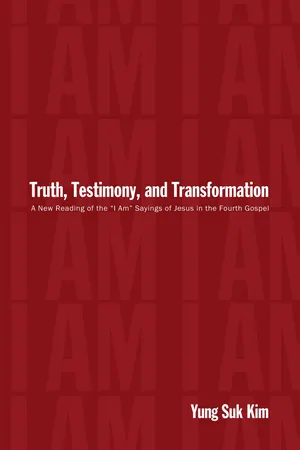
Truth, Testimony, and Transformation
A New Reading of the “I Am” Sayings of Jesus in the Fourth Gospel
- 102 pages
- English
- ePUB (mobile friendly)
- Available on iOS & Android
eBook - ePub
Truth, Testimony, and Transformation
A New Reading of the “I Am” Sayings of Jesus in the Fourth Gospel
About this book
Investigating various contexts of the "I am" sayings in Jewish and Hellenistic traditions, including the immediate context of the Johannine community, Kim seeks to explore the themes and structure of the "I am" sayings of Jesus in the Fourth Gospel. In doing so, Kim demonstrates how the "I am" sayings of Jesus can be understood as Jesus' embodiment of God's presence--the Logos of God in the world--and how such a language can help transform the struggling community into a loving community for all through a new vision of the Logos.
Information
Topic
Theology & ReligionSubtopic
Biblical Studies1
Introduction
This book challenges the high Christology of Jesus in the Fourth Gospel1 and argues that Jesus is best understood as the Jewish Messiah (low Christology), who is sent by, and working for, God.2 Jesus as the Son of God3 shows God the Father to the world by discerning the way of God, testifying to the truth, and liberating people from darkness in the world. That is why Jesus says in John 14:6: “I am the way, and the truth, and the life; no one comes to the Father except through me.”4 Jesus incarnates the Logos of God5 through his life and death. Likewise, the “I am” sayings of Jesus can be understood as Jesus’ enactment of the Logos of God rather than as “Jesus’ divine self-revelation.”6
In fact, low Christology is well attested throughout the Fourth Gospel. First, Jesus never says he is God.7 His self-understanding is the Son of God,8 and he refutes Jews’ claim that he is equal with God: “So how can you say that the one whom the Father has made holy and sent into the world insults God because he said, ‘I am God’s Son’?” (John 10:36). Here Jesus quotes from Psalm 82:6 and argues that the Son of God is not a God, and that even some people are called gods not because they are gods but because they are leaders of the people (John 10:34). It is an irony that Jews accuse Jesus of blasphemy, because in Jewish tradition the Son of God is not divine or equal with God. The “Son of God” refers to Israel (Exod 4:22; Hos 11:1; Jer 31:20), to the Israelites (Hos 2:1; Isa 1:2; Jer 3:19), or to the leaders of the people such as kings, princes, and judges (Isa 9:5; Ps 2:7; 89:27; 110:3). In fact, Jesus says that the Father is greater than he (John 14:28). Similarly, he says: “Servants are not greater than their master” (John 13:16). Even when he talks about the unity of him and the Father: “I and the Father are one” (John 10:30), it does not mean that Jesus and God are equal and the same.9 Actually, “one” is a neuter noun (hen), which connotes the relationship of unity rather than that of equality. If the masculine form (heis) was used, it could mean the equality between God and Jesus. But throughout the Gospel Jesus always says that he is working for God the Father who sent him. Jesus’ identity as the Son of God would be hollow apart from his works of God. Jesus says, “If I don’t do the works of my Father, don’t believe me. But if I do them, and you don’t believe me, believe the works so that you can know and recognize that the Father is in me and I am in the Father” (John 10:37–38; Common English Bible).
Second, Jesus in the Fourth Gospel is more comparable to Moses than to God. As Moses is called by God to deliver the Israelites from the bondage of slavery in Egypt (Exod 3:1–21; 7:1), so is Jesus sent by God to deliver God’s people from darkness.10 Moses is sent like God for God’s work (“I have made you like God to Pharaoh,” Exod 7:1); similarly, Jesus is sent by God as the Son of God who does the work of God. The only difference is the object of mission. Moses is called for Israelites; Jesus is called for the whole world11: “God so loved the world that he gave his only Son . . . God sent the Son into the world, not to condemn the world, but that the world might be saved through him” (John 3:16–17).
Third, Jesus’ “I am” sayings are not meant to say he is divine. When Jesus says, “I am” (ego eimi) to the trembling disciples while walking on the water (John 6:16–21), he means not that he is a God but that “It’s me, Jesus! Do not fear because God will protect you.”12 In such a situation of the sweeping storms, Jesus comforts them with his presence as the Son of God (“I am”), assuring them that God’s love is enough. In this context, the “I am” sayings of Jesus can be best understood as his embodiment of God’s presence in the world. That is, Jesus shows the way of God through his life and death. It is not a new way or another way but the way of God found in Isa 40:3, “Make straight the way of the Lord,” which John the Baptist cites and proclaims in the wilderness (John 1:23). Jesus continues the way of God, as John the Baptist prepares. As we will explore, Jesus discerns the way of God and lives with it. His way is narrow, not a paved highway to success but the way of the cross through which all people may be led to the kingdom of God (in the sense of God’s rule). This way is the way on which Jesus invites his disciples to join him. This way continues to be trodden by his disciples. This understanding of Jesus being the way (“I am the way”) differs from that of Jesus being the accomplished, paved way because of his atoning sacrifice, through which all people can get on the right way to God or heaven.
Fourth, Jesus is not merely the object of faith; his own faithfulness to God must be highlighted. His voluntary, sacrificial love for God and the world cannot be forgotten. Jesus’ faithfulness is expressed through his mission of the Logos: “The Logos that you hear is not mine, but is from the Father who sent me” (John 14:24b). Furthermore, when Jesus prays to the Father, he says: “I gave your Logos to them and the world hated them” (John 17:14). Jesus goes on to pray to the Father: “Make them holy in the truth; your Logos is truth” (John 17:17).13 The Logos of God here is essentially not different from the Logos in the prologue, in which the Logos was with God and was God.
Fifth, Jesus does not come to die in place of sinners in the way of a vicarious death or in the sense of a penal substitution. Forgiveness occurs through mutual forgiving in the Fourth Gospel: “If you forgive anyone’s sins, they are forgiven” (John 20:23). The concept of sin in this Gospel is “not a moral category of behavior but a theological category about one’s responsibility to the revelation of God in Jesus.”14 Interestingly, it is Caiaphas the high priest who has the notion of a vicarious death of Jesus and advises “the Jews that it was better to have one person die for the people” (John 18:14). However, the Fourth Gospel does not present Jesus’ death as atonement for sins or for particu...
Table of contents
- Title Page
- Preface
- Acknowledgments
- 1. Introduction
- 2. “I Am” Sayings in Jewish and Hellenistic Traditions
- 3. The Historical and Literary Context of the Fourth Gospel
- 4. “I Am” Sayings in the Fourth Gospel
- 5. Logic of the Transformation in John 14:6
- 6. Transformation in the Fourth Gospel and the Johannine Community
- 7. “I Am” Sayings of Jesus in Today’s Pluralistic Life Context
- Bibliography
Trusted by 375,005 students
Access to over 1.5 million titles for a fair monthly price.
Study more efficiently using our study tools.
Frequently asked questions
Yes, you can cancel anytime from the Subscription tab in your account settings on the Perlego website. Your subscription will stay active until the end of your current billing period. Learn how to cancel your subscription
No, books cannot be downloaded as external files, such as PDFs, for use outside of Perlego. However, you can download books within the Perlego app for offline reading on mobile or tablet. Learn how to download books offline
Perlego offers two plans: Essential and Complete
- Essential is ideal for learners and professionals who enjoy exploring a wide range of subjects. Access the Essential Library with 800,000+ trusted titles and best-sellers across business, personal growth, and the humanities. Includes unlimited reading time and Standard Read Aloud voice.
- Complete: Perfect for advanced learners and researchers needing full, unrestricted access. Unlock 1.5M+ books across hundreds of subjects, including academic and specialized titles. The Complete Plan also includes advanced features like Premium Read Aloud and Research Assistant.
We are an online textbook subscription service, where you can get access to an entire online library for less than the price of a single book per month. With over 1.5 million books across 990+ topics, we’ve got you covered! Learn about our mission
Look out for the read-aloud symbol on your next book to see if you can listen to it. The read-aloud tool reads text aloud for you, highlighting the text as it is being read. You can pause it, speed it up and slow it down. Learn more about Read Aloud
Yes! You can use the Perlego app on both iOS and Android devices to read anytime, anywhere — even offline. Perfect for commutes or when you’re on the go.
Please note we cannot support devices running on iOS 13 and Android 7 or earlier. Learn more about using the app
Please note we cannot support devices running on iOS 13 and Android 7 or earlier. Learn more about using the app
Yes, you can access Truth, Testimony, and Transformation by Yung Suk Kim in PDF and/or ePUB format, as well as other popular books in Theology & Religion & Biblical Studies. We have over 1.5 million books available in our catalogue for you to explore.