- 316 pages
- English
- ePUB (mobile friendly)
- Available on iOS & Android
eBook - ePub
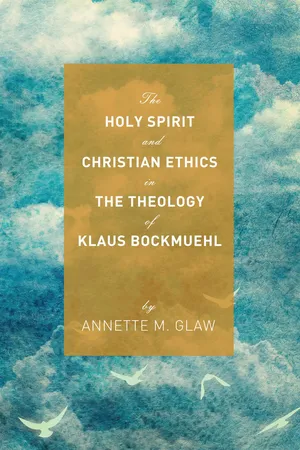
The Holy Spirit and Christian Ethics in the Theology of Klaus Bockmuehl
About this book
Klaus Bockmuehl (1931-1989), former Professor for Systematic Theology at Regent College, Vancouver, published outstanding theological ethical works. The questions that Bockmuehl explored have not lost any relevance: How do we know what God's will is in a particular situation? Is Scripture sufficient for ethical decisions or should we listen to God? Does God even speak today? Is there a distinctive Christian ethic? Bockmuehl's central contribution can be found in his emphasis on the seminal role the Holy Spirit plays within Christian ethics, not only as the one who realizes the reign of God in the life of the individual but also as the one guiding the individual in a particular situation.
This book is the first in-depth study of Bockmuehl, introducing readers to his theology and ethics, including a short biographical overview, delineating and appraising how he understands the role of the Holy Spirit in Christian ethics. It is not a book without criticism and its own creative contribution. Annette Glaw concludes her fascinating study with a proposal for a relational concept of the Holy Spirit as the loving presence of God in Christian ethics.
Information
Topic
Theology & ReligionSubtopic
Christian TheologyPart One
Bockmuehl’s Theological Work
1
Theological and Spiritual Influences on Bockmuehl
Which theologians and spiritual leaders as well as theological and spiritual traditions played a part in molding Bockmuehl’s theology and particularly his understanding of the Holy Spirit and Christian ethics? For instance, who does Bockmuehl draw on for support when expounding his key concept of the guidance by the Spirit? These and similar questions we shall explore in this chapter.
The influences on Bockmuehl are catalogued in chronological order as it would be difficult, and somewhat arbitrary, to arrange this chapter according to the importance of the different influences upon him. Furthermore, I will outline not only direct influences but also affinities and casual parallels to Bockmuehl’s thought. In fact, similarities cannot always be traced back far enough in order to decide with certainty if there was a direct influence or just a casual parallel. In either case, however, this gives us valuable information about Bockmuehl’s theological and spiritual background.
It is characteristic of Bockmuehl that we have to deal with a variety of influences.89 As well as encountering a number of spiritual leaders and theologians in person, he invested time in reading and examining spiritual and theological traditions. Even though he benefited greatly from several traditions, he was at the same time aware of their limitedness as the following statement by him shows: “In theology (and in the church in general) it is always imperative never to accept anybody’s teaching unexamined, never to become anyone’s unconditional disciple. All human theology is but a broken, or partial, reflection of God’s truth, like a mirror with blind spots, or defects, unevennesses or curvatures which enlarge one part of the mirrored object, and unduly reduce others. In short, theology always gives a rendering that in some way is either defective or out of proportion.”90
We may, therefore, conclude that Bockmuehl strove to arrive at his theological stance by testing the various different views according to 1 Thessalonians 5:21: “Test everything. Hold on to the good.”91
In turning now to the different influences upon Bockmuehl, we will focus primarily on the main issues that are distinctive in his thought, above all, Christian ethics and the Holy Spirit.
The Church Fathers and Medieval Theologians/Saints
When reading Bockmuehl, it is striking how often he refers to the Church Fathers and medieval theologians/saints. Bockmuehl was clearly influenced by them, particularly with regard to spirituality, including the topics of love for God and guidance by the Holy Spirit.
When repudiating Luther’s contention that love for God should be expressed by way of loving one’s neighbor, Bockmuehl draws on such Church Fathers and medieval theologians as St. Augustine, Thomas Aquinas, and Bernard of Clairvaux for support. In them he finds advocates for his conviction that the double commandment of love, first and foremost direct love for God, yet also love for one’s neighbor, should be the central theme of ethics.92 When looking at the motivation for doing good works, Bockmuehl refers to Bernard’s exposition of the three stances, each representing a different motivation: the slave works out of fear, the mercenary works to gain a reward, and the son acts out of love for his father. He uses the illustration of the son, which he sees reflected in Jesus’ own life, to picture the kind of attitude we should have toward God’s commission.93
The second point we observe is that Bockmuehl’s last book, Listening to the God who Speaks, in particular, reveals his great indebtedness to the Church Fathers and medieval theologians/saints regarding the topic of guidance by the Holy Spirit. Thus, in order to show that God speaks and guides directly through the Holy Spirit, he not only refers to Scripture but also to the “Luminaries in Church History,” such as Augustine, Bernard of Clairvaux, Francis of Assisi, Patrick, Ansgar, Thomas à Kempis and Johannes Tauler.94 Besides examining their writings with regard to guidance, Bockmuehl particularly draws attention to the fact that the lives of these Church Fathers, saints, and missionaries illustrate the variety of ways in which God gives guidance, either through an external voice (e.g., Augustine, Patrick), a dream (e.g., Augustine’s mother), a vision (e.g., Francis of Assisi, Patrick, Ansgar), or, most commonly, through an inner voice. An important witness to this inner guidance is Augustine, who Bockmuehl describes as “perhaps the greatest theologian and teacher in the history of the Christian church after apostolic times.”95 In his Confessions, for instance, Augustine reflects upon his experience of inner guidance: “You have walked everywhere at my side, O Truth, teaching me what to seek and what to avoid, whenever I laid before you the things that I ...
Table of contents
- Title Page
- Foreword - Graham McFarlane
- Acknowledgments
- Abbreviations
- Introduction
- Part One: Bockmuehl’s Theological Work
- Part Two: The Holy Spirit and Christian Ethics in the Theology of Klaus Bockmuehl
- Part Three: A Critical Appraisal of and a Response to Bockmuehl’s Concept of the Spirit’s Role in Christian Ethics
- Conclusion
- Bibliography
Trusted by 375,005 students
Access to over 1.5 million titles for a fair monthly price.
Study more efficiently using our study tools.
Frequently asked questions
Yes, you can cancel anytime from the Subscription tab in your account settings on the Perlego website. Your subscription will stay active until the end of your current billing period. Learn how to cancel your subscription
No, books cannot be downloaded as external files, such as PDFs, for use outside of Perlego. However, you can download books within the Perlego app for offline reading on mobile or tablet. Learn how to download books offline
Perlego offers two plans: Essential and Complete
- Essential is ideal for learners and professionals who enjoy exploring a wide range of subjects. Access the Essential Library with 800,000+ trusted titles and best-sellers across business, personal growth, and the humanities. Includes unlimited reading time and Standard Read Aloud voice.
- Complete: Perfect for advanced learners and researchers needing full, unrestricted access. Unlock 1.5M+ books across hundreds of subjects, including academic and specialized titles. The Complete Plan also includes advanced features like Premium Read Aloud and Research Assistant.
We are an online textbook subscription service, where you can get access to an entire online library for less than the price of a single book per month. With over 1.5 million books across 990+ topics, we’ve got you covered! Learn about our mission
Look out for the read-aloud symbol on your next book to see if you can listen to it. The read-aloud tool reads text aloud for you, highlighting the text as it is being read. You can pause it, speed it up and slow it down. Learn more about Read Aloud
Yes! You can use the Perlego app on both iOS and Android devices to read anytime, anywhere — even offline. Perfect for commutes or when you’re on the go.
Please note we cannot support devices running on iOS 13 and Android 7 or earlier. Learn more about using the app
Please note we cannot support devices running on iOS 13 and Android 7 or earlier. Learn more about using the app
Yes, you can access The Holy Spirit and Christian Ethics in the Theology of Klaus Bockmuehl by Annette M. Glaw in PDF and/or ePUB format, as well as other popular books in Theology & Religion & Christian Theology. We have over 1.5 million books available in our catalogue for you to explore.