eBook - ePub
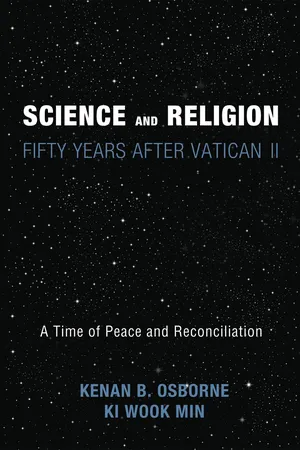
Science and Religion: Fifty Years After Vatican II
A Time of Peace and Reconciliation
- 198 pages
- English
- ePUB (mobile friendly)
- Available on iOS & Android
eBook - ePub
Science and Religion: Fifty Years After Vatican II
A Time of Peace and Reconciliation
About this book
In the past one hundred years, two major realities have changed both science and religion. The world of science has been enriched by quantum physics, the computation of the age of the universe, archaeological data in the Middle East, and a scientific stress on historical writing. The world of religion has been enriched by the establishment of the World Council of Churches and the Second Vatican Council.
In the past fifty years, major scientists and major religious leaders have met together again and again. In the past fifty years, religious leaders from Christianity, Islam, and Judaism have held a number of thought-provoking conferences. In this volume, these gatherings are reviewed and evaluated. Two major religious problems have challenged the science-religion discussions, namely, which God should the scientists agree on, the Trinitarian God, Allah, or Yahweh? Which history of the universe sponsored by these three religions should scientists be looking for? This volume raises questions and suggests some preliminary forms of serious discussion.
Information
Topic
Theology & ReligionSubtopic
Christian Church1
Science and Religion
An Identification of Terms
Part One: Introductory Considerations
The Main Theme of This Chapter
The main theme of this chapter can be stated as follows. Over the past fifty years, many books, articles, and monographs have been written on various issues regarding contemporary science and its impact on the religious world. However, certain scientific developments have continued to raise major questions and even challenges to positions presented by today’s religious world. This chapter provides a sharper specification of these science-religion questions/challenges.
The contextual focus of this entire volume centers almost exclusively on four scientific issues that continue to question and even challenge today’s religious world. The four scientific issues involve the following:
1. Archeological sciences: Contemporary archeological findings in the mid-eastern Asian world continue to challenge the religious interpretation concerning the existence and life of Abraham, the lives of his descendants, and the entire history of Moses as presented in the sacred writings of Christianity, Islam, and Judaism.12 Archeologists have raised the question of historical verification as regards the historical format in which these themes are described and used in the sacred writings of the three religions.13
2. Historical sciences: Contemporary scientific historical methodology continues to challenge the historical veracity of these same themes regarding Abraham, his descendants, and the entire history of Moses as presented in the sacred writings of Christianity, Islam, and Judaism. Are the texts, as they are written, verifiable history or are they mythological narratives? Are they biased historical essays or are they presenting actual historical data? Contemporary historians continue to question the historical verification of the passages mentioned above.14
3. Quantum physics: Contemporary quantum physics challenges religious claims of a divine plan for all finite reality. Each of the three religions mentioned above has formulated a divine plan for creation that historically includes the passages on Abraham, his descendants, and the entire history of Moses. These three plans are central to the sacred writings of Christianity, Islam, and Judaism, since the three religions claim their validity on the basis of their respective divinely revealed plans for all creation. Quantum physics, which focuses on the microcosmic reality of the universe, has discovered many processes, systems, and plans, none of which provide any evidence of a fundamental plan for the entire universe, much less a divine plan for the entire universe. Quantum physics, in its own limited way, offers no scientific substantiation of an all-inclusive divine plan for the entire finite universe. Some physical scientists who specialize in quantum physics have raised the issue of historical verification as regards the format in which the sacred writings of the three religions present a divine plan of created reality.15
4. Physical sciences and the age of the universe: Contemporary scientific data on the age of the universe also challenges the same issues as those mentioned above regarding quantum physics. Contemporary scientists who have studied the age of the entire universe are focused on the macrocosmic aspects of the universe, while quantum physics focuses on the microcosmic aspects of the same universe. Given the age of the universe, which scientists have posited from twelve to seventeen billion years, any and every pinpointing of an overarching timeline and plan is basically questioned. Scientists themselves, whenever they propose an exact dating of some physical development, need almost conclusive evidence in order to assign dates to certain physical developments that have occurred during the existence of the universe. Both scientists and religious scholars are profoundly challenged whenever they have proposed a “universal plan” for these billions of years.
Once again the question of historical verification is at stake, and any and all proposals of a detailed divine plan for a multi-billion-year-old universe can only be judged as valid if there is clear historical verification. Some physical scientists who specialize in the age of the universe have raised serious questions on the issue of historical verification as regards the formats in which the sacred writings of the three religions present a divine plan of created reality.16
These four scientific issues are centrally important to the main theme of this volume, for they are tightly interconnected to specific religious positions. For the sake of clarity, the religious issues in this volume have been limited to the three religious communities mentioned above, namely Christianity, Islam, and Judaism. These three religions have been selected since in their sacred writings the issues regarding Abraham, his descendants, and the Mosaic material are presented as historically intertwined. All three religions profess Abraham as their foundational patriarch. All three trace their histories through Abraham’s descendants. All three present divinely revealed plans for creation.
The above material is dominant in the Hebrew Bible, which involves religious data regarding Abraham and his descendants as well as the entire Mosaic material as found and interpreted in the five books of the Torah. Major aspects of this material also appear in sections of the Qur’an, which not only describe but also interpret the activity of Abraham, Ishamel, Isaac, Jacob, and Moses. In the Christian New Testament, the same main agents from Abraham and Moses are also mentioned as major forerunners of Jesus, and they are interpreted from the standpoint of Jesus as the fulfillment of the earlier Hebrew Scriptures.
It is the historical verification of the biblical material from Abraham to Moses as presented respectively in each of the three religions that has been questioned and challenged by contemporary science. Up until the present, many leaders and scholars from all three religious groups have addressed the four issues in one way or another.17 However, none of their explanations can be considered adequate, as we shall see in later sections of this volume.
The Meaning of “Science” and “Religion” as Used in This Volume
In order to accomplish this goal, there is a need to provide a definition or at least a description of the terms “science” and “religion” as used throughout this volume. Recent literature on science and religion contains a wide diversity of meaning for these two terms. In these recent writings, the denotations and connotations of terms have not been employed in a univocal way.
An example of this diversity of meaning for the terms can be found in a recent volume, The Oxford Handbook of Religion and Science, edited by Philip Clayton and Zachary Simpson. In part 1 of this volume, the individual essays focus on the theme “Religion and Science Across the World’s Traditions.” In the first essay of this section, “Hinduism and Science,” Sangeetha Menon begins with some fundamental religious issues. He writes:
The fundamentals employed are acceptance of diverse views in metaphysics, faith, and belief systems; the ideal of ahimsa—non-violence; the ideal of satya—Truth; the emphasis on ways of living guided by reflection, detachment (sakshibhava) and meditation.18
In this listing, the fundamentals are primarily fundamentals as understood within Hinduism. His use of the terms ahimsa, satya, and sakshibhava clearly indicate a Hindu correspondence, just as the terms “hermeneutics,” “phenomenology,” and “structural analysis” might indicate a postmodern philosophical correspondence in a different essay.
Menon subsequently refers to other factors in the dialogue between Hinduism and contemporary science, namely: the fluid face of truth,19 the issue of the one and the many,20 the beginning and end of creation,21 and also consciousness leading back to self.22 In themselves, these terms are more cross-cultural, but his presentation of the meaning of these terms still bears a Hindu correlation. Truth is interpreted through the understanding of satya. The issue of the one and many is presented through the lens of the Jaina view, which is “many-sided.” The beginning and ending of creation are described in terms of two Hindu hymns, the Nasadiya Sukta and the Perushka Sukta.
Menon is perfectly legitimate in his use of a Hindu construct. The point we wish to make is simply this: he is not focusing on religion-in-general, but on Hinduism, a theme which he had been asked to do. Nor is he truly focusing on contemporary science in general, but on a contemporary Hindu understanding of science. In the pages of his essay, the author engages Hindu positions with the physical sciences (creation), with psychology (neuroscience), and conflict (various sciences and Hindu belief). He notes that in Indian logic there is a fourfold preliminary for every dialogue, namely: elucidations of vishaya (the theme of the discourse), prayojana (its major goal), sambandha (the relation between the theme of the discourse and its goal), and adhikari (the qualified participant).23
In Menon’s essay on religion and science, it is clear that Hinduism is the particular religion of the dialogue, and that this particular religion has certain parameters in which a dialogue with science ne...
Table of contents
- Title Page
- Introduction
- Chapter 1: Science and Religion
- Chapter 2: The Spiritual Beauty of Religion and Contemporary Scientific Issues
- Chapter 3: The Major Issues in Quantum Physics
- Chapter 4: Critical Alternatives
- Chapter 5: Science and Religion
- Chapter 6: Two Major Intra-Religion Complications
- Chapter 7: Conclusions
- Bibliography
Trusted by 375,005 students
Access to over 1.5 million titles for a fair monthly price.
Study more efficiently using our study tools.
Frequently asked questions
Yes, you can cancel anytime from the Subscription tab in your account settings on the Perlego website. Your subscription will stay active until the end of your current billing period. Learn how to cancel your subscription
No, books cannot be downloaded as external files, such as PDFs, for use outside of Perlego. However, you can download books within the Perlego app for offline reading on mobile or tablet. Learn how to download books offline
Perlego offers two plans: Essential and Complete
- Essential is ideal for learners and professionals who enjoy exploring a wide range of subjects. Access the Essential Library with 800,000+ trusted titles and best-sellers across business, personal growth, and the humanities. Includes unlimited reading time and Standard Read Aloud voice.
- Complete: Perfect for advanced learners and researchers needing full, unrestricted access. Unlock 1.5M+ books across hundreds of subjects, including academic and specialized titles. The Complete Plan also includes advanced features like Premium Read Aloud and Research Assistant.
We are an online textbook subscription service, where you can get access to an entire online library for less than the price of a single book per month. With over 1.5 million books across 990+ topics, we’ve got you covered! Learn about our mission
Look out for the read-aloud symbol on your next book to see if you can listen to it. The read-aloud tool reads text aloud for you, highlighting the text as it is being read. You can pause it, speed it up and slow it down. Learn more about Read Aloud
Yes! You can use the Perlego app on both iOS and Android devices to read anytime, anywhere — even offline. Perfect for commutes or when you’re on the go.
Please note we cannot support devices running on iOS 13 and Android 7 or earlier. Learn more about using the app
Please note we cannot support devices running on iOS 13 and Android 7 or earlier. Learn more about using the app
Yes, you can access Science and Religion: Fifty Years After Vatican II by Kenan Osborne OFM,Ki Wook Min in PDF and/or ePUB format, as well as other popular books in Theology & Religion & Christian Church. We have over 1.5 million books available in our catalogue for you to explore.