- 182 pages
- English
- ePUB (mobile friendly)
- Available on iOS & Android
eBook - ePub
About this book
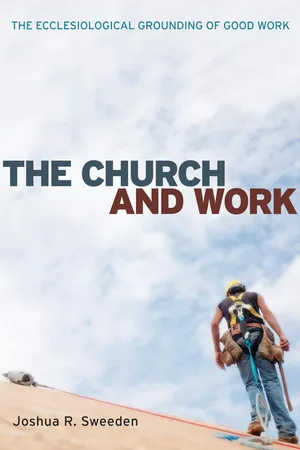
Work is one of the most dominant and unavoidable realities of life. Though experiences of work vary tremendously, many Christians share a common struggle of having to live in seemingly bifurcated spheres of work and faith. Beginning with the conviction that Christian faith permeates all aspects of life, Joshua Sweeden explores Christian understandings of "good work" in relationship to ethics, community practice, and ecclesial witness. In The Church and Work, Sweeden provides a substantial contribution to the theological conversation about work by proposing an ecclesiological grounding for good work. He argues that many of the prominent theological proposals for good work are too abstract from context and demonstrates how the church can be understood as generative for both the theology and practice of good work. This needed ecclesiological development takes seriously the role of context in the ongoing discernment of good work and specifically explores how ecclesial life and practice shape and inform good work. Christian understandings of good work are inconceivable without the church. Accordingly, the church is not simply the recipient and a dispenser of a theology of work, but the locus of its development.
Information
Topic
Theology & ReligionSubtopic
Christian Theology1
Introduction
Toward an Ecclesiology of Work
In 1972, Studs Terkel published a collection of oral histories called Working. After countless interviews and conversations with everyday workers across America, he compiled the results. The text gained immediate attention. The hundreds of reflections on modern work struck a chord with Americans and made vivid what no study or survey had previously. In Terkel’s oral histories, the complex intersections between work and the worker were told, not as raw data, but as story. Stories, of course, exhibit profound depth amidst their simplicity. As researchers and theorists attempted to explain work, Terkel exposed it.
Terkel introduces Working as a book that is, “by its very nature, about violence.” Work, he explains, is about violence “to the spirit as well as to the body . . . to survive the day is triumph enough for the walking wounded among the great many of us.”1 This is not, of course, the nature of work for all persons. Through his many interviews, Terkel does discover a “happy few who find and savor their daily job.” But he wonders if satisfaction at work “tells us more about the person than about the task.” The common attribute for this small percentage of workers, Terkel suggests, is that they find “meaning to their work well over and beyond the reward of the paycheck.”2 Over the past forty years, the popularity of Terkel’s collection has not waned. Despite changes in industries, technological advances, and significant social, political, and economic shifts, the testimonies of workers in the 1970s continue to strike a chord with workers today. For many people, work is still violent; for a happy few, work is satisfying.
For centuries, Christian theologians have wrestled with understanding everyday human work.3 If work is “violent,” from where does the violence arise? Is it intrinsic in work itself, or only in our distortions of work? Similarly, what makes work meaningful or satisfactory? Is there something we might call “redeemed work” and what would it look like? Christian theology can engage these types of questions through a variety of resources within its tradition. From a creation that is declared “good,” to the “curse of toil” in Gen 3, and the “new creation” pronounced in Jesus Christ, Christian theology offers various lenses for explaining the nature and possibilities of human work.4 And yet, explanations of work seem always to fall short. Understanding work appears beyond our grasp since the nature and contextual realities of work are constantly shifting.
The difficulty in understanding work is not surprising since work, as a subject, suffers from an inevitable ambiguity.5 Work is an inescapable reality corresponding directly to human needs and flourishing. Without work humans cannot live, and yet persons suffer and endure injustices and inequities constantly in their work. The ambiguity is only furthered by the fact that work resists definition.6 It is elusive, constantly escaping the grasp of rigid description or classification. Terkel’s oral histories help, but David Jensen may have summarized it best in saying, “Attempting to define work is as elusive as defining the human person. Most of us have a rather gut-level reaction to work: we know it when we see it.”7 Despite its ambiguity, work remains surprisingly tangible and commonplace. For this reason, work continually demands theological attention.
An underlying assumption of this text is that theology is a process of critical reflection on praxis.8 Theology is sometimes construed as theoretical or practical; the former concerned with right thinking, the latter with right action. Theology is also concerned with the interrelatedness of theory and action, or more specifically, the way theory and action are mutually informative and dependent. From this perspective, theology must engage the ordinary and commonplace practices of everyday life. The practices of everyday life are tangible expressions of the interrelatedness of theory and action. Even though few people may recognize the embedded theories and assumptions behind their actions, or the way their actions and experiences shape their thinking, a primary task of theology is to explore how the practices of everyday life exhibit this interrelatedness.9
Work is one of the most ordinary and commonplace practices of everyday life. From a modern, western perspective, work is often construed as paid employment, but a fuller understanding recognizes the centrality of work in every person’s life. From simple tasks of self-care to professional management, work is a daily reality faced equally by the underemployed and over-employed, by the poor and the wealthy, or by those who commute and those who stay home. Similarly, work is not confined to certain hours, days, locations, or spaces. Work is inescapably present on weekends and holidays, in the office and at home, “on the clock” and even in leisure. Karl Barth calls work, “The active affirmation of human existence.”10 Indeed, work is central to human experience, even if all experiences of work are different.11
In Conversation
This study is a contribution to the multifaceted conversation about theology and work. Diverse theological perspectives, interests, and contexts of work have prompted a host of discussions concerning what theology might have to say to work and what work might have to say to theology. In many ways, this text is a response to the conversation about theology and work in the North American and European contexts. My intention is to be a partner in the conversation. In responding to some of the current claims and proposals, I hope not only to expand and continue the conversation, but also address the nature of the conversation itself—i.e., provoke a conversation about the conversation. To accomplish this task, I will turn specifically to the discussion of the nature and understanding of ‘good work.’12
Specifically, this text is an exploration into how ecclesial life and practice can shape and inform good work. Christian theologians have argued that work is part of God’s creation. God worked, and humans too were created to work.13 Affirming the goodness of God’s creation, Christians hold that there must be something more fundamental to work than the experience of toil; God’s intention was for work to be good.14 But is work experienced as good? For many, drudgery, obligation, and compromise are more apt descriptions of work.15 It seems, in fact, that on the occasions work does affirm gifts and passions and encourages creativity and spurs imagination it is relished as a novelty; good work seems to be the exception, not the rule.
Theology is not the only discipline to encourage good work. The theologian, however, is forced to ask on what or whose grounds “good” is understood.16 In particular, a Christian theology of redemption affirms that work can attest to God’s good intentions.17 But recovering good work is a difficult task with a history marked by humans’ coercive power over other humans and the environment. Slavery, destruction, degradation, inequity, avarice, and dehumanization tell the story of work throughout human history. And yet, in the midst of work’s toilsome curse,18 glimpses of good work still emerge.19 Nonetheless, as theological interest in work has sought to expose new possibilities for work, the question still remains: what is the role of the church, as a community of Christian practice, in the formation of good work?
This book is concerned with the limited attention ecclesiology has received in the theological literature on work. Is the lack of explicit ecclesiological attention in theologies of work in danger of discounting the formative role of the church? Can theologies of work fully propose transformations of good work aside from concrete communities of practice? Can the church be understood as generative for both the theology and practice of good work?
Ecclesiology can assist theologies of work in the pursuit of recovering good work in at least three ways. First, ecclesiology can address the disconnect Christians experience between their everyday work and faith.20 Few persons, if any, consider themselves free of work. Even someone who is unemployed is unlikely to feel free from work.21 Dorothee Sölle suggests that the image Treadmill by Walter Habdank, which consists of a man yoked and peddling his master’s treadmill with bare feet, best exemplifies the enslavement of people to work.22 People desire to understand how the everyday, even monotonous work they do has purpose or contributes to others and the world. Ecclesiology can explore how the church has often reconceived and reoriented the everyday and ordinary within its corporate identity.
Second, ecclesiology can assist theologies of work by exploring the church as a hermeneutical community through which work can be evaluated and the tenets of good work understood. This is especially important given the overlaps between work and ethics.23 Michael Cartwright argues that Christian ethics are grounded in a communal hermeneutic as opposed to “formal, ahistorical categories.”24 Accordingly, a Christian notion of good work would find normative grounding in the interpretative community of the church. From an ecclesiological perspective, Christian life is ecclesial life, meaning that Christian faithfulness is invariably tied to the church. Ecclesiology, therefore, identifies the church as the locus from which theology arises, but also takes seriously the church’s ability to form, shape, and habituate its members toward a faithful embodiment of good work.
Thirdly, ecclesiology can assist theologies of work by providing a concrete place for transformative practices of work. William Cavanaugh proposes in his writings on ecclesiology and economics that what is needed for an embodiment of a theological vision of economics is for the church “to be a different kind of economi...
Table of contents
- Title Page
- Foreword - Michael Cartwright
- Acknowledgments
- Chapter 1. Introduction: Toward an Ecclesiology of Work
- Chapter 2. Prominent Motifs of Work in Theology and Modernity
- Chapter 3. Theology and Work: The Contemporary Conversation
- Chapter 4. Good Work and the Church
- Chapter 5. Work of the People
- Chapter 6. The Work of a Public
- Bibliography
Trusted by 375,005 students
Access to over 1.5 million titles for a fair monthly price.
Study more efficiently using our study tools.
Frequently asked questions
Yes, you can cancel anytime from the Subscription tab in your account settings on the Perlego website. Your subscription will stay active until the end of your current billing period. Learn how to cancel your subscription
No, books cannot be downloaded as external files, such as PDFs, for use outside of Perlego. However, you can download books within the Perlego app for offline reading on mobile or tablet. Learn how to download books offline
Perlego offers two plans: Essential and Complete
- Essential is ideal for learners and professionals who enjoy exploring a wide range of subjects. Access the Essential Library with 800,000+ trusted titles and best-sellers across business, personal growth, and the humanities. Includes unlimited reading time and Standard Read Aloud voice.
- Complete: Perfect for advanced learners and researchers needing full, unrestricted access. Unlock 1.5M+ books across hundreds of subjects, including academic and specialized titles. The Complete Plan also includes advanced features like Premium Read Aloud and Research Assistant.
We are an online textbook subscription service, where you can get access to an entire online library for less than the price of a single book per month. With over 1.5 million books across 990+ topics, we’ve got you covered! Learn about our mission
Look out for the read-aloud symbol on your next book to see if you can listen to it. The read-aloud tool reads text aloud for you, highlighting the text as it is being read. You can pause it, speed it up and slow it down. Learn more about Read Aloud
Yes! You can use the Perlego app on both iOS and Android devices to read anytime, anywhere — even offline. Perfect for commutes or when you’re on the go.
Please note we cannot support devices running on iOS 13 and Android 7 or earlier. Learn more about using the app
Please note we cannot support devices running on iOS 13 and Android 7 or earlier. Learn more about using the app
Yes, you can access The Church and Work by Joshua Sweeden in PDF and/or ePUB format, as well as other popular books in Theology & Religion & Christian Theology. We have over 1.5 million books available in our catalogue for you to explore.