eBook - ePub
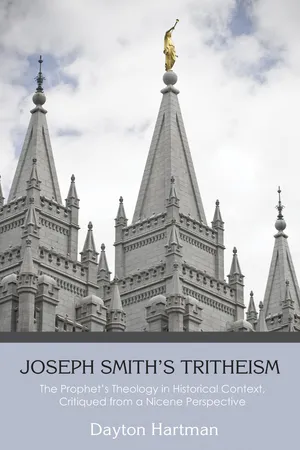
Joseph Smith’s Tritheism
The Prophet’s Theology in Historical Context, Critiqued from a Nicene Perspective
- 162 pages
- English
- ePUB (mobile friendly)
- Available on iOS & Android
eBook - ePub
Joseph Smith’s Tritheism
The Prophet’s Theology in Historical Context, Critiqued from a Nicene Perspective
About this book
"I have always declared God to be a distinct personage, Jesus Christ a separate and distinct personage from God the Father, and that the Holy Ghost was a distinct personage and a Spirit: and these three constitute three distinct personages and three Gods."
--Joseph Smith
Few figures in North American religious history are quite as enigmatic as Joseph Smith. His unabashed adherence to tritheism gave birth to one of the most influential religious movements in American history. Many attempts have been made to engage his life and unorthodox theology. However, Joseph Smith's Tritheism is a unique text that blends church history, thoughtful theological exegesis, and evangelical apologetics in an attempt to engage Joseph Smith's theology anew.
Information
Topic
Theology & ReligionSubtopic
Christian ChurchChapter 1
Introduction
Background
For nearly two thousand years, the doctrine of the Trinity has stood at the center of theological orthodoxy. Based upon the text of enscripturated revelation and in accordance with the rule of faith, Christians have historically recognized the triune nature of God,1 while at the same time holding firm to Abrahamic monotheism.2 In North America, this doctrine was firmly established in the beliefs of those who migrated to the New World in hopes of enjoying religious freedom. What developed, particularly in the Northeastern portion of the American Colonies, was a historically orthodox, theological stronghold.3 Doctrinally, a great deal of homogeny existed among the colonies. While there certainly were theological nuances from sect to sect, there was a general adherence to theological essentials that had historically defined the Christian faith, including the doctrine of the Trinity.
Mark Noll demonstrates that during the late eighteenth and early nineteenth centuries, a drift away from established orthodoxy began to occur, particularly in the Northeast of the American Colonies.4 Even though Noll provides a well-written and meticulously researched account of this theological drift, he does not adequately discuss the resulting unorthodox movements that arose due to this theological innovation. Such information is critical because it was during this time period that the orthodox denominations witnessed a significant falling away of members.5 The abandonment of traditional orthodoxy must be connected to the rise of anti-orthodox attitudes and the movements these sentiments birthed.
A number of the organized movements that departed from orthodoxy arose or settled near Palmyra, New York: the same town that gave rise to the North American tritheism known as Mormonism.6 Ruth Tucker’s historical survey of New Religions, particularly in North America, provides relevant data for understanding the rise of unorthodox movements, yet it does not go far enough in examining the varying influences and motives that led to the splitting away from orthodoxy. The general mood of the colonies in the Northeast was that of freedom in theological exploration and invention, an attitude somewhat resulting from the millennial fervor that had arisen around the time of the American Revolution.7 Interest in millennial apocalyptic religion, regardless of its orthodoxy, had become en vogue. Surprisingly, this factor has yet to be considered as one of numerous influences leading to the eventual rise of North American tritheism. In the nearly two centuries since the time of Joseph Smith, Mormonism’s adherents have remained true to its nuanced and seemingly ever-changing position on the nature of the Godhead. While undertaking clarifications over time, the central element of Smith’s theology, tritheism, has remained intact.8
Two resources, in particular, stand out as excellent accounts of Joseph Smith’s early life, as well as his prophetic career. First, from an evangelical perspective, One Nation Under Gods (2003) proves a valuable resource in understanding early Mormonism. Richard Abanes depicts the questionable character of Joseph Smith in both his business life and his role as a self-proclaimed prophet. However, One Nation Under Gods does not situate Smith’s divergence from historical orthodoxy in its proper context. The book supplies little information to acquaint the reader with the theological climate of the Northeast during and just preceding Smith’s lifetime. Historian and LDS adherent Richard Bushman’s account of Smith’s life, Joseph Smith: Rough Stone Rolling (2007), has become the standard for a modern recounting of Mormonism’s founding prophet’s life from a perspective that is sympathetic to the LDS church. While providing an exceptional portrait of the historical and cultural context in which Mormonism was born, Bushman proves to be unsuccessful in his effort to provide the reader with the necessary understanding of the theological context in which Smith began teaching his unique understanding of God.
Problem Statement
Asserting that Smith restored true doctrine, LDS adherents fail to recognize that Smith was just one of many voices advocating a departure from Christian orthodoxy.9 Joseph Smith proposed, contrary to Nicene orthodoxy, that there is not one God, but that there are many gods. However, the gods that are to be worshipped are the three gods who act with one purpose.10 Rather than attempting a reformulation of historic Trinitarian Christianity, Smith envisioned a theological system meant to replace historic Nicene Christianity.11 Since the time of Joseph Smith, Mormonism has continued to contour itself to the historical context in which it exists. The doctrinal formulations found within early Mormonism have changed over decades, resulting in modern LDS doctrinal explanations, which remain staunchly tritheistic.12 Modern LDS apologists continue to attack historic Nicene orthodoxy as unbiblical, insisting instead upon Smith’s unique tritheistic understanding of God.13 Orthodox Christianity should respond by defining its parameters, rooted in an exegesis of the Scriptures, and maintained by what has been held as the rule of faith since the time of the early church.
Central Research Question
The central theoretical question of this work, therefore, is: What was the theological context in which Joseph Smith diverged from Nicene orthodoxy, and, given his divergence, how should Nicene Trinitarian orthodoxy respond to and criticize Joseph Smith’s tritheism?
The questions that emerge from this problem include:
• What is the clear, systematic teaching of Scripture regarding the nature of God?
• What is the historical, orthodox position on the Trinity, and how early was it established?
• How is the doctrine of the Trinity currently being addressed among orthodox theologians?
• What was the historical context in which Joseph Smith formulated his tritheism?
• In what manner did Joseph Smi...
Table of contents
- Title Page
- Acknowledgments
- Abbreviations
- Chapter 1: Introduction
- Chapter 2: The Trinity in the Scriptures
- Chapter 3: The Development of Nicene Orthodoxy
- Chapter 4: Joseph Smith’s Historical Context
- Chapter 5: Joseph Smith’s Tritheism
- Chapter 6: Conclusion
- Bibliography
Trusted by 375,005 students
Access to over 1.5 million titles for a fair monthly price.
Study more efficiently using our study tools.
Frequently asked questions
Yes, you can cancel anytime from the Subscription tab in your account settings on the Perlego website. Your subscription will stay active until the end of your current billing period. Learn how to cancel your subscription
No, books cannot be downloaded as external files, such as PDFs, for use outside of Perlego. However, you can download books within the Perlego app for offline reading on mobile or tablet. Learn how to download books offline
Perlego offers two plans: Essential and Complete
- Essential is ideal for learners and professionals who enjoy exploring a wide range of subjects. Access the Essential Library with 800,000+ trusted titles and best-sellers across business, personal growth, and the humanities. Includes unlimited reading time and Standard Read Aloud voice.
- Complete: Perfect for advanced learners and researchers needing full, unrestricted access. Unlock 1.5M+ books across hundreds of subjects, including academic and specialized titles. The Complete Plan also includes advanced features like Premium Read Aloud and Research Assistant.
We are an online textbook subscription service, where you can get access to an entire online library for less than the price of a single book per month. With over 1.5 million books across 990+ topics, we’ve got you covered! Learn about our mission
Look out for the read-aloud symbol on your next book to see if you can listen to it. The read-aloud tool reads text aloud for you, highlighting the text as it is being read. You can pause it, speed it up and slow it down. Learn more about Read Aloud
Yes! You can use the Perlego app on both iOS and Android devices to read anytime, anywhere — even offline. Perfect for commutes or when you’re on the go.
Please note we cannot support devices running on iOS 13 and Android 7 or earlier. Learn more about using the app
Please note we cannot support devices running on iOS 13 and Android 7 or earlier. Learn more about using the app
Yes, you can access Joseph Smith’s Tritheism by Dayton Hartman in PDF and/or ePUB format, as well as other popular books in Theology & Religion & Christian Church. We have over 1.5 million books available in our catalogue for you to explore.