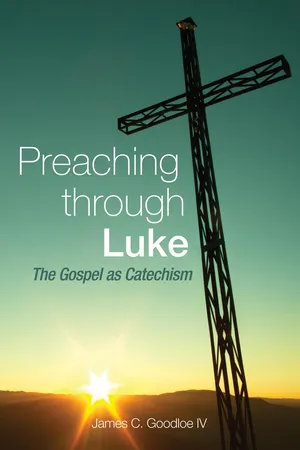
- 338 pages
- English
- ePUB (mobile friendly)
- Available on iOS & Android
eBook - ePub
About this book
Luke wrote this Gospel so "that you [Theophilus] may have certainty concerning the things you have been taught [i.e., catechesis]" (1:4). It proceeds with a barrage of questions.
The first comes from Zechariah: "How shall I know?" (1:18). This is a question of knowledge. The angel Gabriel answers that we shall know by the word of God (1:19).
The second comes from Mary: "How will this be?" (1:34). This is a question of agency, of how the Son of God can become human. Gabriel answers that it will be by the power of God (1:35).
The third comes from Elizabeth: "Why me?" (1:43). Why should the gospel of Jesus Christ come to her? Mary answers that it has to do with God's choice, election, mercy, and salvation (1:47-55).
The fourth has to do with John: "What then will this child be?" (1:66). Zechariah answers that he will be a prophet (1:76-79). John is not the Christ, but he will go before the Christ.
Thus begins the catechism according to Luke, a series of questions in order that we may have certainty concerning the things we have been taught.
Information
Topic
Theology & ReligionSubtopic
Christian Ministry1
How Shall I Know?
❃
Luke 1:1–25; Daniel 9:1–15, 20–23
“Inasmuch as many have undertaken to compile a narrative of the things that have been accomplished among us, just as those who from the beginning were eyewitnesses and ministers of the word have delivered them to us, it seemed good to me also, having followed all things closely for some time past, to write an orderly account for you, most excellent Theophilus, that you may have certainty concerning the things you have been taught.”
Here in the first sentence of the Gospel according to Luke we have a statement of the purpose of the book: it was written in order that “you”—which at the time referred to Theophilus but which now includes all of us who read the gospel—“may have certainty concerning the things you have been taught.” This whole book is here today for us to know the gospel of Jesus Christ, for us to know the content of the Christian faith, for us to know the good news of God, and for us to believe it and to obey it. Thanks be to God!
Given this purpose of the Gospel according to Luke, it is no accident that the first question asked in this book, by the first person we meet in this book, is simply, “How shall I know this?” “How shall I know?” Zechariah asks this in regard to what Gabriel has told him, but it also has a broader meaning and application. Luke records it because it is a good and important question for Theophilus. More than that, Luke records it because it is a good and important question for us. The purpose of the book is for us to have certainty, and the first question is, “How?” How shall we know? How shall we know the gospel of Jesus Christ? How shall we know the good news of God? How shall we know the content of the Christian faith? How shall we know? This is still our question. We need an answer, here at the beginning of the gospel, before we go any farther. How shall we know? We need an answer, on this day in our lives, so that we may move forward in the faith. How shall we know?
The answer is swift. “The angel answered him, ‘I am Gabriel, who stands in the presence of God, and I was sent to speak to you and to bring you this good news.’” It is as if Gabriel was astonished at the question. His answer, in effect, is, “I just told you! That is how you will know.” And yet, there is much more going on here. And even if Gabriel was astonished at Zechariah’s question, we are not, because his question is our question, and we want to know the answer. So what is this answer?
The word “angel” means “messenger.” A messenger is someone who carries and delivers a message for someone else. A messenger does not invent the message. A messenger does not write the message. A messenger is not to interpret the message. A messenger is not to tamper with the message. A messenger carries and delivers a message for someone else. This is what the word “angel” means.
In this case, Gabriel is an angel of the Lord. That is different. Gabriel stands in the presence of God. Gabriel is sent from God to speak to Zechariah, just as he had been sent to speak to Daniel. That is who Gabriel is. That is what Gabriel does. He is an angel of the Lord who carries a message from the Lord to the people of God. On the one hand this sounds fantastic. Very few people have contact with angels. And yet on the other hand, this very device, this very method of delivering the message, plays down the importance of the messenger and plays up the content of the message itself. That is, the angel is not the point of the story. The message that the angel brings, the word from God to the people of God, that is the point of the story. And we have the message. It would not matter if we never had access to an angel again. What the angel brought is the word of God, and that, my friends, we still have today. That is what we have in this very gospel. That is the answer to our question. That is how we shall know. We shall know by the word of God. Thanks be to God!
It has been observed that angels appear in connection with the birth of Jesus Christ and in connection with the resurrection of Jesus Christ, before his resurrections appearances. In the time between his birth and resurrection, and in the time of his resurrection appearances, it is Jesus himself who speaks for, and on behalf of, God. Thus we have not only the word of angels who as messengers bring the word of God, but we have also and even more the word of Jesus Christ himself. Again, none of us has ever met him in the flesh. It appears that Theophilus had not done so. And yet, we still have the teachings of Jesus Christ. We have his words. We have what he said. We have his gospel. That is what is written down in this book through which we are about to read, hear, preach, and listen. It is not the “Gospel of Luke.” Instead, it is the “Gospel according to Luke.” That is because it is the gospel of Jesus Christ! This is the word we have. This is how we shall know.
Short of meeting Jesus Christ in the flesh, short of receiving a visit from Gabriel, how are we to know that the word of Scripture is the word of God? This is an extraordinarily important question and one that has engaged the church for centuries. Several possible answers have been considered and then set aside as inadequate. For instance (1), we do not regard the Bible as the word of God simply because it is ancient. Other writings are as old or older. And there was a day, of course, when the Bible was brand new. So, its antiquity does not establish that it is the word of God. Again (2), we do not regard the Bible as the word of God simply because the church says so. That would be to get things backwards. It was the word of God, communicated through the Bible, which called the church into existence. The church acknowledges the Bible as the word of God, but the acknowledgment does not make it so. And the church’s authority is not sufficient to make it so. Moreover (3), we do not regard the Bible as the word of God because of its internal coherence, though it does demonstrate a remarkable coherence for a document written by many human hands over several centuries in at least three different languages. Finally (4), we do not regard the Bible as the word of God because it measures up to any outer standard, for that would in and of itself acknowledge something else as a higher standard than the word of God, which would be a contradiction.
Instead, we do acknowledge the Bible as the word of God because, and only because, it produces within us the inner conviction that it is the word of God. Yes, that is circular. But it is also personal. The word of God is self-authenticating. Either it convinces us, or it does not. If it does, nothing can take that away from us. If it does not, nothing else can give that to us. In that division of humanity, between those who acknowledge the Bible as the word of God and those who do not, lays a great mystery. The division does not have to do with intelligence. It does not have to do with prior faith. Faith comes from the word of God, not the other way around. It does not have to do with our deserving, for then none of us would receive the word. The mystery seems, instead, to have to do with the election of God, with the free and not outwardly determined choice on the part of God alone as to whom he wishes to hear and to believe.
That is to say, the word of God is independent. It is outside and beyond our control. It cannot be tamed. It cannot be domesticated. It can, perhaps, be used and abused, but not for long. It will not tolerate such foolishness. The word of God is a great and consuming fire, and it is also a spring of living water. It is an absolute standard which humbles us, and it is a word of grace which lifts us up and makes us alive. If you know it, you know what I am talking about.
As for the personal aspect of the word, consider these parallels: If your wife tells you that she loves you, either she convinces you of that or she does not. No one else can convince you of it. If your husband tells you that he loves you, either he convinces you of that or he does not. There are outward patterns of behavior that tend to confirm that or not, that are consistent or not, that are supportive or not, that are appropriate or not. Those are extraordinarily important. And some of us men are not too bright! And yet, a profession of love either awakens a corresponding awareness of love or it does not. Thus, a profession of love is personal. It is not academic. It is not scientific. It is not political. It is personal. And it is either convincing or not. The word of God is at least somewhat like that. Either you hear the word of God as the word of God, or you do not. Either you hear the voice of our creator, or you do not. Either you hear the grace of our redeemer, or you do not. If so, you know it is the word God, more surely than you know anything else. If not, there is nothing else I can do to convince you. I can only encourage you to keep listening. God is good. God is gracious. Many millions before you have listened and heard. Many millions before you have heard and believed. Many millions before you have believed and obeyed. Keep listening.
“How shall we know?” How shall we know the gospel of Jesus Christ? How shall we know the good news of God? How shall we know the content of the Christian faith? There is only one way. We shall know by the word of God alone. That does not mean that we have to see an angel. That does not mean that we have to meet Jesus Christ in the flesh. And it does not mean that we can put it into a test tube and measure it. It is not that kind of knowing. But it does mean that we will be encountered by God as God has chosen to make himself known in and through the word of God as revealed to the prophets, as embodied in Jesus Christ, as entrusted to the apostles, as written and recorded in the Bible. Thanks be to God!
The Gospel according to Luke was written in order “that you may have certainty concerning the things you have been taught.” This whole book is here today for us to know the gospel of Jesus Christ, for us to know the content of the Christian faith, for us to know the good news of God, and for us to believe it and to obey it. If that is of interest to you, you are in the right place. If you want to know all of these things, the first question is, “How shall we know?” And the answer to that question, given in the text itself, is, “We shall know by the word of God alone.” That is where we start. There are many more questions and answers. Luke has them all lined up for us, like a catechism. We will face them one by one. I invite you and urge you to immerse yourself in hearing this word, in being engaged by this word, and so in making it your very own.
“Inasmuch as many have undertaken to compile a narrative of the things that have been accomplished among us, just as those who from the beginning were eyewitnesses and ministers of the word have delivered them to us, it seemed good to me also, having followed all things closely for some time past, to write an orderly account for you, most excellent Theophilus, that you may have certainty concerning the things you have been taught.”
To God be the glory forever and ever! Amen.
2
How Will This Be?
❃
Luke 1:26–38; Job 38:1–11
The angel Gabriel said to Mary, “Behold, you will conceive in your womb and bear a son, and you shall call his name Jesus. He will be great and will be called the Son of the Most High. And the Lord God will give to him the throne of his father David, and he will reign over the house of Jacob forever, and of his kingdom there will be no end.” And Mary said to the angel, “How will this be?” That is a very good question! “How will this be?” At one level, the question is, “How will a virgin conceive?” And yet, at another level, the question is, “How will the Son of God become human?” That is far more difficult and far more interesting. Thus does Mary pose to the angel a profound question, “How will this be?”
Before we get to the answer, consider with me the nature and purpose of the question. It is significant that in the first sentence of the Gospel according to Luke we have a statement of the purpose of the book: it was written in order that “you”—which at the time referred to Theophilus, for whom the book was first written, but which now includes all of us who read the gospel—“may have certainty concerning the things you have been taught.” This whole book is still here today in order for us to know the gospel of Jesus Christ, for us to know the content of the Christian faith, for us to know the good news of God, and for us to believe it and to obey it. That is why it was written, that is why we have it, and that is why we read and preach it today. So let us seek this certainty which it intends.
Given this purpose of the Gospel according to Luke, how does it go about carrying out that purpose? How does it fulfill that purpose? The rest of the gospel, from the first sentence to the end of the book, contains a barrage of questions and answers. It is my contention not only that the questions point to what is important in each part of the gospel story, but also that the questions were of continuing significance to Theophilus, and even that the questions are still of continuing significance to us. That is to say, the book we have before us is not only a gospel story but is also a gospel catechism, a question-and-answer teaching device intended to communicate the Christian faith, intended to be learned and even memorized, intended to engage the learner in the great questions of the faith, an early catechism in the form of a story, indeed a catechism embedded in the gospel.
We have here, in logical order, a series of questions of faith and doubt, life and death, good and evil, truth and falsehood, reality and unreality. We have here the questions that we ask, or that we should ask, about who we are, whose we are, and what we are about. We have here a gift from God, who knows us bet...
Table of contents
- Title Page
- Preface
- Chapter 1: How Shall I Know?
- Chapter 2: How Will This Be?
- Chapter 3: Why Me?
- Chapter 4: What Then?
- Chapter 5: What Good News?
- Chapter 6: How Long?
- Chapter 7: Did You Not Know?
- Chapter 8: What Shall We Do?
- Chapter 9: Whose Son?
- Chapter 10: Whom Shall You Serve?
- Chapter 11: Is Not This . . . ?
- Chapter 12: What Is This Word?
- Chapter 13: Let Down Your Nets!
- Chapter 14: Who Can Forgive?
- Chapter 15: Why with Sinners?
- Chapter 16: Good or Harm?
- Chapter 17: Blessing or Woe?
- Chapter 18: What Benefit?
- Chapter 19: Why Do You Call Me “Lord”?
- Chapter 20: Say the Word!
- Chapter 21: Who Is to Come?
- Chapter 22: Who Forgives Sins?
- Chapter 23: Take Care How You Hear!
- Chapter 24: Who Commands Winds and Water?
- Chapter 25: Only Believe!
- Chapter 26: Who Is This?
- Chapter 27: Who Do You Say That I Am?
- Chapter 28: Who Is the Greatest?
- Chapter 29: How Shall We Follow?
- Chapter 30: Who Hears You?
- Chapter 31: What Shall I Do?
- Chapter 32: How Much More!
- Chapter 33: How Will His Kingdom Stand?
- Chapter 34: Did Not He Make You?
- Chapter 35: Fear Not!
- Chapter 36: Why Are You Anxious?
- Chapter 37: Who Is Faithful?
- Chapter 38: Worse than All the Others?
- Chapter 39: What Is the Kingdom of God?
- Chapter 40: Is It Lawful to Heal?
- Chapter 41: Do You Not Count the Cost?
- Chapter 42: Do You Not Go after the Lost?
- Chapter 43: Who Will Entrust to You the True Riches?
- Chapter 44: Do They Not Hear?
- Chapter 45: Increase Our Faith!
- Chapter 46: Must I Lose My Life to Keep It?
- Chapter 47: Will He Find Faith?
- Chapter 48: Who Can Be Saved?
- Chapter 49: What Do You Want Me to Do?
- Chapter 50: Why Did the Son of Man Come?
- Chapter 51: In Whose Name?
- Chapter 52: By What Authority?
- Chapter 53: Are the Dead Raised?
- Chapter 54: When Will These Things Be?
- Chapter 55: Give Us Strength!
- Chapter 56: Who Is the Greatest?
- Chapter 57: What Is the Father’s Will?
- Chapter 58: Are You the Son of God?
- Chapter 59: What Evil Has He Done?
- Chapter 60: Are You Not the Christ?
- Chapter 61: Why Seek the Living Among the Dead?
- Chapter 62: Was It Not Necessary?
- Chapter 63: Why Are You Troubled?
- Appendix A: Questions in Luke
- Appendix B: Texts, Psalms, and Hymns
- Bibliography
Trusted by 375,005 students
Access to over 1.5 million titles for a fair monthly price.
Study more efficiently using our study tools.
Frequently asked questions
Yes, you can cancel anytime from the Subscription tab in your account settings on the Perlego website. Your subscription will stay active until the end of your current billing period. Learn how to cancel your subscription
No, books cannot be downloaded as external files, such as PDFs, for use outside of Perlego. However, you can download books within the Perlego app for offline reading on mobile or tablet. Learn how to download books offline
Perlego offers two plans: Essential and Complete
- Essential is ideal for learners and professionals who enjoy exploring a wide range of subjects. Access the Essential Library with 800,000+ trusted titles and best-sellers across business, personal growth, and the humanities. Includes unlimited reading time and Standard Read Aloud voice.
- Complete: Perfect for advanced learners and researchers needing full, unrestricted access. Unlock 1.5M+ books across hundreds of subjects, including academic and specialized titles. The Complete Plan also includes advanced features like Premium Read Aloud and Research Assistant.
We are an online textbook subscription service, where you can get access to an entire online library for less than the price of a single book per month. With over 1.5 million books across 990+ topics, we’ve got you covered! Learn about our mission
Look out for the read-aloud symbol on your next book to see if you can listen to it. The read-aloud tool reads text aloud for you, highlighting the text as it is being read. You can pause it, speed it up and slow it down. Learn more about Read Aloud
Yes! You can use the Perlego app on both iOS and Android devices to read anytime, anywhere — even offline. Perfect for commutes or when you’re on the go.
Please note we cannot support devices running on iOS 13 and Android 7 or earlier. Learn more about using the app
Please note we cannot support devices running on iOS 13 and Android 7 or earlier. Learn more about using the app
Yes, you can access Preaching Through Luke by James C. Goodloe IV in PDF and/or ePUB format, as well as other popular books in Theology & Religion & Christian Ministry. We have over 1.5 million books available in our catalogue for you to explore.