- 146 pages
- English
- ePUB (mobile friendly)
- Available on iOS & Android
eBook - ePub
About this book
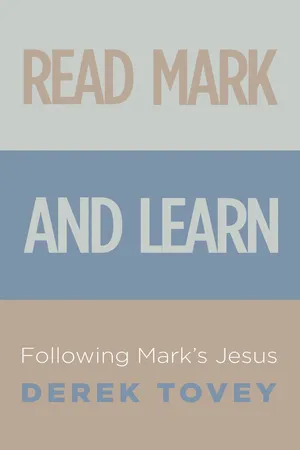
Mark's Gospel ends in an open-ended manner that puzzles many readers. This is part of the evangelist's strategy, so this book maintains; it raises questions about who Jesus is and what it means to follow Jesus. The Gospel writer addresses these two themes as he develops his story of Jesus. Readers are drawn in to consider these themes for themselves. Although there is an open end to the story of the disciples' discipleship, there is an ending to their story embedded in the narrative. Read Mark and Learn aims to help readers engage with this Gospel's intriguing story and to learn from it.
Information
1
Making Sense
of Mark’s Ending
“This is the way the world ends / Not with a bang but a whimper.”1 So wrote T. S. Eliot, concluding his poem, “The Hollow Men.” Mark’s Gospel begins with a “bang,” and ends, not with a whimper, but with silence. The first verse of the Gospel reads: “The beginning of the good news of Jesus Christ, the Son of God.”2 At the conclusion of the Gospel, the reader learns how three women go to the tomb where Jesus is buried early on the first day of the week. When they get there, they find the stone rolled away from the tomb and inside the tomb a young man who tells them that Jesus’ body is not there because he has been raised. The women are to go to the disciples and tell them that Jesus has gone ahead of them to Galilee; they will see the risen Jesus there. Then comes this statement (Mark 16:8): “So they [the women] fled from the tomb, for terror and amazement had seized them; and they said nothing to anyone, for they were afraid.”
There is good reason to think that this was the original ending of the Gospel. But, if so, it has left generations of readers feeling puzzled or dissatisfied. Why should the Gospel have concluded on this note of silence and fear? Should it end here? Can it really have ended here? These last two questions will be addressed first, as it will be seen that many readers and scholars of the Gospel have concluded that it did not end at 16:8, and certainly should not. If you look at your Bible, you will see that, in fact, the Gospel does not end at verse 8. There are a further twelve verses, in which Jesus appears to Mary Magdalene, and two other disciples, and finally the eleven, whom he upbraids for not believing the reports of his resurrection. Then Jesus ascends to heaven, while the disciples go out and proclaim “the good news everywhere, while the Lord worked with them and confirmed the message by the signs that accompanied it” (16:20).
The problem is that it would seem that these verses were added to the Gospel later. They are not part of the Gospel as originally written. You may find that your Bible has a heading such as “The Longer Ending of Mark” above verses 9 to 20. You will probably find another heading reading, “The Shorter Ending of Mark,” with some such text as: “And all that had been commanded them they told briefly to those around Peter. And afterward Jesus himself sent out through them, from east to west, the sacred and imperishable proclamation of eternal salvation.”
The evidence of the ancient manuscripts of Mark’s Gospel is that Mark 16:9–20 are missing from two of the oldest Greek manuscripts (called Codex Sinaiticus and Codex Vaticanus), and from numerous other manuscripts. Moreover a number of early church fathers (such as Clement of Alexandria and Origen) do not appear to be aware of the existence of these verses, and others such as Eusebius and Jerome indicate that the verses are not in copies of Mark known to them.3 Other manuscripts that include them also include the shorter ending; and yet others include the verses with notes and marks in the margins of the manuscripts which indicate that the copyist is aware that these verses are not original to the Gospel. One old manuscript has only the shorter ending of the Gospel.
Hence, the manuscript evidence is mixed but suggests to scholars that the “Longer Ending” and the “Shorter Ending” have been added to the Gospel later. They stand as testimony to the fact that early readers also found that the conclusion of the Gospel at 16:8 was unsatisfactory. There is also a grammatical reason for considering that 16:8 should not be the conclusion of the Gospel. In the Greek the verse concludes with the conjunction, gar, translated into English as “for.” While it is possible to conclude a sentence or a paragraph with the word gar, for a long time the argument went that a whole book could not end in this manner. This presupposes that there must have been something to follow the gar. We may get a sense of this expectation if we translate the last clause not as “for they were afraid,” but “they were afraid for . . .”
A number of scholars have brought forward evidence and arguments to show that it was indeed possible to end a lengthy piece of writing, or a book, with a final gar. The objections of an earlier generation of scholars to such an ending have, therefore, been somewhat set aside, though the issue has not been finally settled. Nevertheless, this grammatical issue, together with the strange, open-ended conclusion that 16:8 brings to the Gospel, has led many scholars to believe that the ending is unfinished, or perhaps lost.
How can this have happened? It has been suggested that the author of the Gospel was unable to finish because he fell ill, or died, or was arrested. Alternatively, some have suggested that the end was deliberately cut or torn away. A more plausible suggestion is that the ending of the Gospel has been accidentally lost. This is especially possible if the Gospel first appeared in codex form as this is more like our modern book than the papyrus scroll: in this case, it is conceivable that the final page (or pages) became detached and lost.4
The difficulty with accepting that the ending was lost is that the loss must have happened early, that is, before other copies that retained the ending as it had been, were made. No manuscripts containing the supposed lost ending have ever been found. Both the “Longer” and the “Shorter” endings found in the manuscripts, or versions of the Bible, strike readers and scholars as attempts to patch up the ending that has supposedly been lost; or, of course, simply to supply another ending.
There is a further consideration. It is difficult to continue smoothly beyond the end of 16:8. The little phrase “they said nothing to anyone” provides a “road block” that is difficult to get around. One either has to ignore it, or alter it in some way, in order to proceed. Scholars generally accept that both the Gospels of Matthew and Luke depend upon Mark as one of their sources. It is interesting to see how they each deal with the problem. Both ignore the statement “they said nothing to anyone,” but Matthew retains the idea of fear: “So they left the tomb quickly with fear and great joy, and ran to tell his disciples” (Matt 28:8). Luke, changing the messenger who delivers the news of the resurrection to “two men in dazzling clothes,” moves directly from their words (also changed from Mark’s version) to the response of the women, which is to remember Jesus’ prophecy of his resurrection (see, e.g., Luke 9:22), and go from the tomb to tell “all this to the eleven and all the rest” (Luke 24:8–9).
These, and other, considerations have caused many readers, certainly an increasing number of scholars in recent years, to conclude that the writer of Mark’s Gospel intended to end his account of “the good news” at chapter 16, verse 8. This is the position I adopt in this book. I invite you to read this book, and the Gospel with that assumption in mind. The writer deliberately and intentionally ended this Gospel with an emphasis on the fear and the silence of the women. Now, in the end, you may make up your own mind about whether or not the Gospel was originally intended to end in this fashion. I cannot entirely rule out the possibility that something has happened to leave the Gospel in this state. But, as I hope to show, I think that fruitful readings of the Gospel may result when one accepts that the writer ended the story at Mark 16:8.
Reasons for Ending the Gospel at 16:8
Once one accepts that the most likely original ending of Mark’s Gospel is the statement that the women run from the tomb, in fear and amazement, and say nothing to anyone because they are afraid, one is faced with an interesting and complex question: “Why did the writer choose to end the story like this?” The answers to this have been many and various. I am going to outline a number of possible answers here. Some may be mutually exclusive; but in other cases, it may be possible to hold together a number of answers, or better, reasons for the ending. Many contemporary readers of the Gospel are finding that it is possible to have multiple readings of the story. It is not necessarily a matter of settling upon one “right” reading, but of asking how does this reading help make sense of this story? Perhaps just as important are the questions: how does this reading help me make sense of this story and what impact might this reading have upon the way in which I respond to the story?
At the outset, it is worth being clear about what is and what is not missing from Mark’s ending. The news of Jesus’ resurrection is most definitely present in the words of the young man in the tomb: “Do not be alarmed: you are looking for Jesus of Nazareth, who was crucified. He has been raised; he is not here” (16:6). What is not recounted is an account of an appearance by Jesus to anyone: either to the women or to anyone else. But an appearance is promised: “But go, tell his disciples and Peter that he is going ahead of you to Galilee: there you will see him just as he told you” (16:7). Mark 16:8 leaves the reader with the impression that the message did not get to the disciples. Thus the reader is left with the question: “If the women did not tell the disciples of Jesus’ resurrection, who did?”
Also, it is as well to recall that by the time Mark’s Gospel was read, or heard (and we must return to this thought later), the news of Jesus’ resurrection, including stories of the appearance of the risen Jesus, had been preached and taught around the Mediterranean world for thirty to forty years. Assuming, as is most likely, that the original audience for Mark’s Gospel would have been Chris...
Table of contents
- Title Page
- Preface
- Acknowledgments
- Chapter 1: Making Sense of Mark’s Ending
- Chapter 2: Who Is Jesus?
- Chapter 3: Following Jesus on the Way
- Chapter 4: Mark 13
- Epilogue: Reading Mark’s Gospel
- Some Suggested Reading on Mark's Gospel
- Bibliography
Trusted by 375,005 students
Access to over 1.5 million titles for a fair monthly price.
Study more efficiently using our study tools.
Frequently asked questions
Yes, you can cancel anytime from the Subscription tab in your account settings on the Perlego website. Your subscription will stay active until the end of your current billing period. Learn how to cancel your subscription
No, books cannot be downloaded as external files, such as PDFs, for use outside of Perlego. However, you can download books within the Perlego app for offline reading on mobile or tablet. Learn how to download books offline
Perlego offers two plans: Essential and Complete
- Essential is ideal for learners and professionals who enjoy exploring a wide range of subjects. Access the Essential Library with 800,000+ trusted titles and best-sellers across business, personal growth, and the humanities. Includes unlimited reading time and Standard Read Aloud voice.
- Complete: Perfect for advanced learners and researchers needing full, unrestricted access. Unlock 1.5M+ books across hundreds of subjects, including academic and specialized titles. The Complete Plan also includes advanced features like Premium Read Aloud and Research Assistant.
We are an online textbook subscription service, where you can get access to an entire online library for less than the price of a single book per month. With over 1.5 million books across 990+ topics, we’ve got you covered! Learn about our mission
Look out for the read-aloud symbol on your next book to see if you can listen to it. The read-aloud tool reads text aloud for you, highlighting the text as it is being read. You can pause it, speed it up and slow it down. Learn more about Read Aloud
Yes! You can use the Perlego app on both iOS and Android devices to read anytime, anywhere — even offline. Perfect for commutes or when you’re on the go.
Please note we cannot support devices running on iOS 13 and Android 7 or earlier. Learn more about using the app
Please note we cannot support devices running on iOS 13 and Android 7 or earlier. Learn more about using the app
Yes, you can access Read Mark and Learn by Derek Tovey in PDF and/or ePUB format, as well as other popular books in Theology & Religion & Biblical Criticism & Interpretation. We have over 1.5 million books available in our catalogue for you to explore.