eBook - ePub
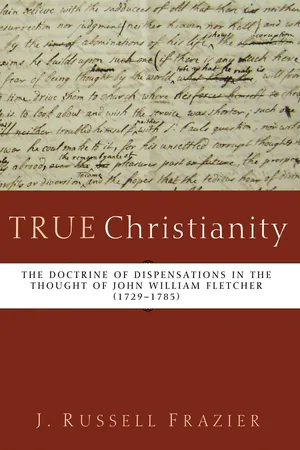
True Christianity
The Doctrine of Dispensations in the Thought of John William Fletcher (1729-1785)
- 320 pages
- English
- ePUB (mobile friendly)
- Available on iOS & Android
eBook - ePub
True Christianity
The Doctrine of Dispensations in the Thought of John William Fletcher (1729-1785)
About this book
John William Fletcher (1729-1785) was a seminal theologian during the early methodist movement and the Church of England in the eighteenth century. Best known for the Checks to Antinomianism, he worked out a theology of history to defend the church against the encroachment of antinomianism as a polemic against hyper-Calvinism, whose system of divine fiat and finished salvation, Fletcher believed, did not take seriously enough either the activity of God in salvation history or an individual believer's personal progress in salvation.
Fletcher made the doctrine of accommodation a unifying principle of his theological system and further developed the doctrine of divine accommodation into a theology of ministry. As God accommodated divine revelation to the frailties of human beings, ministers of the gospel must accommodate the gospel to their hearers in order to gain a hearing for the gospel without losing the goal of true Christianity. This book contains insights for pastors, missionaries, and Christian thinkers on true Christianity from Fletcher, who devoted himself, according to Wesley, to being "an altogether Christian."
Information
Topic
Theology & ReligionSubtopic
Christian Church1
The Milieu of Fletcher’s Theology
While it is not the specific goal of this study to reconstruct the sources of the doctrine of dispensations in Fletcher’s thought (if such a task would even be possible), it will be helpful to outline the historical milieu of the era preceding his emergence as a theological thinker and writer, and to suggest certain constitutional elements of his thought. At one point, Fletcher does make an explicit reference to certain writers and theologians who serve as sources for his doctrine of dispensations;1 he, of course, assumes that the doctrine of dispensations is intrinsic within Scripture.
The majority of Fletcher’s biographers erroneously trace the formative influence upon Fletcher’s life and thought primarily to the Methodists.2 While Methodists certainly had a formative effect upon the young émigré from Switzerland, they were not the only source of influence upon his life and thought. As will become evident, Fletcher was nurtured within an environment that fostered personal piety3 and trained in an environment that was conversant with Enlightenment thought and with continental theology;4 it was the “experimental religion” and the “living faith” of Methodism melded with the via media theology of the Church of England that formed the mature Fletcher.
The Early Church Fathers
In order to understand Fletcher’s doctrine of dispensations, one must grasp a seminal truth about the nature of the Christian faith: Christianity is radically historical in its very essence. Central to the Christian faith is a belief in the historicity of the Christ event. Any teaching that seemed to undermine the historical nature of the faith was contested with utmost vigor. The history of the Christian thought reveals this struggle.
One of the first heresies that presented a challenge to the Christian faith was Gnosticism, which the early church fathers believed undermined the historical nature of the Christian faith. They defended vigorously the Christian faith against the Gnostic onslaught and upheld not only the essential oneness of God but the unity of Old and New Testaments against the bifurcation of the two; they posited a covenant scheme that stressed the essential unity of salvation history and explained a Christian view on the relationship between Judaism and Christianity. When the issues of the relationship between Judaism and Christianity were no longer in the forefront, the language of covenant theology became less predominant.5 Catholicism made no direct, significant contributions to the covenant idea in the ensuing years; however, when the rise of Protestantism “brought the question of the distinctive nature of Christianity again into the foreground,”6 the covenant idea regained prominence.7
The Creeds
Fletcher’s writings reveal a familiarity with the Early Church Fathers. He quoted extensively from them in Equal Check to defend “that the doctrines of free grace and free will . . . are the very doctrines of the primitive Church, and of the Church of England.”8 In considering the objection that the doctrine of dispensation may be too complex for plain Christians, Fletcher underscored that the earliest and “simplest” creed, The Apostles Creed, and The Nicene Creed distinguish “three degrees of faith,” i.e., (1) faith in the Father; (2) faith in the Messiah; (3) and faith in the Holy Spirit.9 One of his contentions over the Athanasian Creed is that while the creed mentions the Christian dispensation, it neither addresses nor validates “the faith of the inferior dispensations” but only denounces any faith that is not catholic and damns all persons who do not hold to the faith of the higher dispensation. Clearly, Fletcher sees a logical connection between the economic Trinity and a three tiered progression in the lives of believers.
Irenaeus
Irenaeus of Lyons was “among the first Christian writers to seek the theological meaning of history.”10 In his response to the Gnostics, he expounded a fully developed view of history and employed the term “economy of salvation” by which he meant “‘the way in which God has ordered the salvation of humanity in history.’”11 Irenaeus emphasized the progression of the biblical story; recounting the history of God’s salvific activity, he began with creation and unfolded chronologically God’s redemptive purposes for humanity. His doctrine of the recapitulation of all humanity points to Jesus as the climax of history. The covenant idea plays a prominent role in Irenaeus’ theology. Everett Ferguson has suggested that “Irenaeus was a covenant theologian.”12 While Irenaeus’ covenant theology13 is implicit in DAP, it is explicit in AH.14 Adversus Haereses is Irenaeus’ response to the Gnostic, Marcionite heresy of his day and to the form of Gnosticism purported by Ptolemaeus, a disciple of Valentinus. Ireneaus employed the covenant idea to underscore the unity and continuity of the Old and New Testaments and divine revelation.
Irenaeus’ calculation of the number of covenants varies. “Sometimes he reckons four (Noah, [Abraham], Moses, Christ; more often only two.”15 When he makes referenc...
Table of contents
- Title Page
- Preface
- Acknowledgments
- Abbreviations
- Introduction
- 1. The Milieu of Fletcher’s Theology
- 2. God of Nature and of Grace: Theological Foundations for the Doctrine of the Dispensations
- 3. The Doctrine of Dispensations: An Overview
- 4. The Dispensation of the Father
- 5. The Dispensation of the Son
- 6. The Dispensation of the Spirit
- Conclusion
- Bibliography
Trusted by 375,005 students
Access to over 1.5 million titles for a fair monthly price.
Study more efficiently using our study tools.
Frequently asked questions
Yes, you can cancel anytime from the Subscription tab in your account settings on the Perlego website. Your subscription will stay active until the end of your current billing period. Learn how to cancel your subscription
No, books cannot be downloaded as external files, such as PDFs, for use outside of Perlego. However, you can download books within the Perlego app for offline reading on mobile or tablet. Learn how to download books offline
We are an online textbook subscription service, where you can get access to an entire online library for less than the price of a single book per month. With over 1.5 million books across 990+ topics, we’ve got you covered! Learn about our mission
Look out for the read-aloud symbol on your next book to see if you can listen to it. The read-aloud tool reads text aloud for you, highlighting the text as it is being read. You can pause it, speed it up and slow it down. Learn more about Read Aloud
Yes! You can use the Perlego app on both iOS and Android devices to read anytime, anywhere — even offline. Perfect for commutes or when you’re on the go.
Please note we cannot support devices running on iOS 13 and Android 7 or earlier. Learn more about using the app
Please note we cannot support devices running on iOS 13 and Android 7 or earlier. Learn more about using the app
Yes, you can access True Christianity by J. Russell Frazier in PDF and/or ePUB format, as well as other popular books in Theology & Religion & Christian Church. We have over 1.5 million books available in our catalogue for you to explore.