- 192 pages
- English
- ePUB (mobile friendly)
- Available on iOS & Android
eBook - ePub
About this book
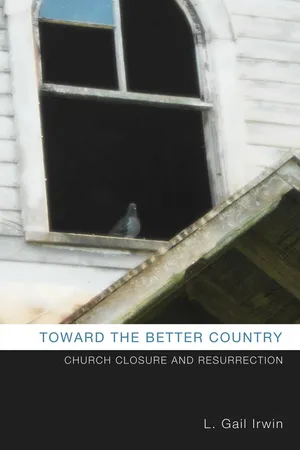
At a time when pews are not as full as they used to be, many churches are struggling to stay open. But no matter how creative or hard-working, some congregations are unable to revitalize their ministry. Is it time to talk about closing your church? Are there any other options for your future?
Toward the Better Country tells the stories of real congregations that have faced a significant downsizing, merger, or closure and found positive ways to move forward in ministry. While no local church is meant to live forever, congregations that have chosen to faithfully complete their ministry are finding hope in the new ventures born from passing on their spiritual and material legacies.
Based on over thirty interviews with church leaders from various denominations, this practical resource offers guidance to lay leaders, clergy, and regional leaders as they deal with the grief and discernment process of struggling churches. Designed for group study, each chapter includes reflection questions for discussion. A listing of additional resources is also included.
Information
Topic
Theology & ReligionSubtopic
Christian Church1
Introduction
From one person, and this one as good as dead, descendants were born, “as many as the stars of heaven and as the innumerable grains of sand by the seashore.”
All of these died in faith without having received the promises, but from a distance they saw and greeted them. They confessed that they were strangers and foreigners on the earth, for people who speak in this way make it clear that they are seeking a homeland. If they had been thinking of the land that they had left behind, they would have had opportunity to return. But as it is, they desire a better country, that is, a heavenly one. Therefore God is not ashamed to be called their God; indeed, he has prepared a city for them.
Hebrews 11: 12–16
My Church’s Story
I grew up in the heyday of the mainline church, in a growing suburb of Los Angeles, among nuclear families living in the burgeoning subdivisions that replaced the avocado orchards of an earlier time. My church was a product of the new era. Started in 1960, my parents were charter members. The United Church of Christ was a young denomination, and the church attracted mobile, upper-middle-class Christians moving to California, who populated its sprawling Sunday School wing and married in its romantic contemporary sanctuary. I remember busy classrooms that smelled of paste, crowded Christmas programs, and youth group meetings attended by dozens of students.
When I entered seminary in the mid 1980s, I presumed the church I was devoting my life to would be similar to the one I grew up in. But by the time I was ordained a few years later, I felt the culture shifting in ways I could not predict. I moved to the Midwest and accepted a call to a small-town congregation where I did everything I was taught to do: taught confirmation class to teenagers, married young couples, and buried the dead. The church didn’t grow, but it held its own as the elderly passed away and new families moved in. Reading the news and feeling the pulse of culture, I had the sense that change was on the horizon, but in that small town, the cyclone of history didn’t touch down very often. I immersed myself in the daily routines of ministry, and I loved it.
About a decade later, at the turn of a new century, I asked God for a new challenge. God obliged and sent me to a small, urban church that was on the brink of collapse. Started in 1960, like my home church, its founders had high hopes for it to grow into a large, suburban “program church.” Based on the history of American churches up to that time, this wasn’t a far-fetched dream. But for many reasons, that dream did not take hold. The suburban housing developments that sprang up in the area put this church off the high-traffic roadways. The pastors chosen were perhaps not equipped with the skills needed to grow the church after its initial burst of energy. The congregation had no partners in its denominational family to offer support; instead, it was seen by neighbor churches as competition.
In the early 1980s, when the church had reached its peak of about 175 members, they called in a consultant who advised them to leave their location and purchase land for a building more visible from a major highway. Instead, they built an addition, including a larger sanctuary and office space.
With the new addition built but not yet paid for, the church began to spiral into decline. A previous pastor was accused of sexual misconduct. Another was blamed for poor handling of the accusation. In the mounting tension, members jumped ship, leaving the small church saddled with betrayal and debt.
When I arrived at this church as their pastor, they were depressed and listless. Their membership had plummeted, and there were about forty worshipers each week, barely enough to pay my half-time salary, manage the building, and provide basic programming. But when the option of closing surfaced in conversation, it was not seriously considered. That would amount to giving up.
Despite their hard times, the church had a number of unusual assets. The leadership included several young retirees, local artists, and musicians who were passionate about the ministry. The congregation had effectively reached out to gay and lesbian Christians in the community and was known informally as a welcoming place for all. It was embedded in a neighborhood that was now more urban than suburban, a community experiencing ethnic and demographic change.
I spent several years rebuilding what I imagined was a functional faith community. Position descriptions were clarified for leaders. We paid off the mortgage. The Sunday School was revived and strengthened. I attended revitalization conferences held by my denomination. Spiritual formation became a new focus for us. A few new members joined. We shared our building with a Hmong congregation, a food cooperative, a drumming group, and an AA meeting. We “came out of the closet” as a church welcoming of gay and lesbian Christians. Although progress was slow, it seemed to be steady.
Then, about seven years into my tenure, worship attendance began to drop. For a struggling church like mine, such a sign was like the slowing of a heartbeat. Still, I was not willing to give up. Finally, I asked for a sabbatical. I wanted to explore what it might mean to do church in new ways. I went away for three months, studied the emergent church movement, and came back full of ideas.
When I returned, it was September, 2008, the month that insurance giant AIG collapsed and the stock market came down with it. Almost immediately, I could see the church was sick. It was like returning home to find a familiar parent aging in unfamiliar ways. My little congregation was showing all the signs of impending death. They turned inward and communicated in hushed tones. Committees began to function outside their normal boundaries. Programs were planned, but no one would show up. When I tried to get people to talk about what they were experiencing, they were silent.
Less than a year after my return from sabbatical, I was asked to resign. I had been with them eleven years. I had failed to help them revitalize, and now I was leaving without helping them close.
Throughout my tenure in that congregation, I sought professional and pastoral advice on how to love and pastor them through decline. Instead, I received a lot of advice about revitalization and church growth. But this was a congregation that had lost its capacity to grow. I knew I was “beating a dead horse.” What no one helped me with was how to lay the horse peacefully to rest.
This book is the outcome of my experience with that congregation, and the compilation of dozens of interviews I have conducted since then with lay people, clergy, and denominational leaders who have experienced the decline and death of churches. I have found God’s presence in the telling and hearing of stories like these, and I hope you will too. My goal is to help you reflect on what your church and denomination are experiencing in the day-to-day process of leading declining congregations. My intention is not just to help churches close with dignity, but to help them be resurrected as part of the universal church, in new forms that address people’s continuing spiritual longings, our hunger for justice and peace, and our culture’s need for places of social engagement.
Your Church’s Story
If you have opened this book, you probably have already observed that the pews at your church are not as full as they used to be on Sunday morning. In fact, I’m guessing that you have already spent significant energy on keeping your church open. You have spearheaded stewardship programs, walked the neighborhood with flyers, launched fundraisers and capital campaigns, or streamlined your church’s organizational structure. You are one of the first to arrive at a church function, and one of the last left folding up the chairs. Sometimes, you are the only one who shows up.
You have gone to many conferences and workshops, and you have the tote bags and binders to prove it. You came home with lots of new ideas, but somehow they are all a blur now. You have sat through denominational meetings listening to other church leaders talk about their meaningful mission projects, youth outings, and building additions. Sometimes you have wished you could disappear under the table when it came your turn to tell about something exciting your church is doing. On your keychain, you carry keys to the church’s front door, the Sunday School supply closet, and the tool shed, but there is one door you haven’t been able to unlock: the one that leads to your church’s survival.
Many committed Christians will do whatever it takes to keep their churches open when faced with a decline in membership, financial resources, or spiritual energy. We do these things because we love our churches and are wired as Christians to maintain them for our beloved elderly, ourselves, and our children. But history has shown that no local church is meant to live forever in its present form. Like people, churches are born, live and breathe, fulfill their missions, and pass away. But because the church is God’s project, your declining church may also be the seedbed of some new ministry venture God is dreaming of.
If you or your congregation needs to have a conversation about significant decline and the possible options available to you in the future, including downsizing for sustainability, merger, partnership with another organization, or closure, this book is a tool to assist in that dialog. You have come to the right place.
Our Church’s Story
The fact that you are reading this book is an indication that you are facing the reality of your church’s present and future health in a positive way. More and more, church leaders are looking seriously at the financial and emotional cost of maintaining declining structures and seeking creative solutions.
But there are some congregations that refuse to take action and keep relying on old remedies for a new condition. Seeing their numbers decline, they advertise more, or bring in bigger balloons for Rally Day to attract young families. Churches like my former congregation have even built additions and hoped that “if we build it, they will come.” But our former assumptions about what once made a church successful do not necessarily apply anymore.
The twentieth-century institutional church, with its emphasis on membership loyalty and continuity across generations of families, is quickly becoming extinct in a culture of high mobility and cautious commitment. Many Christians sense that the church is entering a time of re-evaluation and rebirth: we are being called back to a more “missional”1 model, an organization focused not on its own institutional life, but on its unique mission to serve others in the manner of Christ. The mission may be enacted with or without buildings, paid pastors, or the traditional a...
Table of contents
- Title Page
- Foreword - Reverend David C. Schoen
- Acknowledgments
- Chapter 1: Introduction
- Chapter 2: The Rise and Fall of Sacred Places
- Chapter 3: Expressions of Grief in the Faith Community
- Chapter 4: Discerning the Failure to Thrive: Lay Leaders
- Chapter 5: Discerning the Failure to Thrive: Pastors
- Chapter 6: Discerning the Failure to Thrive: Regional Pastors
- Chapter 7: Multiple Paths to the Future
- Chapter 8: A Tale of Two Closures
- Chapter 9: Laying the Foundation for Future Ministry
- Chapter 10: Seven Ways to Say Good-Bye
- Chapter 11: New Wine for New Wineskins
- Appendix A
- Appendix B
- Appendix C
- Additional Resources
- Bibliography
Trusted by 375,005 students
Access to over 1.5 million titles for a fair monthly price.
Study more efficiently using our study tools.
Frequently asked questions
Yes, you can cancel anytime from the Subscription tab in your account settings on the Perlego website. Your subscription will stay active until the end of your current billing period. Learn how to cancel your subscription
No, books cannot be downloaded as external files, such as PDFs, for use outside of Perlego. However, you can download books within the Perlego app for offline reading on mobile or tablet. Learn how to download books offline
Perlego offers two plans: Essential and Complete
- Essential is ideal for learners and professionals who enjoy exploring a wide range of subjects. Access the Essential Library with 800,000+ trusted titles and best-sellers across business, personal growth, and the humanities. Includes unlimited reading time and Standard Read Aloud voice.
- Complete: Perfect for advanced learners and researchers needing full, unrestricted access. Unlock 1.5M+ books across hundreds of subjects, including academic and specialized titles. The Complete Plan also includes advanced features like Premium Read Aloud and Research Assistant.
We are an online textbook subscription service, where you can get access to an entire online library for less than the price of a single book per month. With over 1.5 million books across 990+ topics, we’ve got you covered! Learn about our mission
Look out for the read-aloud symbol on your next book to see if you can listen to it. The read-aloud tool reads text aloud for you, highlighting the text as it is being read. You can pause it, speed it up and slow it down. Learn more about Read Aloud
Yes! You can use the Perlego app on both iOS and Android devices to read anytime, anywhere — even offline. Perfect for commutes or when you’re on the go.
Please note we cannot support devices running on iOS 13 and Android 7 or earlier. Learn more about using the app
Please note we cannot support devices running on iOS 13 and Android 7 or earlier. Learn more about using the app
Yes, you can access Toward the Better Country by L. Gail Irwin in PDF and/or ePUB format, as well as other popular books in Theology & Religion & Christian Church. We have over 1.5 million books available in our catalogue for you to explore.