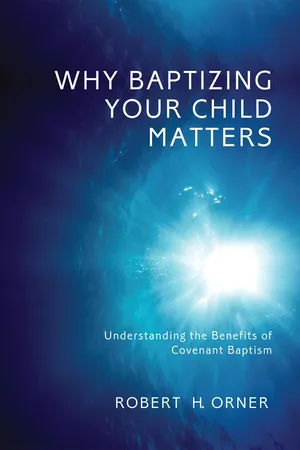
This book is written for young families. It avoids the baptism debate while graciously presenting the story of God's faithful provision, protection, and promise of deliverance for His people given through the sign of the covenant. Beginning with Adam and continuing through Abraham--where the covenant is ratified and developed in the forming of the nation of Israel--it traces through the Scripture 1) God's common grace for all people, 2) His covenant grace for believers and their children received through the sign of the covenant, and 3) His saving grace applied through faith. The reader is shown how the same levels of grace are given in a deeper and fuller way upon the finished work of Jesus Christ. The themes of provision, protection, and deliverance are applied to our present day. The book concludes by taking the reader through five questions commonly asked of parents and congregations during the baptism ceremony.
- 62 pages
- English
- ePUB (mobile friendly)
- Available on iOS & Android
eBook - ePub
About this book
Information
Topic
Teología y religiónSubtopic
Religión1
To Be Known
I recently learned that in the days of the Civil War (1861–1865), as some soldiers prepared for battle, they pinned slips of papers with their name and home address to the back of their coats. Others stenciled their identification onto their knapsacks, or scratched it in the soft, lead backing of the Army belt buckle. The battles were gruesome, and the odds of dying extremely high. Most of the fallen were simply buried where they fell. Because record keeping was so poor and “dog tags” were not officially used until 1913, there was no way to identify the fallen soldiers, so they were placed in the category of “unknown.”
At the conclusion of the Civil War, the remains of 300,000 Union veterans buried in the South were located, exhumed and then reinterred in a national cemetery. Even still, 54 percent of these fallen soldiers are classified as “unknown.” When we consider the fallen soldiers from both the Union and the Confederacy the percentages increase. For example, at Vicksburg National Cemetery, 75 percent of the Civil War dead are listed as unidentified, while at Salisbury National Cemetery 99 percent of the 12,126 soldiers interred are listed as “unknown.”
It is disheartening to consider the number of lives that have been sacrificed in war only to be left in a category called “unknown,” when in fact each of these men and women were human beings who were at one point in their life not only known but loved.
As a parent, the thought of sending my son off to war and almost certain death is disparaging in itself. But to consider the possibility of him perishing in that conflict only to have his unidentified body dumped in a mass grave is unthinkable. Over a decade ago my wife and I lost our second son Noah Zachary in stillbirth, and though losing him has left a lasting mark on our lives, knowing his name and on occasion visiting his grave on a hilltop in east Tennessee brings comfort.
All that said, as unfortunate as a lack of identity or being “unknown” in death is, to be “unknown” in life is tragic. This is where the hope of the gospel brings immense value. If you were to stand back and get the “big picture” of Scripture from beginning to end, it would be a portrayal of God gathering for Himself a people, the church, through the work of His Son Jesus Christ. It is a majestic portrait of God taking this people from death to life and adopting them into His family as dearly loved children, brothers and sisters in Christ. In fact, He has done far more than hang a dog tag around our necks; He has written His name on us! With that name we have been graciously given all the rights and privileges of full sons and daughters.
Our story begins when God created man and woman in His likeness and in perfect relationship. The Garden of Eden was a place of complete provision and protection; however, Adam and Eve rejected this relationship and chose a path of their own. As a result they were expelled from the paradise of Eden. Yet though their sin resulted in a fallen world, God gave hope for a renewed Garden, deliverance from the penalty of sin and a renewed relationship through a subtle promise of His Son. This promise found in Genesis 3:15 is what in theological circles is called the proto—evangelium, or the first announcement of the Messiah, when Adam and Eve where told that one day Christ would come and with his heel crush the head of the deceiving serpent.
The promise is that at one point in history, another “Adam” would come to earth. However, this Adam, though tempted by the same serpent, would not fall, instead going on to live a perfectly righteous life! This second Adam was Jesus, and His righteous life has been given to those who receive it by faith. Though we have sinned, do sin and will continue to sin, His righteous robe covers all of our defilement so we can freely have fellowship with a holy God, who has become our “daddy.”
Because our endemic sin problem requires a punishment, the second Adam—Jesus Christ—went on and took our punishment. He bore the wrath of God, the hell that each one of us deserves. His resurrection from the dead is a promise that though death may have a sting, we have nothing to fear or dread!
This is a promise of forgiveness of sins, restored relationship, and that one day a new and better Eden is coming! Yet for Adam and Eve that was still a very long way off, and day by day they now had to live in a world of hard work and broken relationships. Life after the Garden was tragic, as their first–born son Cain brutally murdered his younger brother Abel. As the population of the earth grew, so did the terminal effect of sin. In fact by Genesis 6 it was so bad that we read, “And the Lord regretted that he had made man on the earth, and it grieved him to his heart. So the Lord said, ‘I will blot out man whom I have created from the face of the land, man and animals and creeping things and birds of the heavens, for I am sorry that I have made them’” (vv. 6–7).
Nevertheless, as bad as it had become, in the midst of the chaos we see a secondary theme of God’s gracious provision, protection and deliverance of His children. Verse 8 states, “But Noah found favor in the eyes of the Lord.” Because God showed his favor to Noah, this favor was passed on to his family. As a result, as the rest of the world drowned beneath the waters of the Flood, Noah and his family were provided salvation in the ark that God had commanded Noah to build. As the author of Hebrews reflected back on this account, he wrote, “By faith Noah, being warned by God about things not yet seen, in reverence prepared an ark for the salvation of his household, by which he condemned the world, and became an heir of the righteousness which is according to faith” (v. 7, emphasis mine).
In this passage we see that because of Noah’s faith, his household received the blessing of protection from God and were saved from death in the flood. Yet only Noah is mentioned as “an heir of the righteousness which is according to faith.” In other words, the author of Hebrews declares that Noah’s salvation went beyond the Flood, as he was a benefactor of the coming righteousness of the second Adam, Christ.
The Flood did not end the sin endemic on the face of the earth. As the population of the earth grew, so did their rebellion against God. Human rebellion reaches a tipping point again at Babel, when God scatters the nations through giving multiple languages. After Babel we find that God narrows His focus down to one man out of whom He would build a vast people. In fact, this man would not only become the father of the nation of Israel, but the father of all who come to faith in Jesus Christ.
2
Why Abraham Matters
It is in Genesis 12 that we first come across this man then called Abram. At the start of this chapter God commands him to leave his country, his people and his father’s household. Notice how chapter 12 starts out:
“Now the Lord said to Abram, ‘Go from your country and your kindred and your father’s house to the land that I will show you. And I will make of you a great nation, and I will bless you and make your name great, so that you will be a blessing. I will bless those who bless you, and him who dishonors you I will curse, and in you all the families of the earth shall be blessed.’” (vv. 1–3)
Verse one is a call to leave all that is secure and simply follow. Note well that God does not tell Abram where he is going, other than it being a “land that I will show you.” Abram’s responsibility was simply to “go.” Verses 2 and 3 then lay out all that God is going to do. What we find there is amazing! Not only will a great nation come from him, and his name be known throughout time, but we also see the theme of God’s divine blessing: “I will bless you,” “you will be a blessing,” “I bless those who bless you” and “in you all the families of the earth shall be blessed.” Included with God’s calling of Abram was His promise of divine protection and provisi...
Table of contents
- Title Page
- Introduction
- Chapter 1: To Be Known
- Chapter 2: Why Abraham Matters
- Chapter 3: The Making of a Nation
- Chapter 4: The Coming of Christ
- Chapter 5: Same Seal, New Sign
- Chapter 6: The Baptism Service
- Conclusion
- Bibliography
Trusted by 375,005 students
Access to over 1.5 million titles for a fair monthly price.
Study more efficiently using our study tools.
Frequently asked questions
Yes, you can cancel anytime from the Subscription tab in your account settings on the Perlego website. Your subscription will stay active until the end of your current billing period. Learn how to cancel your subscription
No, books cannot be downloaded as external files, such as PDFs, for use outside of Perlego. However, you can download books within the Perlego app for offline reading on mobile or tablet. Learn how to download books offline
Perlego offers two plans: Essential and Complete
- Essential is ideal for learners and professionals who enjoy exploring a wide range of subjects. Access the Essential Library with 800,000+ trusted titles and best-sellers across business, personal growth, and the humanities. Includes unlimited reading time and Standard Read Aloud voice.
- Complete: Perfect for advanced learners and researchers needing full, unrestricted access. Unlock 1.5M+ books across hundreds of subjects, including academic and specialized titles. The Complete Plan also includes advanced features like Premium Read Aloud and Research Assistant.
We are an online textbook subscription service, where you can get access to an entire online library for less than the price of a single book per month. With over 1.5 million books across 990+ topics, we’ve got you covered! Learn about our mission
Look out for the read-aloud symbol on your next book to see if you can listen to it. The read-aloud tool reads text aloud for you, highlighting the text as it is being read. You can pause it, speed it up and slow it down. Learn more about Read Aloud
Yes! You can use the Perlego app on both iOS and Android devices to read anytime, anywhere — even offline. Perfect for commutes or when you’re on the go.
Please note we cannot support devices running on iOS 13 and Android 7 or earlier. Learn more about using the app
Please note we cannot support devices running on iOS 13 and Android 7 or earlier. Learn more about using the app
Yes, you can access Why Baptizing Your Child Matters by Orner in PDF and/or ePUB format, as well as other popular books in Teología y religión & Religión. We have over 1.5 million books available in our catalogue for you to explore.