- 298 pages
- English
- ePUB (mobile friendly)
- Available on iOS & Android
eBook - ePub
About this book
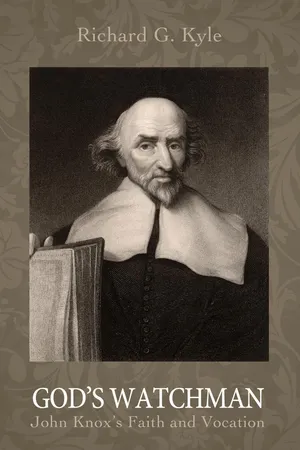
John Knox ranks among the great leaders of the Reformed tradition. In particular, he made significant contributions to this movement as it unfolded in Scotland. In doing so, Knox wore many hats--prophet, pastor, preacher, reformer, statesman, revolutionary, and more. God's Watchman: John Knox's Faith and Vocation attempts to connect these aspects of Knox's life. Being a man of action, these roles come to the forefront. Still, they rest on a particular faith shaped by his interpretation of Scripture, his view of God, and the events of sixteenth-century Europe. Section one of this study establishes these beliefs. Part two spells out his vocation--namely, functioning as a prophet, pastor, and preacher. All of this--his faith and vocation--culminated in his revolutionary political ideas, which are the subject of section three.
Information
Topic
Theology & ReligionSubtopic
Christian TheologyPart One
Historical and Theological Foundations
1
The Reformer in His Context
Revolutionary or servant of God? Thundering prophet or consummate politician? Nasty old man or spiritual pastor? Ardently loved or passionately despised? Will the real John Knox please stand up? John Knox indeed was a complex and contradictory figure. To be sure, he displayed several faces and wore many hats.
The Scottish reformer, therefore, has been the subject of many interpretations—some wildly different. Knox was a controversial figure in his day. And he continues to be so down to the present. He has been both loved and hated by his contemporaries and historians through the centuries. No sixteenth-century reformer has aroused such a range of emotions and opinions. Few people have taken a neutral stance in regard to John Knox.
These differing opinions largely concern several related questions: What was Knox’s role or vocation? How did he perform this role or vocation? What kind of person was John Knox? How important was he to the Scottish Reformation? Historians have expressed different views regarding Knox’s role or vocation—prophet, pastor, preacher, reformer, statesman, revolutionary, and more.1 Actually, most modern scholars have focused on two aspects of one general subject: Knox’s political ideas, especially his theory of resistance, and his attitudes toward female rulers.2
This study attempts to connect these aspects of Knox’s life. He functioned as a pastor, preacher, and a reformer of religion on a national level. And such reform often entailed advocating revolutionary ideas—especially the slaying of idolatrous or Catholic rulers. While these roles predominate, they rest on a particular religious faith shaped by his interpretation of Scripture, his view of God, and the events of sixteenth-century Europe. Section one establishes these beliefs. Part two spells out his vocation—namely functioning as a prophet, pastor, and preacher. All of this—his faith and vocation—culminated in his revolutionary political ideas, which are the subjects of section three.
In respect to evaluating Knox, W. Stanford Reid divided the reformer into three camps: his supporters, his opponents, and those in the middle.3 Knox’s advocates have seen him as the “right man for the right time in Scotland.” Some of these admirers see little fault in Knox. In their eyes, Knox has no warts and may have even been “St. John.”4
But the Scottish reformer has had his fierce opponents—both in his day and today. In his time, of course, the leading Catholics denounced him. So did the more secular Protestants who opposed his program. In our day, some biographers and historians have criticized Knox’s attitude toward Queen Mary, his outlook regarding female rulers, his advocacy of violence, or minimized his role in the Scottish Reformation.5 The film Mary Queen of Scots portrays Knox as a strange man with a long black beard who jumps out from behind a bush and berates the queen. “The image of John Knox as a cross between Ian Paisley and the Ayatollah Khomeini” seems to be “lodged in the popular mind,” says Stewart Lamont.6
Fortunately, some observers have taken the middle ground. They do not go overboard in either their praise or condemnation of Knox. Instead, they have sought a measure of objectivity. They regard Knox as a leading figure in the Scottish Reformation, but not the only force. There would have been a reformation without Knox. Still, he helped chart its course. Some observers in this camp have even become somewhat indifferent toward the Scottish reformer.7
Whether one views Knox positively or negatively, he certainly pursued his vocation with great vigor. His vocation was to preach the gospel, not to be a writer nor an ecclesiastical organizer or official. His main duty in life was, as he expressed it frequently, “to blow my master’s trumpet.” He saw himself as a preaching, rather than a writing, prophet proclaiming the gospel of God’s grace in Jesus Christ: “For considering myself rather called by God to instruct the ignorant, comfort the sorrowful, confirm the weak, and rebuke the proud by lively voice in these most corrupt days, then to compose books for the age to come. . . .”8
Knox expressed his vocation in three overlapping roles—preacher, pastor, and prophet. He served as the pastor or minister of congregations in Scotland, England, and the Continent. Unlike our time, the minister’s primary function was to preach God’s Word. Thus the roles of pastor and preacher must be regarded as inseparable. As a minister, however, Knox did more than preach. He pastored or shepherded the flock, instructing and comforting them in their trials and tribulations. Still, when Knox preached, he often thundered like an Old Testament prophet—rebuking the proud and corrupt by a lively voice. His vocation focused on individuals, congregations, and entire nations. When attempting to reform religion on the national level, Knox often adopted the role and rhetoric of an Old Testament prophet.
In working out his vocation as a prophet, Knox can legitimately be seen as a revolutionary, a political figure, and the reformer of religion on a national level. But he also functioned as a pastor. And in doing so, a softer, more caring John Knox emerged. He could, of course, roar like a...
Table of contents
- Title Page
- Preface
- Part One: Historical and Theological Foundations
- Part Two: Vocational Considerations
- Bibliography
Trusted by 375,005 students
Access to over 1.5 million titles for a fair monthly price.
Study more efficiently using our study tools.
Frequently asked questions
Yes, you can cancel anytime from the Subscription tab in your account settings on the Perlego website. Your subscription will stay active until the end of your current billing period. Learn how to cancel your subscription
No, books cannot be downloaded as external files, such as PDFs, for use outside of Perlego. However, you can download books within the Perlego app for offline reading on mobile or tablet. Learn how to download books offline
We are an online textbook subscription service, where you can get access to an entire online library for less than the price of a single book per month. With over 1.5 million books across 990+ topics, we’ve got you covered! Learn about our mission
Look out for the read-aloud symbol on your next book to see if you can listen to it. The read-aloud tool reads text aloud for you, highlighting the text as it is being read. You can pause it, speed it up and slow it down. Learn more about Read Aloud
Yes! You can use the Perlego app on both iOS and Android devices to read anytime, anywhere — even offline. Perfect for commutes or when you’re on the go.
Please note we cannot support devices running on iOS 13 and Android 7 or earlier. Learn more about using the app
Please note we cannot support devices running on iOS 13 and Android 7 or earlier. Learn more about using the app
Yes, you can access God’s Watchman by Richard G. Kyle in PDF and/or ePUB format, as well as other popular books in Theology & Religion & Christian Theology. We have over 1.5 million books available in our catalogue for you to explore.