- 198 pages
- English
- ePUB (mobile friendly)
- Available on iOS & Android
eBook - ePub
About this book
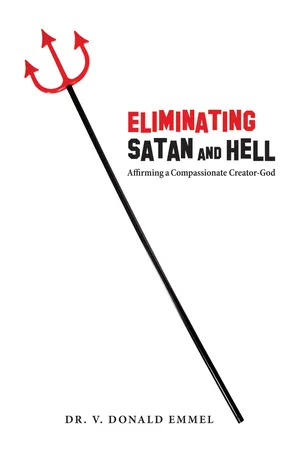
This book is written for millions of people who have been taught to fear the myths of Satan and Hell, and millions of others who reject the concepts and wish reassurances. When a Lutheran groom and his lovely Harvard-educated bride stood before me, would she eventually go to Hell because she is a Hindu and not a Christian? Is there really a Satan and a Hell, and is our Creator that cruel? It was then that Donald Emmel began his intensive study of the myths of Satan and Hell.
Emmel's research reveals that through misunderstandings and mistranslations we have ended up with a cranky, punishing Creator that is not in the Hebrew canon, nor the Gospels, nor the authentic letters of Paul. Emmel concludes that Jesus and Paul retained the Hebrew canon's concepts of hassatan as an adversary working with God, and sheol and gehenna as places of death.
In explaining our world today, we must not fly in the face of the vast scientific knowledge, which we utilize but which the ancient mythmakers did not. The ancient myths of Satan as a destructive god, and Hell as punishment for sinners, no longer have validity in the world we now embrace and should therefore be eliminated from our theologies.
Information
Topic
Theology & ReligionSubtopic
Christian Church1
The Basics of Myth and Scriptural Formation
Weeds in the Garden
There are weeds in all gardens that no longer belong and need pulling out according to Eric Liu and Nick Hanauer in their recent book, The Gardens of Democracy. This applies as well to ancient myths. We no longer live in the days of 2500 BCE, or even 500 BCE, when ancient myth-makers developed their stories, trying to explain their pre-scientific universe as best they could with extremely limited knowledge. They developed myths of gods, with evil beings fighting not only each other but also humans, and underground storehouses to punish the evil dead. For the ancients these explained their world. Their personal lives and societies were based upon these myths. They only knew that the sun, moon and stars crossed the skies immediately above them. They did not know our universe extends millions of light-years out into the expanse of the skies. They had no conception of millions of evolutionary years for humans to develop and survive on this planet to become what we now are. They had no biological science telling them about DNA and what can or cannot be inherited. They had stories of an ideal human beginning in a garden where there was no hard work, no pain in childbirth, no death.
The naturalist Edward O. Wilson reminds us in his research on species evolution that ancient societies needed stories to help them understand and explain the meaning of their lives. “The best, the only way our forebears could manage to explain existence itself was a creation myth. And every creation myth, without exception, affirmed the superiority of the tribe that invented it over all other tribes. That much assumed, every religious believer saw himself as a chosen person. Organized religions and their gods, although conceived in ignorance of most of the real world, were unfortunately set in stone in early history.”1
In this work we must challenge the myths in the garden that no longer work and replace them with the best knowledge we now possess. Our conclusions about hell and Satan must not conflict with the basic science that we know today.
The Nature of Myths
For the ancients their myths were not fairy tales or untruths, but their best constructs that gave meaning and power to what they were experiencing. It was their imaginative way of creating a worldview out of the unseen forces of systemic good and evil, of the realities of pain and happiness, of the prosperity and tragedy of their daily lives. Their mythic stories made stabs at understanding and defining the beginning of creation, the origin of evil, the nature of death, concepts of law and justice, of political order and the use of power.
It is important for this study to clarify that these gods were mythical entities with personalized names representing forces of good and evil. They were never physical entities or actual beings in the cosmos. We also need to recognize these ancient myths are not to be taken literally. The British scholar on religion Karen Armstrong warns us of this in her History of God.2 Therefore, my task in this work is to look at the historical situations out of which the myths of hell and Satan developed and to recognize them for what they were: namely myths. This may be unsettling for many Christians, especially for the biblical literalist. It would be insensitive and a mistake summarily to dismiss their concerns without giving the development and purpose of the ancient myths and supportive reasons for a change of understanding. Fortunately, Rob Bell, in his Love Wins, has opened the dialogue for Evangelicals.
As the ancients developed their legends, they envisioned a supernatural sphere where these mythic gods lived and interacted with humans on earth. We will bump into Marduk, Enlil, Satan, Belial, and Mastemah, each representing aspects of what I will call “systemic evil.” These myths were also developed to reflect and justify current political systems. A double purpose operated. First, a society that used vengeance, male domination, and absolute authority could justify their actions by constructing a mythical sphere of gods who used the same vengeance, male domination, and absolute authority. They could then lay the myth on their subjects claiming what is happening on the supernatural level of the gods should be happening on the earthly level. Thus legitimizing their rule. In the next chapter we will see this in one of the earliest myths, the Enuma Elish myth.
When Myths No Longer Work
It is also crucial to look at the nature of myths and how they are used. Kenelm Burridge, in New Heaven, New Earth, has completed a major study on myths and millennial developments, both historic and modern. He traces the steps through which mythic constructs that once gave meaning to a group are changed and new ones are developed.
First, there is what Burridge calls an awareness of being disenfranchised. By this Burridge means there is a sense of power coming from an understanding of life that gives a feeling of completeness or at-one-ness with the universe. When the existing myth no longer works and the oneness is shattered, an individual consciously or unconsciously feels disenfranchised and left out. This state of being becomes unbearable, and individuals and/or groups reach out to restore completeness in a way that is intelligible and has integrity. They begin a search into their only universe of knowledge and their past tradition to see what might still be relevant. In this exploration, old convictions are constructed into new myths.
The second phase is to test their new myths against the reality they are experiencing. They attempt to see if there is more economic security, more sense of self-worth; they search for some sense of power in control of their lives so they do not simply feel at the mercy of events. Burridge says much of this may be disorganized until a prophet emerges with a new concept which gives a better sense of reality and coherence to life. The prophet, however, must connect with the traditions of the past and reshape them so there is a relationship to a new security and integrity that would give a cohesive understanding of what is being experienced.
The third phase comes when individuals find others who are sharing the same questions and newly found convictions. They begin then to form like-minded communities around their new myths of explanation. We see in Burridge that myths are not static, nor to be locked in, since they represent a group’s thinking for a particular time in history. For that time and place, however, the particular myth was very important to the believers. It gave a framework into which the believer could stand with some assurance since others around them believed the same thing. When outdated, the new myths included changed efforts at understanding the forces of nature, of human activity, of measurements of right and wrong, and concepts of death and judgment.
The new myths or understandings then became definitions of reality, both politically and religiously. Wherever a myth is embodied or personalized into the personhood of a god it becomes difficult to challenge. As such, it retains a legitimacy and unquestioned status quo until new happenings or information force a change. It is my conviction that concepts of hell and Satan which may have worked for the past and may have been given a legitimacy of reality in certain religious circles, are no longer valid in the gardens of our contemporary world given what we now know of our universe, how we understand the human being, and our experience of systemic evil.
From Beliefs to Inerrancy
Because this work will be focusing largely upon Judeo-Christian stories and history we need to understand the formation of its literature. Coming out of the struggle for the early Christian community to define itself as opposed to other beliefs, there began to develop carefully defined concepts of what was true and authoritative. Unfortunately, this consigned all other beliefs as heresy to be condemned. Much of this condemnation centered around what authority would be given to Scriptures, which was the subject of great debate by the church fathers during the first Christian centuries as we shall see.
Eventually there developed doctrines that all biblical Scripture was authoritative in revealing the nature of God and the universe. These doctrines were hardened into an inerrancy in the European Middle Ages when the newly developing science conflicted with church doctrine. It was then that some theologians said the earth did not circle around the sun in an inerrant path as Copernicus had confirmed, but that the Scriptures themselves were inerrant in all things. Thus, Copernicus was wrong and must be condemned. This began concepts of biblical literalism, and the inerrancy of Scriptures, that are still alive today in many circles and teachings. It is a huge tree in our gardens that must be replaced with current biblical scholarship. It is my thesis that wherever we come out in this journey about hell, Satan and the nature of God, it must correlate to the world in which we now live, not the world of the ancients or the Middle Ages.
The Pentateuch Formation
At the very beginning of this journey we need to recognize what current biblical scholarship is telling us about how the Hebrew and Christian Scriptures were shaped and reshaped. Becoming clear on this now will be of great help when we later examine various biblical sources and their dates.
In the eighth century BCE, ancient Israelite legends began to be drawn together into written form. These earliest stories were not literal histories of documentable events. Rather, they were ways of interpreting the myths and legends of a particular people called Israel whose god was Yahweh. In the first five books of the Hebrew Bible, called the Pentateuch or Torah, major scholars for the last 150-some years have recognized differences in their narrative language. When these differences were sorted out they identified four different streams of writing.
The first stream is called “J” because “Yahweh” (Jehovah in the German) is the mythic term used for god’s name. This J stream was written sometime between 922 and 722 BCE. It contains ancient Hebrew myths of understanding their life at that period of history. In J we find the oldest Hebrew creatio...
Table of contents
- Title Page
- Preface
- Chapter 1: The Basics of Myth and Scriptural Formation
- Chapter 2: Life and Death in Ancient Myths
- Chapter 3: An Alternative Hebrew Community
- Chapter 4: Hebrew Myths of Systemic Evil
- Chapter 5: Hebrew Myths of Life, Death, and Sheol
- Chapter 6: Yahweh
- Chapter 7: Israel, a Monarchy or Servant?
- Chapter 8: Persian Myths and the Introduction of Satan
- Chapter 9: The Cradle for Apocalyptic Myths
- Chapter 10: Greek Myths of Tartarus and Hades
- Chapter 11: Search for a Different Understanding
- Chapter 12: Jewish Apocalyptic Myths
- Chapter 13: Daniel and the Oral Law
- Chapter 14: Jewish Sectarian Groupings
- Chapter 15: First-Century Political Conflict
- Chapter 16: Paul on Satan, Sin, Hell, and Related Concepts
- Chapter 17: Satan in the Gospels
- Chapter 18: Hell in the Gospels
- Chapter 19: The Nature of the Creator-God
- Chapter 20: An Unsettled Christendom
- Postscript
- Bibliography
Trusted by 375,005 students
Access to over 1.5 million titles for a fair monthly price.
Study more efficiently using our study tools.
Frequently asked questions
Yes, you can cancel anytime from the Subscription tab in your account settings on the Perlego website. Your subscription will stay active until the end of your current billing period. Learn how to cancel your subscription
No, books cannot be downloaded as external files, such as PDFs, for use outside of Perlego. However, you can download books within the Perlego app for offline reading on mobile or tablet. Learn how to download books offline
Perlego offers two plans: Essential and Complete
- Essential is ideal for learners and professionals who enjoy exploring a wide range of subjects. Access the Essential Library with 800,000+ trusted titles and best-sellers across business, personal growth, and the humanities. Includes unlimited reading time and Standard Read Aloud voice.
- Complete: Perfect for advanced learners and researchers needing full, unrestricted access. Unlock 1.5M+ books across hundreds of subjects, including academic and specialized titles. The Complete Plan also includes advanced features like Premium Read Aloud and Research Assistant.
We are an online textbook subscription service, where you can get access to an entire online library for less than the price of a single book per month. With over 1.5 million books across 990+ topics, we’ve got you covered! Learn about our mission
Look out for the read-aloud symbol on your next book to see if you can listen to it. The read-aloud tool reads text aloud for you, highlighting the text as it is being read. You can pause it, speed it up and slow it down. Learn more about Read Aloud
Yes! You can use the Perlego app on both iOS and Android devices to read anytime, anywhere — even offline. Perfect for commutes or when you’re on the go.
Please note we cannot support devices running on iOS 13 and Android 7 or earlier. Learn more about using the app
Please note we cannot support devices running on iOS 13 and Android 7 or earlier. Learn more about using the app
Yes, you can access Eliminating Satan and Hell by V. Donald Emmel in PDF and/or ePUB format, as well as other popular books in Theology & Religion & Christian Church. We have over 1.5 million books available in our catalogue for you to explore.