- 308 pages
- English
- ePUB (mobile friendly)
- Available on iOS & Android
eBook - ePub
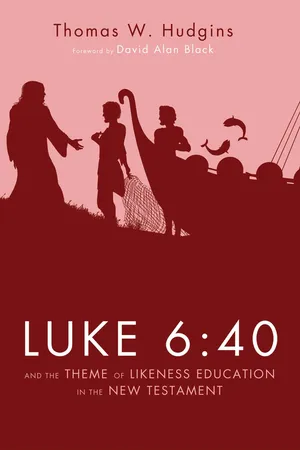
Luke 6:40 and the Theme of Likeness Education in the New Testament
About this book
What does Jesus mean when he says, "A disciple is not above his teacher, but each disciple, after being fully trained, will be like his teacher" (Luke 6:40)? This verse has been quoted, cited, and referenced in vast amounts of Christian education and discipleship literature. Nevertheless, the verse is nearly untouched in exegetical discussions with the exception of source-critical analyses. From this verse arises an undeveloped theme in the Gospel of Luke and the New Testament--the theme of likeness education. Using content analysis methodology, Luke 6:40--one of the keystone passages in Christian education literature--serves as the starting point for mining out the theme of likeness education in the New Testament. This study consists of three concentric areas of investigation: (1) Luke 6:40 and its immediate context, (2) Luke-Acts, and (3) the New Testament corpus.
Information
1
Introduction
Introduction
Studies concerning the Sermon on the Plain (SOP), Luke’s complement to Matthew’s Sermon on the Mount (SOM), are primarily entangled in source-critical discussions (i.e., which author used which source and for what reason). Because of the amount of attention given to this interpretive method, less attention has been given to other aspects of biblical interpretation in studies dealing with the SOP, such as lexical, syntactical, structural, and rhetorical analyses. One victim of exegetical neglect is Jesus’s “proverbial maxim”1 concerning the teacher-student relationship (Luke 6:40). It is one of the most important New Testament (NT) texts dealing with Christian education, second only to the Great Commission (Matt 28:19–20).
“An apprentice2 is not above his or her teacher; but each one, after having been fully trained, will be like his or her teacher” (Luke 6:40). This verse has been quoted, cited, and referenced in vast amounts of Christian education and discipleship literature.3 Nevertheless, the verse is nearly untouched in exegetical discussions with the exception of source-critical analyses. These discussions are primarily concerned with (1) where the saying originated, (2) whether Luke’s or Matthew’s form of the saying is original, and (3) how different forms of the saying (see Matt 10:24–25; John 13:16; 15:20) are used in their respective texts.4 Some have even suggested that this verse lacks cohesion with its context, leaving interpreters dumbfounded as to how it functions in the paragraph- and section-levels of the discourse.5
From this verse arises an undeveloped theme in the Gospel of Luke, the theme of likeness education. Jay Adams, commenting on this verse, writes:
Our teaching must be of the sort that the Lord commanded. And it calls for great care, because as He once said, “When he is fully trained, the disciple will be like his teacher” (Luke 6:40). Please note, Jesus did not merely say “think” like his teacher, but “be” like his teacher. Holistic teaching takes place whether we know it or not, whether we like or not. We cannot avoid it. That is why it is important to be sure that we know what is being taught by our lives, as well as our lips. Any dichotomy between the two is false and unbiblical.6
Whatever likeness education is, it involves more than mere cognition. Joe Aldrich, referring to the importance of Luke 6:40 in evangelism, echoes Adams’s comments: “Notice it doesn’t say ‘he will know what his teacher knows.’ He will be like his teacher—good or bad, beautiful or ugly.”7 The goal in discipleship is not to know what Jesus knows. Instead, as Lawrence O. Richards writes, the goal is “likeness to his person.”8 Transformation into this likeness requires audial and visual instruction in the things that make Jesus who he is—his life, attitude, values, emotion, commitment, etc.9 Other writers have referred to research in the area of mentoring/modeling, citing Luke 6:40 as one of the foundational texts. For example, Bill Donahue and Greg Bowman say that research in leadership has validated the words of Jesus:
[Studies] confirm that in about thirty-six months, the people you lead will very closely reflect who you are. A loving teacher will produce loving disciples. A joyful teacher typically has disciples who are filled with joy. The sobering aspect of this principle is that it works whether the values and practices the teacher models are good or bad. Therefore, it is critical that you model the right pattern of living for your leaders.10
These statements seem fair and accurate. Nevertheless, an in-depth analysis of the text in its context will ensure accurate application. For example, was Jesus using a general principle and applying it positively or negatively in Luke 6:40? Was it directed only for his disciples, or was he directing such statements at the crowds, or perhaps even the Pharisees? Did this saying have a revealing-concealing nature as Jesus’s parables did elsewhere?11 Or, is Jesus teaching sagaciously, either using a proverb creatio ex nihilo or using a maxim common in Greco-Roman/Judaic first-century Palestine?
An analysis of Luke 6:40 is only the place to begin. Like Matthew’s Gospel, Luke’s Gospel was designed for discipleship, particularly in the regions where Paul had preached and taught the gospel.12
Statement of the Problem
This study attempts to develop the theme of likeness education in the NT through lexical, syntactical, structural, rhetorical, and theological connections to Luke 6:40 and its immediate context. The aim is to answer the question “What is likeness education...
Table of contents
- Title Page
- Foreword
- Preface
- Acknowledgments
- Chapter 1: Introduction
- Chapter 2: Likeness Education in Luke 6:40 and Its Context
- Chapter 3: Likeness Education in Luke-Acts
- Chapter 4: Likeness Education in the New Testament
- Chapter 5: Conclusion
- Appendix 1: Outline of Acts
- Appendix 2: Jesus’s Prayers in John
- Bibliography
Trusted by 375,005 students
Access to over 1.5 million titles for a fair monthly price.
Study more efficiently using our study tools.
Frequently asked questions
Yes, you can cancel anytime from the Subscription tab in your account settings on the Perlego website. Your subscription will stay active until the end of your current billing period. Learn how to cancel your subscription
No, books cannot be downloaded as external files, such as PDFs, for use outside of Perlego. However, you can download books within the Perlego app for offline reading on mobile or tablet. Learn how to download books offline
Perlego offers two plans: Essential and Complete
- Essential is ideal for learners and professionals who enjoy exploring a wide range of subjects. Access the Essential Library with 800,000+ trusted titles and best-sellers across business, personal growth, and the humanities. Includes unlimited reading time and Standard Read Aloud voice.
- Complete: Perfect for advanced learners and researchers needing full, unrestricted access. Unlock 1.5M+ books across hundreds of subjects, including academic and specialized titles. The Complete Plan also includes advanced features like Premium Read Aloud and Research Assistant.
We are an online textbook subscription service, where you can get access to an entire online library for less than the price of a single book per month. With over 1.5 million books across 990+ topics, we’ve got you covered! Learn about our mission
Look out for the read-aloud symbol on your next book to see if you can listen to it. The read-aloud tool reads text aloud for you, highlighting the text as it is being read. You can pause it, speed it up and slow it down. Learn more about Read Aloud
Yes! You can use the Perlego app on both iOS and Android devices to read anytime, anywhere — even offline. Perfect for commutes or when you’re on the go.
Please note we cannot support devices running on iOS 13 and Android 7 or earlier. Learn more about using the app
Please note we cannot support devices running on iOS 13 and Android 7 or earlier. Learn more about using the app
Yes, you can access Luke 6:40 and the Theme of Likeness Education in the New Testament by Thomas W. Hudgins in PDF and/or ePUB format, as well as other popular books in Theology & Religion & Biblical Criticism & Interpretation. We have over 1.5 million books available in our catalogue for you to explore.