eBook - ePub
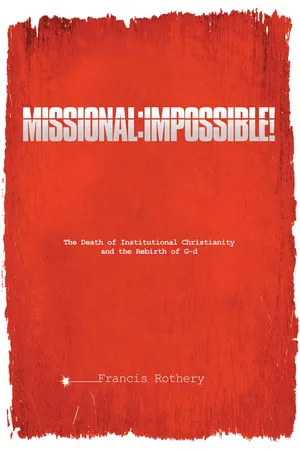
Missional: Impossible!
The Death of Institutional Christianity and the Rebirth of G-d
- 242 pages
- English
- ePUB (mobile friendly)
- Available on iOS & Android
eBook - ePub
Missional: Impossible!
The Death of Institutional Christianity and the Rebirth of G-d
About this book
Mainline Christianity in the West is dying. Addiction to hierarchical and bureaucratic power is killing it. A management-god and a mission-god have usurped the Way of Christ. In the midst of decline the missional movement is attempting to reboot the church. Its goal is to remake a New Christian West through mission, leadership, mapping, and planning. Yet it is trapped in the language and methods of modernity. Its final solution is a polarizing vision of cultural domination by one social group, the Christians. The Way of Life and Truth has been forgotten. Christ is not a conquering King, a written Word, or an absolute Idea, but a divine Human Being. Social wholeness can only be realized through a rediscovery of Conversation, Reconciliation, and Empowerment. These reflect Christ's practices of eternal dialogue and reciprocal giving in small communities. Through this mutual Way of Life people of all faiths (and none) can discover deep within themselves Our Un/Known G-d. A gentle voice is whispering in the heart of all humanity, "I am . . . the Way."
Information
Topic
Theology & ReligionSubtopic
Christian MinistryPart 1
Domination Christianity
a Management Misshaped Church
1
Management Is the Message
“Tillich knew, all human institutions, including the church,
are inherently demonic.”
are inherently demonic.”
—Chris Hedges1
“The medium is the message.”
—Marshall McLuhan2
Managing Decline in a Mission-shaped Church
The mainline Christian Churches of the West have lost something vital. Managing decline has become the focus of most Christian leaders in the United Kingdom and Europe. The mainline churches of the USA are beginning to experience similar problems. Perplexingly, decline persists year on year even after increasing emphasis and investment of time and energy in Christian mission. What follows is the national picture in the United Kingdom over the last thirty years. The Anglican church has lost nearly 40 percent of its membership, about 1 million people, and still falling marginally according to the 2012 statistics. It now has an attendance of 1.8 million out of a population of sixty-three million people. It has ceased to reflect the religious zeitgeist of the nation. The Catholic Church is the largest denomination at 4 million. Yet it has declined by 37 percent and is in crisis in terms of priesthood recruitment. The Methodist Church has declined by 50 percent, the United Reformed Movement by 46 percent and the Baptists by 21 percent.
2011 Census polls on UK religion paint the following picture. In a poll conducted by YouGov in March 2011 when asked the census question What is your religion? 61 percent of people in England and Wales ticked a religious box, while 39 percent ticked no religion. When the same sample was asked the follow-up question Are you religious? only 29 percent of the same people said Yes, while 65 percent said No, meaning over half of those the census would count as having a religion said they were not religious. Asked when they had last attended a place of worship for religious reasons, most people in England and Wales (63 percent) had not attended in the past year, 43 percent last attended over a year ago and 20 percent had never attended. Only 9 percent of people had attended a place of worship within the last week.
The findings of the census mean that approximately fifty-six million people do not attend Christian worship. Yet about thirty-two million still describe themselves as Christian. What this indicates is that even those who would identify themselves as Christian are not interested in mainline Christianity. Why?
The traditional answer is to blame secularization. Yet some observers think that the UK has entered into a period of post-secularism. This means that many people have their own spirituality but are still not attending religious institutions. One explanation may be that decline is connected with the secularization and bureaucratization of the churches. Lack of vitality in mainline Christianity may be due to an unhealthy preoccupation with hierarchical bureaucracy and management practices.
Ecclesiologist Tony Jones has noted that “the bureaucracy of mainline Christianity is holding back the church from what it can be.” The facts seem to confirm this. For, while churches that are run like corporations are declining, the less bureaucratized are growing. In the UK in the last thirty years the Russian Orthodox Church has grown by 60 percent and the Pentecostal Movement has grown by 177 percent.3
The common feature of these churches is that they are not centralized institutions. They are not run like religious businesses. Their faith is mediated through the spiritual and the experiential. They do not have an overreliance on prescriptive bureaucratic machinery or church canon law. Their leaders do not function like managers. Convincingly, the missiologist Alan Hirsch has identified “organic systems” to be an essential feature of the DNA of faith movements that are vital and growing: “in contrast with a centralized institution, missional movements are structured more like an interconnected organism than through hierarchical organization. Organic systems manifest (i) an ethos of a movement (as opposed to institution), (ii) the structure of a network, (iii) spread like viruses, and (iv) are reproducing and reproducible.”4
The Faith Of The Managers: Domination
“Bureaucratic administration means fundamentally domination through knowledge,” said the sociologist Max Weber. To what degree has the practice of bureaucracy and management dominated and misshaped the mission of the Church? Sarah Coakley in Has the Church of England lost its Reason? has identified what she terms “the secular bureaucratization of the episcopate.” Sarah writes of “the danger of the covert assimilation of worldly or bureaucratic notions of power and authority into the decisions of the Church about Episcopal standing and oversight . . . [and] . . . Along with the notable turn in priestly life in general to the secular bureaucratic models of leadership, efficiency and mission-efficacy has gone an almost unnoticed capitulation—as I see it—to the idolatry of busyness . . . Is our creeping ecclesial bureaucratization indeed the way forward for the Church in all its ministries?”5 Anglican clergyman and TV presenter Peter Owen-Jones has also described the effect of bureaucracy on his vocation by saying: “I feel more like a religious civil servant than God’s suffering servant.” He is not alone. When significant amounts of time and energy are given to the management of religious institutions a living faith becomes secondary. The faith of leaders becomes managerialized. In the process of bureaucratic erosion a key element of faith is lost; the ability to risk. A heaviness descends. Order is fetishized. Innovation becomes threatening. Balance is lost. The spiritual health of institutions becomes terminal.
Running a religious corporation requires a focus on the managerial and the bureaucratic. This is difficult to maintain except at the expense of honesty and collegiality in relationships. The maintenance of Christian institutions has usurped and gradually replaced the fragile relationships that create authentic community and real religion. David Whyte reminds us that “We only have to look at the most important word in the lexicon of the present workplace—manager—to understand its inherent weakness. Manager is derived from the old Italian and French words managgio, meaning the training, riding and handling of a horse . . . Sometime over the next fifty years or so, the word manager will disappear from our understanding of leadership and thankfully so.”6
A curious overlap has occurred in the last twenty-five years that has blurred management and mission practices. Stephen Pattison has highlighted mission language as part of a developing theology of management in the mainline churches. “The use of words with religious association in management like mission and vision, should be enough to alert us to the fact that management may have more than a passing resemblance to Christianity. When it is remembered that some of the roots of management theory and practice lie in ecclesiastical control practices in medieval Catholicism and nineteenth century entrepreneurial Protestantism in the USA, it should come as no surprise that management can credibly be seen in some ways as a religious activity embodying a certain kind of faith. This has led me to suggest elsewhere that management can be regarded as a Christian heresy and that it is therefore possible to analyse the faith of the managers.”7 Pattison points out that modern management theory borrows from the language and ideas found in the history of Catholic and Protestant mission. This is the dark underbelly of Christianity and its collusion with coercive and violent colonialism. Catholicism and Protestantism were promoted and maintained through the managerial and mission practices utilized by their priests and pastors.
Management is the Medium
Pattison continues, “in the case of mission this concept has the positive connotations of clarity of purpose, urgency, outward directedness and the need for change. However it has the more negative connotations evidenced in church history, such as unquestioning response to a command from above, dualism, seeing the world as a hostile place that needs changing and regarding those outside the organization as alien or demonic objects needing conversion or elimination. Christian mission has often been aggressive, violent, exploitative, and colonial—hence the utility of the concept of mission within the military.” In consequence, the message that is subtly communicated through Christian institutions has become management itself. Christianity has become a managed commodity with a mission to capture a market share in capitalist culture.
The danger of incorporating mission language into management theory is that, in practice, they become similar. In mainline Christian churches management has become the dominant method of operation. This similarity in language creates a situation where mainline churches can use management as a lever to co-opt and control more organic mission initiatives, such as the mission-shaped church. By definition management always seeks to control. In this way the mainline Christian churches continue to perpetuate a form of managerialized Christian social dominance. This is because church management and mission are essentially concerned with leadership and social dominance by one social group, i.e., Christians. Tragically, the Gospel of Reconciliation that Christ practiced has been usurped by a management and mission emphasis. Where do mainline churches look for power? In what have they really put their faith? Management practices and the machinery of bureaucracy are usurping the Christ of inclusive community—even in mission-shaped initiatives. The presbyterian saint A. W. Tozer puts this trend in perspective: “Some things are not negotiable . . . A winsome, magnetic saint is worth 500 promoters and gadg...
Table of contents
- Title Page
- Acknowledgments
- Introduction
- Overview
- PART 1: Domination Christianity
- PART 2: The Missional Illusion
- PART 3: Recovering Reconciliation
- PART 4: Our Un/Known G-d
- Glossary
- Bibliography
- About the Author
Trusted by 375,005 students
Access to over 1.5 million titles for a fair monthly price.
Study more efficiently using our study tools.
Frequently asked questions
Yes, you can cancel anytime from the Subscription tab in your account settings on the Perlego website. Your subscription will stay active until the end of your current billing period. Learn how to cancel your subscription
No, books cannot be downloaded as external files, such as PDFs, for use outside of Perlego. However, you can download books within the Perlego app for offline reading on mobile or tablet. Learn how to download books offline
Perlego offers two plans: Essential and Complete
- Essential is ideal for learners and professionals who enjoy exploring a wide range of subjects. Access the Essential Library with 800,000+ trusted titles and best-sellers across business, personal growth, and the humanities. Includes unlimited reading time and Standard Read Aloud voice.
- Complete: Perfect for advanced learners and researchers needing full, unrestricted access. Unlock 1.5M+ books across hundreds of subjects, including academic and specialized titles. The Complete Plan also includes advanced features like Premium Read Aloud and Research Assistant.
We are an online textbook subscription service, where you can get access to an entire online library for less than the price of a single book per month. With over 1.5 million books across 990+ topics, we’ve got you covered! Learn about our mission
Look out for the read-aloud symbol on your next book to see if you can listen to it. The read-aloud tool reads text aloud for you, highlighting the text as it is being read. You can pause it, speed it up and slow it down. Learn more about Read Aloud
Yes! You can use the Perlego app on both iOS and Android devices to read anytime, anywhere — even offline. Perfect for commutes or when you’re on the go.
Please note we cannot support devices running on iOS 13 and Android 7 or earlier. Learn more about using the app
Please note we cannot support devices running on iOS 13 and Android 7 or earlier. Learn more about using the app
Yes, you can access Missional: Impossible! by Francis Rothery in PDF and/or ePUB format, as well as other popular books in Theology & Religion & Christian Ministry. We have over 1.5 million books available in our catalogue for you to explore.