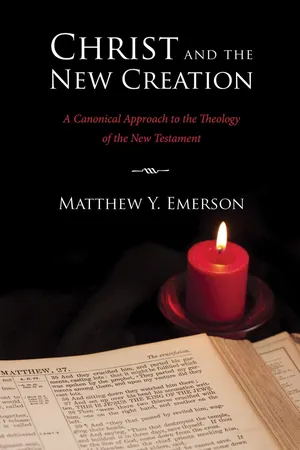
eBook - ePub
Christ and the New Creation
A Canonical Approach to the Theology of the New Testament
- 206 pages
- English
- ePUB (mobile friendly)
- Available on iOS & Android
eBook - ePub
Christ and the New Creation
A Canonical Approach to the Theology of the New Testament
About this book
In Christ and the New Creation, Matthew Emerson takes a fresh approach to understanding New Testament theology by using a canonical methodology. Although typically confined to Old Testament theology, Emerson sees fruitfulness in applying this method to New Testament theology as well. Instead of a thematic or book-by-book analysis, Emerson attempts to trace the primary theological message of the New Testament through paying attention to its narrative and canonical shape. He concludes that the order of the books of the New Testament emphasize the story of Christ's inauguration, commissioning, and consummation of the new creation.
Information
Chapter 1
Theological Foundations For a Canonical Approach to Reading Scripture
Introduction
Behind every hermeneutical strategy lie particular theological foundations. These foundations are often assumed or even ignored, though, in many texts on interpretation in order to get on to “more pressing” questions.35 Almost every conceivable answer to these questions and more has been given in various biblical interpretation texts.36 These difficult issues and the various solutions given, though, are not the foundation on which interpretation stands. It is without exception that every hermeneutical method has behind it a particular theological method. While many contemporary works on hermeneutics do not address the theological foundations for their interpretive practices,37 this does not mean that those foundations are nonexistent or unimportant.
Furthermore, many of the controversies in current hermeneutics texts, such as the propriety of a Christological reading, the place of historical background information in exegesis, and the place of the reader in interpretation, are more often controversies over theological method than they are over hermeneutical practice. For example, the question of the place of the reader in exegesis is really a theological question about the nature of the text and the nature of reading, not primarily a question about hermeneutical method. The question in these hermeneutical debates should therefore not be, “what is the best interpretive strategy?” but instead, “what is the best theological method that will then provide a hermeneutic for the interpreter?” Theological method is prior to hermeneutical method, and so these hermeneutical questions must be grounded first in their theological underpinnings.
It is the purpose of this chapter, then, to briefly state the theological foundations for the hermeneutical project at hand before moving to that project. The thesis of this chapter is that a canonical hermeneutic, which will be employed as the main interpretive strategy in the rest of the book, is supported by theological foundations rooted in the history of interpretation which reflect a coherent understanding of bibliology, pneumatology, and Christology.
Definitions
Theological Method
Before articulating these foundations, a few definitions are in order. First is the term “theological method.” In defining theological method, we should not conceive of it as a set of cold, “scientific” steps. It is instead the framework for interpreting the text. As Bernard Lonergan states, “Method is not a set of rules to be followed meticulously by a dolt. . . . It would outline the various clusters of operations to be performed by theologians when they perform their various tasks.” Or, in other words, it is a “. . . ‘framework for collaborative activity,’” which must be searched out and agreed upon, “Before ‘theologians’ [and interpreters’] “various tasks” can be performed . . . .”38 Lonergan is arguing, then, that theological method, or how to approach the text before one begins to interpret it, is the foundation upon which hermeneutics must stand. To state it yet another way, the interpretation of the text must be first grounded in a theological method of approaching the text. Theological method, then, is the framework or arena in which hermeneutical method finds its grounds and operates in its interpretation of the text. Hermeneutics, on the other hand, are the specific practices involved in the interpretation of a specific text. Theological method constructs the framework within which interpretation happens, while hermeneneutical method articulates the practices by which the text is interpreted.
There are a number of examples that demonstrate that theological method determines hermeneutical practice. One such example is an interpreter’s use of historical background information in approaching the text at hand. Is it necessary, as Grant Osborne39 or Andreas Köstenberger40 (among many others) would argue, to study the worldview and historical background of the author and audience of the text at hand? Or does that information cloud the interpreter’s understanding of the text and negatively affect the hermeneutical method of the exegete, as Hans Frei has argued?41 For these students of the biblical text, the place of historical background information in interpretation is of vital importance in their hermeneutical method. But behind that hermeneutical method stands a theological method, and one in this instance that asks how history can appropriately be understood and used in interpretation in light of the nature of Scripture and of its authorship.
Another example of the foundational nature of theological method is the different approaches New Testament (NT) theologians apply to their task. Some, such as Heikki Raïsänen,42 argue that NT theology is a historical enterprise dedicated to simply and only describing the theology found in the individual NT books. Others, such as James Mead,43 argue that biblical, and thus NT, theology should be prescriptive or confessional in nature, and thus its task is not only to describe what the NT authors believed about Christ and his church but also to help the church understand what they also should believe and therefore do according to the NT. Once again this difference in hermeneutical approach is grounded in a difference in theological method. For Raïsänen and others, the NT is a historical document that should be studied only as such and therefore the hermeneutical and theological task can only be descriptive. For Mead and others, on the other hand, the NT is not only a historical document but also the revealed Word of God, which not only describes what the early church believed but also has implications for the church today. The theological method of approaching the text is different for these scholars and thus their hermeneutical methods, descriptive vs. prescriptive, differ as well.
A final example is the difference between a compositional approach to hermeneutics and theology and a critical approach. For the first, scholars like Charles Scobie argue the Bible is one book, textually connected, inspired ultimately by the one God, and thus to be interpreted holistically.44 For th...
Table of contents
- Title Page
- Preface
- Acknowledgments
- Abbreviations
- Introduction
- Chapter 1: Theological Foundations For a Canonical Approach to Reading Scripture
- Chapter 2: Hermeneutical Foundations For a Canonical Approach to Reading Scripture
- Chapter 3: The Gospels and Acts
- Chapter 4: Romans-Colossians—Both Jew and Gentile Living as New Creations in Christ
- Chapter 5: 1 Thessalonians-Hebrews
- Chapter 6: The Catholic Epistles
- Chapter 7: Revelation—The Climax of the Canon
- Conclusion
Trusted by 375,005 students
Access to over 1.5 million titles for a fair monthly price.
Study more efficiently using our study tools.
Frequently asked questions
Yes, you can cancel anytime from the Subscription tab in your account settings on the Perlego website. Your subscription will stay active until the end of your current billing period. Learn how to cancel your subscription
No, books cannot be downloaded as external files, such as PDFs, for use outside of Perlego. However, you can download books within the Perlego app for offline reading on mobile or tablet. Learn how to download books offline
We are an online textbook subscription service, where you can get access to an entire online library for less than the price of a single book per month. With over 1.5 million books across 990+ topics, we’ve got you covered! Learn about our mission
Look out for the read-aloud symbol on your next book to see if you can listen to it. The read-aloud tool reads text aloud for you, highlighting the text as it is being read. You can pause it, speed it up and slow it down. Learn more about Read Aloud
Yes! You can use the Perlego app on both iOS and Android devices to read anytime, anywhere — even offline. Perfect for commutes or when you’re on the go.
Please note we cannot support devices running on iOS 13 and Android 7 or earlier. Learn more about using the app
Please note we cannot support devices running on iOS 13 and Android 7 or earlier. Learn more about using the app
Yes, you can access Christ and the New Creation by Matthew Y. Emerson in PDF and/or ePUB format, as well as other popular books in Théologie et religion & Critique et interprétation bibliques. We have over 1.5 million books available in our catalogue for you to explore.