eBook - ePub
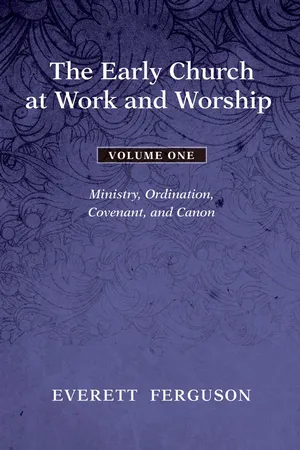
The Early Church at Work and Worship - Volume 1
Ministry, Ordination, Covenant, and Canon
- 354 pages
- English
- ePUB (mobile friendly)
- Available on iOS & Android
eBook - ePub
The Early Church at Work and Worship - Volume 1
Ministry, Ordination, Covenant, and Canon
About this book
This is the first volume of Ferguson's collected essays, and includes some of his most memorable work, especially on "laying on of hands."
Information
Topic
Teología y religiónSubtopic
Teología cristiana1
Images of the Church in Early Christian Literature1
The study of ecclesiology often deals with the institutional, external aspects of the church. Less attention has been given to the nature or essence of the church. One approach many have found helpful in studying the essential nature of the church is by way of the images employed in reference to it.
The value of this approach in regard to the New Testament was demonstrated by Paul Minear’s impressive and influential compilation of Images of the Church in the New Testament (1960). I covered the images used for the church in the New Testament in my book The Church of Christ: A Biblical Ecclesiology for Today (1996). Herwi Rikhof, The Concept of the Church: A Methodological Inquiry into the Use of Metaphor in Ecclesiology (1981), and Avery Dulles, Models of the Church (1987), examined imagery in contemporary theological discussion of the church. Less attention, however, has been given to the use of images for the church in Christian writers of the early centuries after the New Testament. Thomas Halton’s collection of sources, The Church (1985), for the series Message of the Fathers of the Church (volume 4) gives only 10 out of 234 pages to “The Images of the Church,” noting the church as sheepfold, as edifice, as mother, as bride of Christ, and as the sheet let down from heaven in Peter’s vision (Acts 10:9–16). E. Glenn Hinson’s nearly contemporary collection of sources, Understandings of the Church (1986), for the series Sources of Early Christian Thought gives no explicit treatment of images for the church.
This situation changed somewhat with the massive, nearly 700 page, work of F. Ledegang, Mysterium ecclesiae: Images of the Church and Its Members in Origen (2001).2 Ledegang’s comprehensive study groups the scores of images and related terminology in the writings of Origen into six categories: body of Christ, bride of Christ, family, house and sanctuary, people of God, and “the earth and all that is in it.” For this paper I will take Ledegang’s six categories and give a passage from Origen and then some passages from Origen’s chronological predecessors and contemporaries.
What is immediately evident in these images for the church is that they all emphasize the communal aspect of Christian faith and life. This communal emphasis stands in contrast to the individualistic approach of so many of the expressions of Christianity in the modern Western world. Most of these images are rooted in Biblical usage. They, furthermore, testify not only to the importance of the church in Christian thought, but also to the relation of the church to key theological concepts.
Body
My approach is to give a passage from Origen and then some passages from his predecessors and contemporaries. Of Origen’s extensive use of the body imagery I select one passage not from a commentary or homily that explicitly refers to its scriptural basis.
We say that the divine Scriptures declare the body of Christ, animated by the Son of God, to be the whole church of God, and the members of this body—considered as a whole—to consist of those who are believers. Since, as a soul vivifies and moves the body . . . , so the Word, arousing and moving the whole body, the church, to the things that need to be done, moves also each individual member belonging to the church, so that they do nothing apart from the Word.3
Origen in the context uses the analogy of the church to a body, animated by a soul, to support the union of the soul of Jesus, perfect man, with the eternal Word, Son of God; but he is drawing on 1 Cor 12:12 and 27 and Rom 12:4–5.
Origen’s predecessor, Clement of Alexandria, made use of the body imagery for the church. In commenting on Ps 19:4–6, he quotes some who say that the “Lord’s tabernacle is his body,” but others say, “it is the church of the faithful.”4 Clement of Alexandria, like Origen, uses this imagery of the church as the body of Christ to reason back to the nature of Christ. He alludes to 1 Cor 12:12 with the words, “As a human being consisting of many members . . . is a combination of two—a body of faith and a soul of hope—so the Lord is of flesh and blood.”5 In an extended commentary on ...
Table of contents
- Title Page
- Acknowledgments
- Abbreviations
- 1. Images of the Church in Early Christian Literature
- 2. Attitudes to Schism at the Council of Nicaea
- 3. A Note on Irenaeus, Adversus Haereses IV.8.3
- 4. Ordination in the Ancient Church, I: Greek, Roman, and Jewish Backgrounds
- 5. Ordination in the Ancient Church, II: The Ceremony of Ordination
- 6. Ordination in the Ancient Church, III: Ordination in the Second and Third Centuries
- 7. Ordination in the Ancient Church, IV: Ordination in the First Century
- 8. Selection and Installation to Office in Roman, Greek, Jewish, and Christian Antiquity
- 9. Jewish and Christian Ordination: Some Observations
- 10. Qumran and Codex D
- 11. Origen and the Election of Bishops
- 12. Eusebius and Ordination
- 13. Laying On of Hands: Its Significance in Ordination
- 14. The Covenant Idea in the Second Century
- 15. Justin Martyr on Jews, Christians, and the Covenant
- 16. Canon Muratori: Date and Provenance
- 17. The Muratorian Fragment and the Canon: A Review of Hahneman
- 18. Pseudepigraphy: Post-Canonical Letters
- 19. Factors Leading to the Selection and Closure of the New Testament Canon: A Survey of Some Recent Studies
- Bibliography
Trusted by 375,005 students
Access to over 1.5 million titles for a fair monthly price.
Study more efficiently using our study tools.
Frequently asked questions
Yes, you can cancel anytime from the Subscription tab in your account settings on the Perlego website. Your subscription will stay active until the end of your current billing period. Learn how to cancel your subscription
No, books cannot be downloaded as external files, such as PDFs, for use outside of Perlego. However, you can download books within the Perlego app for offline reading on mobile or tablet. Learn how to download books offline
Perlego offers two plans: Essential and Complete
- Essential is ideal for learners and professionals who enjoy exploring a wide range of subjects. Access the Essential Library with 800,000+ trusted titles and best-sellers across business, personal growth, and the humanities. Includes unlimited reading time and Standard Read Aloud voice.
- Complete: Perfect for advanced learners and researchers needing full, unrestricted access. Unlock 1.5M+ books across hundreds of subjects, including academic and specialized titles. The Complete Plan also includes advanced features like Premium Read Aloud and Research Assistant.
We are an online textbook subscription service, where you can get access to an entire online library for less than the price of a single book per month. With over 1.5 million books across 990+ topics, we’ve got you covered! Learn about our mission
Look out for the read-aloud symbol on your next book to see if you can listen to it. The read-aloud tool reads text aloud for you, highlighting the text as it is being read. You can pause it, speed it up and slow it down. Learn more about Read Aloud
Yes! You can use the Perlego app on both iOS and Android devices to read anytime, anywhere — even offline. Perfect for commutes or when you’re on the go.
Please note we cannot support devices running on iOS 13 and Android 7 or earlier. Learn more about using the app
Please note we cannot support devices running on iOS 13 and Android 7 or earlier. Learn more about using the app
Yes, you can access The Early Church at Work and Worship - Volume 1 by Everett Ferguson in PDF and/or ePUB format, as well as other popular books in Teología y religión & Teología cristiana. We have over 1.5 million books available in our catalogue for you to explore.