- 206 pages
- English
- ePUB (mobile friendly)
- Available on iOS & Android
eBook - ePub
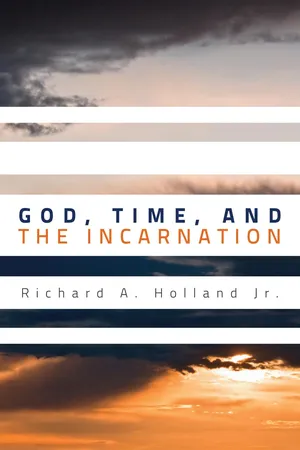
God, Time, and the Incarnation
About this book
The dominant view among Christian theologians and philosophers is that God is timeless--that he exists outside of time in an "atemporal" eternity. In God, Time, and the Incarnation, Richard Holland offers a critical evaluation of this traditional view in light of the most central doctrine of Christianity: the Incarnation of Christ.
Holland reviews the history of this controversy, highlighting the various theological problems for which atemporal models have been offered as a solution. He asserts the central importance of the Incarnation for Christian theology and evaluates several atemporal models in light of this doctrine. Finally, he suggests that the traditional atemporal view is not compatible with a robust and orthodox view of the Incarnation. This book rejects the traditional atemporal view of God's relationship to time and argues, based on the Incarnation, that God experiences temporal sequence in his existence.
Information
Topic
Theology & ReligionSubtopic
Philosophy History & Theory1
The Nature of Time and the History of the Debate
When the history of the debate about God’s relation to time is examined, the earliest voices have been nearly unanimous in their assertion that God lives an atemporal existence; and dissent from this view (with few exceptions) seems to have been expressed only recently. For each prominent contribution, slightly different reasons and arguments have been given to support the classical atemporal position. In this chapter, I want to highlight some of the most important contributions by key figures of early Christian history, including that of Augustine, Boethius, Anselm, and Aquinas; and I’ll briefly survey one modern argument made by Friedrich Schleiermacher. It will be important to note what theological priorities are brought into the discussion, and what motivates each of these theologians to adopt the atemporal view—an emphasis on God’s immutability is often seen, for example. These prominent figures have built what has become the foundation of the classical atemporal view. In order to move the debate forward, I want to challenge the ordering of the theological priorities; and so I will suggest that the doctrine of the Incarnation should be at the center of the discussion and the foundation of our understanding of God’s relation to time.
The debate about the nature of time and the debate about God’s relationship to time are inseparable, because the former (in many ways) has shaped the latter—especially with regard to the terminology and methodology employed. So before examining the historical contributions to the discussion of God’s relation to time, I first want to frame the debate by highlighting several of the most important philosophical and theological concepts relating to the nature of time itself. This will include a brief synopsis of major philosophical contributions, and will highlight several insights from philosophical inquiry and physical scientific investigation, as well as J. M. E. McTaggart’s formulation of A-series and B-series distinctions.1 Additionally, some important methodological considerations will be discussed from a Christian perspective.
The Nature of Time
Important philosophical questions asked with regard to the nature of time include: What is time?, What is the relationship between time and “eternity”?, Is time part of the created universe only?, Is time real or merely an illusion of experience?, Is time static (tenseless) or dynamic (tensed)?, and What does the biblical evidence contribute to our understanding of the nature of time? Answers given to these and other related questions are a continuous matter of debate. When approaching the subject, however, any philosophical inquiry will be wise to follow the advice given by John Callahan in his Four Views of Time in Ancient Philosophy. Callahan argues that there are two sources of knowledge about time: first, common experience; and second, philosophical investigation. With regard to the first, he argues that “[t]his common knowledge of time is something that we must consider, and any detailed examination of time must not be out of harmony with it. Otherwise we should be explaining something other than that which men in general call time.”2 Additionally, whatever is said of the nature of time will have important implications for one’s view of God’s relationship to time. What follows is a brief survey of some of the more important philosophical contributions to understanding the nature of time, and an examination of how these contributions have left their mark in the debate on God and time.
Early Philosophy
As with most areas of the Western philosophical tradition, the ancient Greeks have laid down the foundations in the inquiry into the nature of time. As the pre-Socratics sought to define the fundamental nature of the universe, two opposing points of view emerged. For Heraclitus (540–480 BC), the universe was characterized primarily by change. He argued that everything in nature is in a continual state of flux, and that change is constant and pervasive, even if imperceptible. He writes, “Cold warms up, warm cools off, moist parches, dry dampens;”3 and “One cannot step twice into the same river, nor can one grasp any mortal substance in a stable condition, but it scatters and again gathers; it forms and dissolves, it approaches and departs.”4 Contrasting this view, Parmenides (515–445 BC) taught that all plurality is an illusion and that change is impossible. The concept of non-existence is impossible, he argued, because if something can be spoken of, it must exist. He writes, “It must be that what is there for speaking and thinking of is; for, whereas nothing is not; that is what I bid you to consider.”5 But since change requires something coming in to existence from non-existence, change cannot be possible; and what exists must be unchanging and eternal. Zeno (490–430 BC) followed Parmenides, offering his famous paradoxes intended to prove that motion was impossible.
The work of Plato (427–347 BC) was perhaps (in part) an effort to unite the two seemingly contradictory notions put forward by the pre-Socratics. With his theory of Forms, he postulated a model of the universe divided between the unchanging ultimate reality and the ever changing and moving physical world. Plato’s model of the universe along with his understanding of the nature of time has had great influence in Christian philosophical theology, from Augustine to the present day. For Plato, time belonged to the realm of the natural, physical world. Plato taught that time was a created image, modeled after the perfect Form of the eternal. He writes, “Now the nature of the intelligible being is eternal, and to bestow eternity on the creature was wholly impossible. But [the father and creator] resolved to make a moving image of eternity, and as he set in order the heaven he made this eternal image having a motion according to number, while eternity rested in unity; and this is what we call time.”6 This description of time as the “moving image of eternity” fits neatly into Plato’s larger theory of Forms. The description of time as “moving” implies that eternity is in some sense static. As is the case with everything experienced in the natural world, so it is that when one experiences time, one is experiencing an imperfect moving image of an eternal, unchanging Form.
Implicit in the idea of time being the image of an eternal Form is the fact that time is a created part of the universe. Plato argued that in creation, time was not brought about from something that existed before the physical world, but rather came into being with the physical world. He writes, “For there were no days and nights and months and years before the heaven was created, but when he constructed the heaven he created them also.”7 To be sure, Plato was not saying that merely the periods of time known as “day,” “month,” and “year” came as a result of the creation of the physical universe. Rather, he was arguing that time itself came into existence with the physical universe. Lawrence Fagg agrees with this conclusion as he writes, “Thus Plato divided the cosmos into the temporal domain of the natural world and the nontemporal realm of an eternal Ideal.”8
Not only did Plato argue that time was confined to the physical universe, he further argued that the two were inextricably connected. In the Timaeus, the protagonist makes two clear assertions that, first, the planets of the solar system were necessary for the creation of time, and, second, that the motion of the planets is time. He writes, “And in order to accomplish this creation [of time], he made the sun and the moon and five other stars, which are called planets, to distinguish and preserve the numbers of time, and when God made the bodies of these several stars he gave them orbits in the circle of the other.”9 Later in the same portion of the dialogue, he refers to the bodies as “all the stars which were needed to make time,”10 arguing that day and night are created by one revolution of the earth, the month is created by the orbit of the moon, and the year by the orbit of the sun. Plato’s belief that the motion of the bodies constituted time is made even more clear as he writes, “Thus, and to this end, cam...
Table of contents
- Title Page
- Acknowledgments
- Introduction
- Chapter 1: The Nature of Time and the History of the Debate
- Chapter 2: The Doctrine of the Incarnation
- Chapter 3: Analysis of the Atemporal View
- Chapter 4: Analysis of Some Alternatives to the Atemporal View
- Chapter 5: An Argument from the Incarnation
- Bibliography
Trusted by 375,005 students
Access to over 1.5 million titles for a fair monthly price.
Study more efficiently using our study tools.
Frequently asked questions
Yes, you can cancel anytime from the Subscription tab in your account settings on the Perlego website. Your subscription will stay active until the end of your current billing period. Learn how to cancel your subscription
No, books cannot be downloaded as external files, such as PDFs, for use outside of Perlego. However, you can download books within the Perlego app for offline reading on mobile or tablet. Learn how to download books offline
Perlego offers two plans: Essential and Complete
- Essential is ideal for learners and professionals who enjoy exploring a wide range of subjects. Access the Essential Library with 800,000+ trusted titles and best-sellers across business, personal growth, and the humanities. Includes unlimited reading time and Standard Read Aloud voice.
- Complete: Perfect for advanced learners and researchers needing full, unrestricted access. Unlock 1.5M+ books across hundreds of subjects, including academic and specialized titles. The Complete Plan also includes advanced features like Premium Read Aloud and Research Assistant.
We are an online textbook subscription service, where you can get access to an entire online library for less than the price of a single book per month. With over 1.5 million books across 990+ topics, we’ve got you covered! Learn about our mission
Look out for the read-aloud symbol on your next book to see if you can listen to it. The read-aloud tool reads text aloud for you, highlighting the text as it is being read. You can pause it, speed it up and slow it down. Learn more about Read Aloud
Yes! You can use the Perlego app on both iOS and Android devices to read anytime, anywhere — even offline. Perfect for commutes or when you’re on the go.
Please note we cannot support devices running on iOS 13 and Android 7 or earlier. Learn more about using the app
Please note we cannot support devices running on iOS 13 and Android 7 or earlier. Learn more about using the app
Yes, you can access God, Time, and the Incarnation by Richard A. Holland Jr. in PDF and/or ePUB format, as well as other popular books in Theology & Religion & Philosophy History & Theory. We have over 1.5 million books available in our catalogue for you to explore.