eBook - ePub
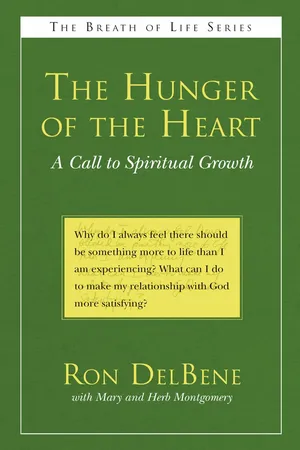
The Hunger of the Heart
A Call to Spiritual Growth
- 112 pages
- English
- ePUB (mobile friendly)
- Available on iOS & Android
eBook - ePub
The Hunger of the Heart
A Call to Spiritual Growth
About this book
Do you feel that there should be something more to life than what you're experiencing? Do you wonder what you can do to make your relationship with God more satisfying?
In 'The Hunger of the Heart', Ron DelBene responds to these questions that are in the hearts of so many people today. In his well-known and well-loved style of sharing personal, real-life stories in his writing, the author issues a call to spiritual growth to all persons - regardless of where they are in their spiritual journeys.
DelBene describes fourteen stages of spiritual development, using the image of a tree's growth, rather than the typical ladder image for Christian growth. Based on the experiences of thousands of people he has met and counseled, these stage descriptions serve as guidelines for making sense of the yearnings, doubts, anger, and wonder that enter every Christian's life.
Information
Topic
Theology & ReligionSubtopic
Christian ChurchChapter 1
Called to Wholeness
“I invite you to begin thinking of yourself as a pilgrim.”
*
Why do I always feel there should be something more to life than I am experiencing?
What can I do to make my relationship with God more satisfying?
How can I get my life together?
These are a few of the questions typically faced by people who come to me seeking spiritual direction. They are questions I have faced myself, and you probably have as well.
Before we examine the stages of spiritual growth that point to some answers, let’s recall what God has in mind for us. Scripture tells us that we are called to be whole people who grow into a deeper balance and union with the parts of ourselves, with other people, and with God. Specifically we are told, “You must therefore be perfect just as your heavenly Father is perfect” (Matt. 5:48, jb).
To be perfect as God is perfect? What an unattainable, even unfair expectation—an expectation that puts us in what is commonly referred to as a double bind. Such a bind produces an inner dialogue that goes like this:
I need to be perfect like God.
But you can’t be perfect like God.
I have to be! It’s right there in Scripture.
But you know you can’t.
Even though I know I can’t, I must keep trying.
We can alleviate this dilemma by understanding what is meant by the word perfect. In the original Greek, it means “whole” or “integrated” or “together.” For most people, this opens an entirely new way of looking at their spiritual potential.
Consider your own life. Surely there have been times when you have felt that everything was going well, when you were a whole person with your life moving in the proper direction. You were together, integrated in mind, body, and spirit. You were functioning as one, functioning as God intends.
For some people the potential for a rich spiritual life is damaged because perfection, as they understand it, is unattainable. Jean was such a person. When she came to see me, she was a wife and mother in her early thirties and confronting the issue of always having to be perfect. Worry about being perfect had begun in early childhood. In her journal, Jean wrote about her troubling history:
I was afraid because I knew what would happen when I brought home a report card with five A’s and one B. And it did. The first comment from my father was “Why the B?” So the next grading period I really wanted to “prove” myself. I worked very hard and came home with six A’s.
I was so proud. I knew I had made it. But what was the first response of my father? “Must have been an easy term. Don’t let it go to your head. Your class is probably not too smart.”
So there I was! I couldn’t win. I remember that time so very well. Maybe that’s when I decided that I was a loser. And that was only one instance of many times when I felt I had to live up to something that I couldn’t. And I remember crying about that.
Then I remember the church just adding to that with more about how I needed to be perfect. Wow, I spent my whole life trying to be perfect for my father and never making it, and now God was asking me to be perfect. I was a loser even before I really started.
When I heard that perfect really means whole or integrated, I got a new lease on life. . . . Suddenly it was like God was a part of my life. My own integration was what God was talking about. At that moment I was just filled with God’s love. What freedom! The truth really does make you free.
Whereas some people have their spiritual development warped by the mistaken understanding of perfection, others fall victim to the “ladder mentality.” Early in the Christian tradition of spirituality, the ladder became a popular image symbolizing our growth toward God. Such an image was consistent with the prevailing understanding of God as being “up there” (in heaven) and we were “down here” (on earth). Our responsibility was to get up there to God.
In times past, the ladder image was effective because it was both easy to visualize and to understand. Today we realize that this image did not fully take into account that God had already “come down” and become one of us in the person of Jesus. No longer was there a need to get “up there” to God.
The ladder image also suggested that spiritual growth means rising, step-by-step, to an ever higher level. (The song “We Are Climbing Jacob’s Ladder”—“higher, higher”—is based on the image of the ladder in Genesis 28:12.) We have inherited the idea that the higher we go, the better we are. Certainly it is true that through such activities as prayer, Christian meditation, ministry to others, and study of the Scriptures we grow spiritually. But if we hold to the ladder image, we are in danger of being unduly concerned with where we are in relation to others. Are we ahead of someone else? Are others ahead of us? Often we hear judgments, and perhaps even make them ourselves, about who is where on the ladder leading heavenward.
In place of the ladder image, I offer the tree as a more appropriate symbol for our time. At any given moment a tree is complete. If you plant a tree that is two inches in diameter, you don’t say, “I planted half a tree today.” A tree is a tree no matter what the size. The difference between a tree that is two inches in diameter and one that is twenty inches is that one has been around longer than the other.
So it is with us. God did not create just half a you or half a me. From the moment of our birth, each of us is complete. At times our growth is more rapid than at other times, but at every point in our lives we are whole.
The tree, too, has periods when growth is more evident. This is apparent when the tree is cut down and the growth rings inside the trunk are visible. Some rings are wide, indicating a time when growth was intense. Other rings are narrow, indicating that growth was slight. These growth rings can be likened to the stages in our spiritual lives. There are growing times when we seem especially close to God. Then there are those times when we feel stunted spiritually; we sense very little growth and wonder if we are standing still or maybe even backsliding. Yet even in those seemingly arid times, growth is still occurring.
Martin, whom I first met in his early twenties, was impatient with his spiritual growth and never satisfied with his progress. The tree image was especially helpful for him in realizing how a person can be both whole and growing. In one of Martin’s journal entries he wrote:
When I heard that I am complete now, I immediately thought, no I’m not. Then the more I thought about it, the more I see what you mean. I was never pleased with my prayer life, with my walk with God, the spiritual good I was doing. I always had to be better. Now I see that I am where I am supposed to be. That’s a relief. I can begin to enjoy where I am. I know I’m alive and growing, but I’m ...
Table of contents
- Title Page
- Chapter 1: Called to Wholeness
- Chapter 2: The Awakening Stage
- Chapter 3: The Seeking Stage
- Chapter 4: The Learning Stage
- Chapter 5: The Relief, Anger, Fear Stage
- Chapter 6: The Doubting Stage
- Chapter 7: The Testing Stage
- Chapter 8: The Discipline Stage
- Chapter 9: The Rebelling Stage
- Chapter 10: The Urged-On Stage
- Chapter 11: The Confession Stage
- Chapter 12: The Insight Stage
- Chapter 13: The Release Stage
- Chapter 14: The Expectation Stage
- Chapter 15: The Integration Stage
- Chapter 16: Going On
- The Breath Prayer
- About the Authors
Trusted by 375,005 students
Access to over 1.5 million titles for a fair monthly price.
Study more efficiently using our study tools.
Frequently asked questions
Yes, you can cancel anytime from the Subscription tab in your account settings on the Perlego website. Your subscription will stay active until the end of your current billing period. Learn how to cancel your subscription
No, books cannot be downloaded as external files, such as PDFs, for use outside of Perlego. However, you can download books within the Perlego app for offline reading on mobile or tablet. Learn how to download books offline
Perlego offers two plans: Essential and Complete
- Essential is ideal for learners and professionals who enjoy exploring a wide range of subjects. Access the Essential Library with 800,000+ trusted titles and best-sellers across business, personal growth, and the humanities. Includes unlimited reading time and Standard Read Aloud voice.
- Complete: Perfect for advanced learners and researchers needing full, unrestricted access. Unlock 1.5M+ books across hundreds of subjects, including academic and specialized titles. The Complete Plan also includes advanced features like Premium Read Aloud and Research Assistant.
We are an online textbook subscription service, where you can get access to an entire online library for less than the price of a single book per month. With over 1.5 million books across 990+ topics, we’ve got you covered! Learn about our mission
Look out for the read-aloud symbol on your next book to see if you can listen to it. The read-aloud tool reads text aloud for you, highlighting the text as it is being read. You can pause it, speed it up and slow it down. Learn more about Read Aloud
Yes! You can use the Perlego app on both iOS and Android devices to read anytime, anywhere — even offline. Perfect for commutes or when you’re on the go.
Please note we cannot support devices running on iOS 13 and Android 7 or earlier. Learn more about using the app
Please note we cannot support devices running on iOS 13 and Android 7 or earlier. Learn more about using the app
Yes, you can access The Hunger of the Heart by Ron DelBene, Herb Montgomery,Mary Montgomery, Montgomery in PDF and/or ePUB format, as well as other popular books in Theology & Religion & Christian Church. We have over 1.5 million books available in our catalogue for you to explore.