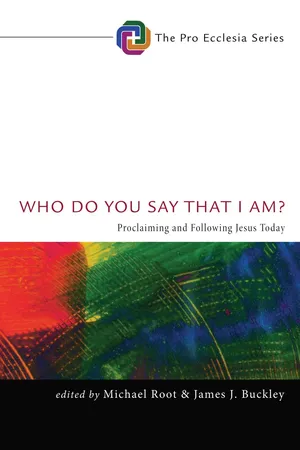
eBook - ePub
Who Do You Say That I Am?
Proclaiming and Following Jesus Today
- 118 pages
- English
- ePUB (mobile friendly)
- Available on iOS & Android
eBook - ePub
Who Do You Say That I Am?
Proclaiming and Following Jesus Today
About this book
No question is more central to Christian living, preaching, and theology than Jesus' question to his disciples: Who do you say that I am? Some would have it that pastors and theologians, biblical exegetes and historians, dogmatic and moral theologians, Catholic and Evangelical have more differences than similarities in the way Christians with such diverse vocations respond to Jesus' question. And there is little doubt that there sometimes seem to be unbridgeable gulfs between the way historians and believers, Internet gossipers and preachers, classical christological debates and present-day praying and pastoral care implicitly or explicitly address the Lord's question. But the authors here address these and other issues in ways that are remarkably convergent, as if a "Catholic and Evangelical theology" for proclaiming and following Jesus today has emerged, or is indeed emerging.
Information
Topic
Teologia e religioneSubtopic
Teologia cristiana1
The Search for the Real Jesus
Introduction
Many years ago I walked into the office of Paul Tillich at Harvard University to ask about a dissertation topic. With hardly a moment’s hesitation Tillich said, “You must write on Martin Kähler. But first you must translate his famous book, Der sogenannte historische Jesus und der geschichtliche, biblische Christus.”1 Who in the world was Martin Kähler? But you don’t argue with your doctor father. I went to the Harvard library and checked out many of Kähler’s books, including the one Tillich assigned to me. Soon I figured out why Tillich wanted me to translate Kähler’s book into English. Tillich had just published the second volume of his Systematic Theology. In it he made this statement: “The attempt of historical criticism to find the empirical truth about Jesus of Nazareth was a failure. The historical Jesus, namely, the Jesus behind the symbols of his reception as the Christ, not only did not appear but receded farther and farther with every new step. . . . The result of the new (and very old) questioning is not a picture of the so-called historical Jesus but the insight that there is no picture behind the biblical one which could be made scientifically probable.”2
Kähler was Tillich’s professor of dogmatics at the University of Halle. In using the phrase “the so-called historical Jesus,” Tillich was obviously echoing the basic thesis of Kähler’s book, namely, that the search for Jesus behind the Gospels results in a “so-called historical Jesus,” the Jesus of critical historiography. The title of Kähler’s book contrasts “the so-called historical Jesus” with the “historic, biblical Christ” portrayed by the four canonical Gospels. The Gospels are written testimonies given by followers of Jesus who believed in him as the Christ, the risen Lord, and the Son of God. The scientific attempt to shake out the facts from the faith-filled memories of Jesus as the Christ will never get us any closer to the real Jesus. The real Jesus is the “historic, biblical Christ.”
A lot of gossip was reporting Tillich to have said, “If historical critics today were to prove that Jesus never existed, it would not make any difference to Christian faith.” I have never found where Tillich said that, but if he did he was possibly reiterating Kähler’s assertion that the faith of believers in Christ is not dependent on what scholars prove about the historical Jesus, positively or negatively. When Tillich was a theological student, Arthur Drews published his book The Christ Myth.3 He used the methods of historical science to prove that Jesus never existed. The book created a storm of protests in Germany but found echoes of support in England, France, and Holland. Once the fate of the historical figure of Jesus is placed in the hands of historical science, theology cannot control the results. Kähler—and Tillich after him—said that Christian faith is based on the apostolic testimonies to Jesus the Christ, not on the latest findings of historical scientists.
My Harvard dissertation argued that Kähler’s judgment was valid not only with reference to the original quest of the historical Jesus, but from a theological point of view it is perennially valid, and therefore equally applicable in relation to what has been called the “new quest” of the Bultmannians as well as the current quests now being conducted by scholars of every stripe, from the neoliberals of the “Jesus Seminar” to those more conservative like N. T. Wright.
I. The Kähler Renaissance
When I went to the University of Heidelberg to do what Tillich told me to do, I discovered to my great delight that a Kähler renaissance was underway. Kähler’s book had been written more than a decade before Albert Schweitzer’s The Quest of the Historical Jesus,4 but it was Schweitzer’s that shook the theological world. Most historians and theologians accepted Schweitzer’s judgment that the nineteenth-century attempts to write a “life of Jesus” were failures. Whether written from a conservative, liberal, or mediating position, the biographers tended to find a Jesus they were looking for. They depicted the figure of Jesus after their own image. They put their own ideas into the mouth of Jesus. They succumbed to what Henry Cadbury called “the peril of modernizing Jesus.”5
After the Second World War theologians in Germany rediscovered the relevance of Kähler for their own constructive work. Rudolf Bultmann was the dominant New Testament theologian in the 1950s and 1960s. The doubts that Schweitzer raised about the possibility of writing a biography of Jesus were increased by Bultmann to the highest possible pitch, when he said: “I think we can now know almost nothing concerning the life and personality of Jesus.”6 Bultmann also accepted Kähler’s claim that Christian faith is not based on the figure of the historical Jesus as reconstructed by critical historiography.
Karl Barth, Emil Brunner,7 and Paul Tillich, contemporaries of Bultmann, also concurred with Kähler. In the 1930s they were called dialectical theologians, but in the course of time each went his own way. Time will permit me to offer only a sample of Barth’s insights, which both Brunner and Tillich shared.
Barth contributed to the Kähler renaissance. In his Church Dogmatics he wrote, “It is an abiding merit of Martin Kähler, which cannot be over-praised, that in his work Der sogenannte historische Jesus und der geschichtliche biblische Christus, 1892—at a time when it cost something to say so—he called the whole ‘Life of Jesus movement’ in plain language a ‘wrong way.’”8 Barth approved of Kähler’s key idea “that the real historical Christ is no one other than the biblical Christ attested by the New Testament passages, i.e., the incarnate Word, the risen and exalted One. . . . There is no reason why historico-critical Bible research should not contribute to the investigation and exposition of this historical Christ of the New Testament, instead of . . . chasing the ghost of an historical Jesus in the vacuum behind the New Testament.”9
Søren Kierkegaard also influenced the dialectical theologians. He advanced the idea that faith cannot be dependent on the always fluctuating results of historical research. He asked, how can the probability knowledge of historical science provide the foundation of hope for eternal life? The dialectical theologians frequently quoted 2 Corinthians 5:16: “Even though we have known Christ after the flesh, yet now we know him so no more.” The Christus kata sarka is the so-called historical Jesus of the historiographers, who profess to bracket out faith from their scholarly investigations. True, they bracket out biblical Christian faith. In its place they substitute their own rationalistic presuppositions or some other ideological commitments. The end product is a hypothetical Jesus, depicted as a mere man, and thus not the real Jesus, the historic, biblical Christ.
II. The Historical Jesus of the New Quest
The combined influence of the dialectical theologians, especially Barth and Bultmann, ensured that the quest of the historical Jesus would be placed on a back burner. The great systems of constructive theology for most of the twentieth century showed little interest in the Jesus research of technical scholarship. That was true not only of dialectical theology, but also of other types of theology: secularization theology, language analysis theology, process theology, as well as the confessional theologies of the various Christian traditions. Students parsed every neologism of the reigning philosophical thinkers—Heidegger, Sartre, Jaspers, Whitehead, and Wittgenstein—all of whom exercised enormous influence on various schools of theology.
Then something happened. The Bultmann school developed a heart murmur. Some of his former students feared that the patient was about to die. Dr. Käsemann volunteered to perform the operation. In a famous article, “The Problem of the Historical Jesus,”10 Käsemann reopened the quest of the historical Jesus. His goal was more modest than that of the biographical and psychological inquiries of the old quest. Käsemann feared that Bultmann’s indifference to the historical Jesus would lead to docetism. Docetism was an ancient heresy that denied that Jesus was really a full-fledged human being. For Bultmann the historical Jesus possessed no constitutive significance for Christian faith in the exalted Lord, the kerygmatic Christ. For Käsemann it became a question of inescapable theological necessity to penetrate behind the kerygmatic Christ of apostolic preaching to establish continuity with the historical Jesus. He g...
Table of contents
- Title Page
- Contributors
- Preface
- Chapter 1: The Search for the Real Jesus
- Chapter 2: Jesus and the Historians
- Chapter 3: Why the Roman Cross?
- Chapter 4: The Benedictine Jesus
- Chapter 5: “Lord, to Whom Shall We Go? You Have the Words of Eternal Life”
- Chapter 6: Proclaiming the Lord Jesus Christ
- Chapter 7: Behold the Lamb of God Who Does What?
Trusted by 375,005 students
Access to over 1.5 million titles for a fair monthly price.
Study more efficiently using our study tools.
Frequently asked questions
Yes, you can cancel anytime from the Subscription tab in your account settings on the Perlego website. Your subscription will stay active until the end of your current billing period. Learn how to cancel your subscription
No, books cannot be downloaded as external files, such as PDFs, for use outside of Perlego. However, you can download books within the Perlego app for offline reading on mobile or tablet. Learn how to download books offline
Perlego offers two plans: Essential and Complete
- Essential is ideal for learners and professionals who enjoy exploring a wide range of subjects. Access the Essential Library with 800,000+ trusted titles and best-sellers across business, personal growth, and the humanities. Includes unlimited reading time and Standard Read Aloud voice.
- Complete: Perfect for advanced learners and researchers needing full, unrestricted access. Unlock 1.5M+ books across hundreds of subjects, including academic and specialized titles. The Complete Plan also includes advanced features like Premium Read Aloud and Research Assistant.
We are an online textbook subscription service, where you can get access to an entire online library for less than the price of a single book per month. With over 1.5 million books across 990+ topics, we’ve got you covered! Learn about our mission
Look out for the read-aloud symbol on your next book to see if you can listen to it. The read-aloud tool reads text aloud for you, highlighting the text as it is being read. You can pause it, speed it up and slow it down. Learn more about Read Aloud
Yes! You can use the Perlego app on both iOS and Android devices to read anytime, anywhere — even offline. Perfect for commutes or when you’re on the go.
Please note we cannot support devices running on iOS 13 and Android 7 or earlier. Learn more about using the app
Please note we cannot support devices running on iOS 13 and Android 7 or earlier. Learn more about using the app
Yes, you can access Who Do You Say That I Am? by Michael Root,James J. Buckley, Root, Buckley in PDF and/or ePUB format, as well as other popular books in Teologia e religione & Teologia cristiana. We have over 1.5 million books available in our catalogue for you to explore.