- 140 pages
- English
- ePUB (mobile friendly)
- Available on iOS & Android
eBook - ePub
About this book
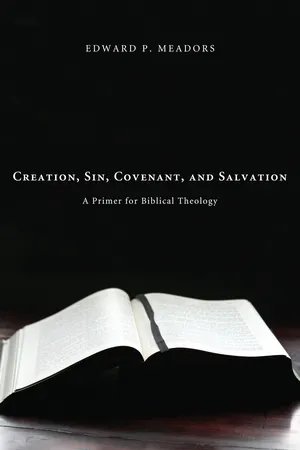
Creation, Covenant, Sin, and Salvation is a primer for biblical theology that is accessible to lay readers of all ages. This is the ideal book for those seeking a short, accessible synopsis of the Christian worldview. Sprinkled with anecdotes and illustrations, the book eases readers into a succinct yet comprehensive discussion of biblical thought. The final chapter explains the authority, practical value, and intended purpose of Scripture. Meadors inspires readers to think critically about the real life believability of the Christian faith, especially its intellectual coherence. In keeping with biblical theology, the book affirms the continuity of biblical revelation from beginning to end before consummating in the resurrection of the dead and God's restoration of all creation.
Information
1
Eden: Fact or Fairy Tale?
Do you understand the Bible? Do you understand how the Bible’s many parts interrelate to tell the epic story of God’s revelation in Scripture? Can you go beyond facts, figures, dates, memory verses, lists, and scholarly words to express the Bible’s comprehensive message? Do you really know the wisdom of “all Scripture” that leads to salvation in Jesus Christ? Can you articulate why the Bible is a trustworthy guide for living in our multifaceted contemporary world? Is your understanding of the Bible really yours, or is it what you’ve inherited with conviction and passion but never really thought through in depth on your own?
These big questions cannot be answered in a class, a degree, or in a flashy monograph. Biblical theology is a journey of daily thought that spans one’s entire lifetime. It involves daily meditation over Scripture attended by prayer and worship in the body of Christ, the church. It involves conversation with the thoughts of other theologians, past and present, celebrated and obscure, as well as modest lay persons who genuinely desire knowledge of the truth.
Biblical theology seeks to understand reality as it is revealed in the Bible from Genesis to Revelation. Working from the awareness that the Bible reveals a diverse yet coherent message, biblical theology confronts the contemporary world with a radical and countercultural worldview—that God really does exist, that he created us, loves us, has a design for how we should live, wants to rescue us, and will in the end determine our eternal fate. Biblical theology is about God’s kingship, his plan, and his work within history and within humanity to achieve his ultimate end. Biblical theology is a coherent story and a worldview.
Biblical theology is also evangelical. It professes to be the truth and to be good news to those who receive it in obedient, active faith, and as a result are transformed by the renewing of their minds. God’s goodness surpasses the capacity of words as he defeats evil with good right up to the creation of the resurrected body and the new heavens and the new earth. His glory has no end. Nothing is impossible with God.
This little book may be rightly categorized as a primer—a primer on biblical theology. Like a primer on a small gasoline engine, it is my hope that these pages will successfully ignite thoughts and conversations that will lead to productive reading of Scripture and a deeper understanding of God’s story and humanity’s place within it. Functioning as a primer, we will discuss the contemporary relevance of Scripture in non-academic terms and incorporate illustrations and anecdotes here and there to keep the engine going. However, creation, sin, covenant, and salvation will remain our constant focus as they are the vital organs of Scripture—overlapping themes essential to an understanding of every book of the Bible. It all begins with God and his creation of reality.
Surprised by Reality
Kathy and I had no business being there. But I was a struggling young professor, and the prospect of an affordable vacation was irresistible. So two days before, we loaded up the kids for an all expenses paid vacation in Beckley, West Virginia—a luxurious holiday in exchange for enduring a sales pitch for a “once in a lifetime investment opportunity.”
In truth the sales pitch was not nearly the hard sell that I’d suffered the summer before in Branson, Missouri, or the summer before that in Crossville, Tennessee. There was no arm-twisting or seductive coercion, just a short painless presentation. When that was over and my VISA card and bank account were secure from danger, I felt tremendous relief—like I’d slipped through customs unnoticed or dodged a speeding ticket with a mere reprimand. Out of harm’s way, I breathed deeply and settled into full vacation mode.
Moments later the tires of our minivan came to a grumbling halt at the majestic mountain property that “could be ours.” Meandering about, we found an opening in the forest and began a descent into the wooded darkness. What followed has been with me ever since.
No, this was not the stuff of a blockbuster hit. We didn’t stumble upon a violent crime scene with bloodied, dismembered body parts. We were not attacked by an escaped criminal. We didn’t discover a hidden stash of Confederate gold. Nor did we chance upon a celebrity, see a UFO, or have an encounter with an angel. Instead we found ourselves in the middle of a mountainous expanse that had never been disturbed—ever. Fingerprints of humankind were entirely absent. No bottle tops, no plastic grocery bags, no cigarette butts, no rusty machine parts from yesteryear. We were in a virgin forest of mature hardwoods, blooming Mountain Laurels, and gigantic lichen spotted boulders.
Scurrying up a massive rock, I was intoxicated by the life surrounding me. My vocabulary proved totally inadequate with the worn out cliché “unbelievable” being all that I could muster. The absence of a thesaurus at the depths of my innermost being was humbling. But that was ok. Exaggerations elsewhere were here fitting and true. The pure beauty of that moment was, in truth, unbelievable. It was awesome. We were in a cathedral of intoxicating life, a sanctuary of the purest kind. In all my travels, real or imaginary, I’d never experienced anything like it.
Most amazing to me was the fact that this place was real. And as the reality of the moment sank in, so did the truth of a childhood fairy tale. As I gazed upward at the forest canopy, reality suddenly surpassed the fanciful. “This is like the garden of Eden,” I whispered. And it was.
To write further in memory of this event would require poetry. And I am most definitely not a poet—at least not a good one. Nor do I want to give the impression that I’m in the mold of Henry David Thoreau or John Denver—both of whose talents far exceed my own. Yet, despite my average aesthetic aptitude, I left that forest invigorated, inspired, and with a vivid memory of a reality that bordered on the fantastic. I would love to go back.
We thought seriously about a mortgage on the precious property, but in the end wisely said no. West Virginia was a long way from our home in Upland, Indiana, and the Eden we imbibed would shortly cease to exist. Bulldozers and backhoes would soon insure that ours was in fact a “once in a lifetime experience.” Fairways and palatial estates wouldn’t be the same.
Have you ever had an experience of creation like that—when words seemed inadequate and silence alone seemed fitting? My guess is that you have, whether in the mountains or on the seashore, on a lake or in the woods, the morning after a fresh snow or late at night under the stars—or perhaps in awe of a stunning sunset.
I believe these sudden encounters with the sublime reveal an innate human awareness of God’s revelation within nature, what the apostle Paul described as God’s eternal power and divine nature—God’s invisible attributes that we can still detect in creation today (Rom 1:20).
Biblical Eden
Years and years before our trip to West Virginia, my first mental contact with biblical Eden came from the lips of my mother as she read aloud Ken Taylor’s The Bible in Pictures for Little Eyes. The long rectangular book reduced the Bible to short episodes, fascinating pictures, and simple questions. There was nothing I loved more than blurting out answers to these questions faster than my little brother, David. Competitive from the crib, I proved the truth of the fall at every developmental stage—despite my mother’s persistent efforts.
The Bible stories made their impressions, however. With the first picture, I saw God moving above waters through a dark cloud-encircled tunnel that stretched toward the light of sun rays at the other end. God’s mysterious power was comforting, yet scary at the same time. Falling in the black waters of creation in the dead of night was strangely terrifying.
The second and third pictures were idyllic depictions of the Garden of Eden. These were a little less impressive, perhaps because they didn’t seem as real or maybe because they weren’t scary.
I recently opened a library copy of Taylor’s book to refresh my memory. Remarkably, the images instantly restored childhood impressions from forty years before. The beautiful world of Eden included an elephant, a peacock, two deer beneath a palm tree, a parrot, an alligator, a jumping fish, and purple flowers similar to ones I’d seen in our neighborhood. Of course, David and I had liked it that the animals weren’t eating one another. They were friendly.
In the third picture Adam and Eve stood at a distance gazing up through beams of light toward heaven. They stood behind a bush of yellow flowers, so we couldn’t see their naked bodies. A resting leopard looked on kindly from beneath the shade of a plant similar to the trees in my dinosaur books. There were two large deer, one with antlers like one of Santa’s reindeer, and another jumping fish.
And such was Eden. It was ok but not exciting—not to little boys who lived on baseball and TV episodes of Daniel Boone. I would find far more interesting the next story about the Devil and the fall, then Cain and Abel, Noah and the ark, the Tower of Babel, Abraham’s talk with God beneath the stars, Jacob’s wrestling match with an angel, and on and on. The creation story, not seeming entirely real or entertaining, soon lost my interest.
Today I have the impression that many Christians view the creation account in similar terms. Genesis 1–2 is a text of poetic truth that stands at the periphery of Christianity’s pillar doctrines. Saving faith in Jesus Christ is what really matters—not one’s beliefs about creation. Evolution, Intelligent Design, Creationism, harmonization of Adam and the dinosaurs—“that stuff just doesn’t really interest me” . . . “And I’m not really that interested in studying the biblical theology of creation—I remember it from childhood” . . . “the scientists and fundamentalists can battle it out—let’s move on to the meaty issues of justification and the atonement!”
Such thinking, however, comes at the expense of biblical theology, where creation is literally the beginning and the end of all that the Bible reveals—including justification and the aton...
Table of contents
- Title Page
- Preface
- Chapter 1: Eden: Fact or Fairy Tale?
- Chapter 2: It’s a Humpty Dumpty World: Sin and its Consequences
- Chapter 3: The Covenant Solution: It’s All About Relationships
- Chapter 4: Salvation: What God Made, He can Fix
- Chapter 5: The Self-Authenticating Power of Scripture
Trusted by 375,005 students
Access to over 1.5 million titles for a fair monthly price.
Study more efficiently using our study tools.
Frequently asked questions
Yes, you can cancel anytime from the Subscription tab in your account settings on the Perlego website. Your subscription will stay active until the end of your current billing period. Learn how to cancel your subscription
No, books cannot be downloaded as external files, such as PDFs, for use outside of Perlego. However, you can download books within the Perlego app for offline reading on mobile or tablet. Learn how to download books offline
Perlego offers two plans: Essential and Complete
- Essential is ideal for learners and professionals who enjoy exploring a wide range of subjects. Access the Essential Library with 800,000+ trusted titles and best-sellers across business, personal growth, and the humanities. Includes unlimited reading time and Standard Read Aloud voice.
- Complete: Perfect for advanced learners and researchers needing full, unrestricted access. Unlock 1.5M+ books across hundreds of subjects, including academic and specialized titles. The Complete Plan also includes advanced features like Premium Read Aloud and Research Assistant.
We are an online textbook subscription service, where you can get access to an entire online library for less than the price of a single book per month. With over 1.5 million books across 990+ topics, we’ve got you covered! Learn about our mission
Look out for the read-aloud symbol on your next book to see if you can listen to it. The read-aloud tool reads text aloud for you, highlighting the text as it is being read. You can pause it, speed it up and slow it down. Learn more about Read Aloud
Yes! You can use the Perlego app on both iOS and Android devices to read anytime, anywhere — even offline. Perfect for commutes or when you’re on the go.
Please note we cannot support devices running on iOS 13 and Android 7 or earlier. Learn more about using the app
Please note we cannot support devices running on iOS 13 and Android 7 or earlier. Learn more about using the app
Yes, you can access Creation, Sin, Covenant, and Salvation by Edward P. Meadors in PDF and/or ePUB format, as well as other popular books in Theology & Religion & Biblical Criticism & Interpretation. We have over 1.5 million books available in our catalogue for you to explore.