eBook - ePub
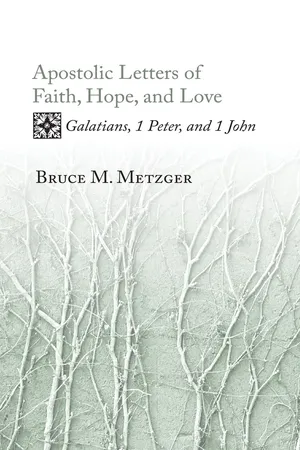
Apostolic Letters of Faith, Hope, and Love
Galatians, 1 Peter, and 1 John
- 110 pages
- English
- ePUB (mobile friendly)
- Available on iOS & Android
eBook - ePub
About this book
Professor Metzger has been a leader in New Testament studies for the past fifty years, through his teaching, his publications, his text-critical work, and his translation work. This volume brings his deep insight to three key epistles, focusing on three fundamental Christian virtues.
Information
chapter 1
Paul’s Epistle to the Galatians
A Letter of Faith
Galatia is part of Asia Minor—what is now Turkey. The Galatian people were ethnically Gauls. That is to say, their ancestors had come from the region we know as France. The language that their ancestors had used—and perhaps they still made use of it—was the Gallic language, related to Irish and Welsh.
In the third and second centuries BC there were migrations of Gallic people from France, going eastward, crossing over into Asia, and settling in the central part of Asia Minor. They were ruled by native Gallic rulers. And then in 25 BC the last of their native rulers died, and the Roman government moved in and made Galatia a Roman province. It was no longer an independent kingdom; it became part and parcel of the approximately thirty Roman provinces.
This area was evangelized by Paul and Barnabas (AD 48–49), on the first missionary journey that the apostle Paul took (see Acts 13–14). He probably touched upon the southern part of the province of Galatia. Subsequently he made a second and a third missionary journey (see Acts 15:36—18:17; and 18:18—20:6). And it was also on one of those subsequent journeys that he had bad news as to the situation of the churches that he had founded previously in Galatia. He had heard the bad news that some Jewish Christian believers from Jerusalem had gone north and then west into Asia Minor and were beginning to unsettle the religious convictions of the Christians in Galatia by telling these people—most of whom were of Gentile background—that they were not really Christians unless they agreed to abide by the Old Testament precepts: to eat only kosher food, submit to the ritual act of circumcision, and observe the various feast days prescribed in the Old Testament. In short, these Jewish Christians from Jerusalem of the Pharisaic-type were telling these Gentiles in Galatia: You cannot become a Christian unless you enter the church by way of the vestibule of the synagogue.
Paul heard troubling rumors of how his converts were now wondering Are we second-class Christians? Must we observe all the Old Testament precepts, not merely the Ten Commandments? 1 We can understand that Paul was very seriously distressed at hearing this. He sets out at once to write a letter, since he could not retrace his steps at the moment, and to try to correct these aberrations of Christian teachings and the false doctrines that were being sown among congregations that he had helped to found on a previous visit. The occasion for the writing of this brief letter was Paul’s concern that these Christians were slipping back again, and were becoming, not Christians who put their trust only in the Lord Jesus Christ, but who put their trust also in what they might do to earn their standing in addition to having faith in Christ.
In interpreting the Bible, we must naturally be careful to interpret everything that is said. But now and then—and I say this with caution—we can be alerted by what is not said. Of course, there is nothing in this letter about television and one cannot draw any kind of conclusion because Paul says nothing specifically about television. But we see that in every one of his other letters Paul begins by giving thanks (see Rom 1:8-17; 1 Cor 1:4-9; 2 Cor 1:3-7; Phil 1:3-11; Col 1:3-8; 1 Thess 1:2-10). He thanks even what God has done at Corinth, in spite of all the troubles that were being fomented in that city. When we see that only in this letter does he plunge right into an attempt to set his readers straight without his usual initial paragraph of thanksgiving, I think it is legitimate to draw a conclusion from what is not said. In this case, Paul is so much exercised that his beloved converts are slipping away that he cannot even think of one thing for which to give thanks to God.
It is very easy to outline this letter of six chapters because it falls neatly into three different sections. In chapters 1 and 2, Paul speaks about historical background. Chapters 3 and 4 are devoted primarily to theology. Chapters 5 and 6 deal chiefly with ethics.
The writer begins with the salutation similar to his salutation in other letters. But following the salutation is no paragraph of thanksgiving. The next words are a parenthesis. Some English versions use parentheses. The NRSV uses dashes: “Paul an apostle—sent neither by human commission nor from human authorities, but through Jesus Christ and God the Father, who raised him from the dead—” (Gal 1:1). That is the close of the parenthesis. So the salutation itself would be, “Paul an apostle,” and we skim through the parenthetical words, “Paul an apostle . . . and all the members of God’s family who are with me, To the churches of Galatia.” This is the normal way that hundreds of other ancient letters begin. The name of the author (the writer) and the name of the recipient. There is no street address, not even a city, because the person carrying the letter would have received information that would enable him or her to go to that particular place and to give the letter to the designated recipient(s).
Paul then proceeds to the greeting: “Grace to you and peace from God our Father and the Lord Jesus Christ, who gave himself for our sins to set us free from the present evil age, according to the will of our God and Father; to whom be the glory, for ever and ever. Amen” (Gal 1:3-5).
One way to read a letter is to try to analyze from what is said what is being answered. If you hear somebody on the telephone, you catch, of course, only what that individual is saying. You must piece together from the tenor of what has been said what the person on the other end of the line is saying, or complaining about, or questioning. In the letters of the New Testament, if a writer denies something—makes a negative statement—it is possible, in fact it may be probable, that such a denial is directed against some statement that has been made that requires some kind of correction. Paul an apostle—sent neither by human commission nor from human authorities . . . .” His detractors were probably saying that Paul is a second-rate apostle, because he is not among the Twelve whom Jesus selected in the days of his flesh. Paul’s detractors were probably saying that his authority is not on the same level with the authority of the Twelve. And so these Pharisaically-minded people from Jerusalem, these Jewish Christians, were sowing seeds of dissension, saying to the Galatians: The preacher you have heard is a second-rate apostle. He was not chosen by Jesus Christ in the days of his flesh. However that might be, the main point here is that Paul is affirming that his apostleship is not of human origin but was a divine commission. He was not made an apostle by a group of people, not “by human commission”—not from synod, or presbytery, or conference. Nor was his commission given to him by a bishop, by a supervisor, by a plurality of people, or by a single individual human being. He is an apostle “neither by human commission nor from human authorities”; but he is an apostle “through Jesus Christ.” And he will later (in chapters 1 and 2) emphasize that they can rely on him as being on a par with these pillars of the church in Jerusalem because he, like them, was also called by Jesus Christ.
The salutation, “Grace to you and peace” (1:3) is similar to the salutation in every other New Testament letter. What a magnificent way to begin a letter. None of the ancient pagan letters has anything like the magnificence of “Grace to you, and peace.” Peter uses the same phrase, adding “mercy.” This is the way the Christians learned to write their letters. Notice that Paul never says, “Peace be to you, and grace.” He always put grace first: “Grace to you and peace.” He did not sit down and figure this out mentally—it just came to him as the most appropriate thing in the world. Our standing rests only on the goodness, the love, the compassion, the grace of God. That is primary. And after that we have peace. “Grace to you and peace.”
The New Testament speaks about having peace with God and enjoying the peace of God. These are the two sides: the objective and the subjective aspects of peace. Peace with God: hostility that existed because of our sin has been taken away. We have peace with God, objectively are at peace through Christ. Then we subjectively enjoy the peace of God. That tranquility, that calmness, that degree of downright satisfaction knowing that God is our heavenly Father. Peace with God—on this we can base the peace that we have of God. This is peace through “Jesus Christ, who gave himself for our sins to set us free,” to rescue us, “from the present evil age”; and all of that is traced back to the sovereign “will of our God and Father, to whom be the glory for ever and ever” (1:4-5).
In the RSV and NRSV you will find a white line following v. 5 and before the opening of v. 6. That blank space is not an imperfection accidentally left by the printer because he failed to press the lines together. The blank space was deliberately left there. The RSV and NRSV translators thought not only that they would help the reader by paragraphing, but also here and there left a blank space (a white line) to indicate that a totally different subject matter followed.
So now with the preliminaries completed, Paul plunges right into the subject matter of his letter. And he does so without pausing to give thanks for anything. He begins by declaring, “I am astonished.” This might be positive or it might be negative. What follows makes it abundantly clear that it is negative. “I am astonished that you are so quickly deserting him who called you in the grace of Christ” (1:6). That is a way of expressing dissatisfaction. I am astonished that you are so quickly turning tail and becoming traitors to—that you are deserting—the one who called you.
Who is it that calls us? Luther thought that the “him” in “deserting him who called you” means they were deserting Paul, going after other leaders. But Paul never anywhere indicates, in other parts of the letter, that he is the one who issued the call; it is the Deity. Does this mean then that “you are deserting Christ who called you”? No, it can hardly mean that, because of what follows, deserting Christ who called you in the grace of Christ. This is repetitious and must mean—for it is totally in harmony with Paul’s way of thinking elsewhere—“deserting God.” God called you in the grace of Christ.
Paul proceeds quickly, in the rest of chapter 1, to indicate that they are setting up a false gospel—which is not another one (1:6-7). And this gospel that he preaches, he says in v. 12, he did not receive “from a human source,” but it came to him through a revelation of Jesus Christ.
He now enumerates, in the rest of chapter 1, the various times he was at Jerusalem, and therefore able to be in contact with the twelve apostles, or at least as many of them as remained there. He was there, he said, very briefly after his conversion on the Damascus Road; he then went away into Arabia (v. 17). We are not told by Paul what he did there, but he probably meditated. He probably thought through the implications that God had called him on the Damascus Road, not because of good works that Paul had done—in fact, he was persecuting the church of Jesus Christ. He called him only because God’s will and purpose wanted to make of Paul a chosen vessel to bring the Gospel to the Gentiles. Then, after three years, he did visit Cephas (or Peter), but only for two weeks (v. 18). They talked together about various things, but not a long ...
Table of contents
- Title Page
- Abbreviations
- Preface
- Introduction
- Chapter 1: Paul’s Epistle to the Galatians
- Chapter 2: The First Epistle of Peter
- Chapter 3: The First Epistle of John
- Conclusion
- Select Bibliography
Trusted by 375,005 students
Access to over 1.5 million titles for a fair monthly price.
Study more efficiently using our study tools.
Frequently asked questions
Yes, you can cancel anytime from the Subscription tab in your account settings on the Perlego website. Your subscription will stay active until the end of your current billing period. Learn how to cancel your subscription
No, books cannot be downloaded as external files, such as PDFs, for use outside of Perlego. However, you can download books within the Perlego app for offline reading on mobile or tablet. Learn how to download books offline
Perlego offers two plans: Essential and Complete
- Essential is ideal for learners and professionals who enjoy exploring a wide range of subjects. Access the Essential Library with 800,000+ trusted titles and best-sellers across business, personal growth, and the humanities. Includes unlimited reading time and Standard Read Aloud voice.
- Complete: Perfect for advanced learners and researchers needing full, unrestricted access. Unlock 1.5M+ books across hundreds of subjects, including academic and specialized titles. The Complete Plan also includes advanced features like Premium Read Aloud and Research Assistant.
We are an online textbook subscription service, where you can get access to an entire online library for less than the price of a single book per month. With over 1.5 million books across 990+ topics, we’ve got you covered! Learn about our mission
Look out for the read-aloud symbol on your next book to see if you can listen to it. The read-aloud tool reads text aloud for you, highlighting the text as it is being read. You can pause it, speed it up and slow it down. Learn more about Read Aloud
Yes! You can use the Perlego app on both iOS and Android devices to read anytime, anywhere — even offline. Perfect for commutes or when you’re on the go.
Please note we cannot support devices running on iOS 13 and Android 7 or earlier. Learn more about using the app
Please note we cannot support devices running on iOS 13 and Android 7 or earlier. Learn more about using the app
Yes, you can access Apostolic Letters of Faith, Hope, and Love by Bruce M. Metzger in PDF and/or ePUB format, as well as other popular books in Theology & Religion & Biblical Criticism & Interpretation. We have over 1.5 million books available in our catalogue for you to explore.