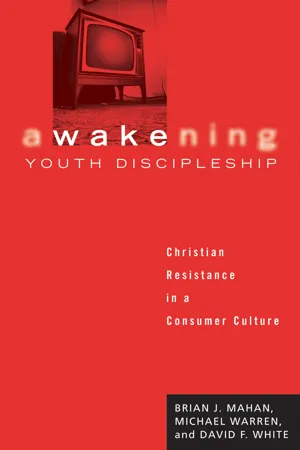
Youth ministry has increasingly lost touch with its origins in the way of Jesus and the social practices intrinsic to Christian discipleship, and has instead substituted layers of “Jesus talk,” middle class values, fun and games, and doses of “warm fellow-feeling.” Awakening Youth Discipleship articulates the history of this domestication of youth and ministry. Mahan, Warren, and White tell a story of the ways in which our society has colluded to shape a domesticated adolescence. The authors believe a Christian response to this challenge must be multilevel, addressing the problem at three levels—society, church, and individual. The authors propose reclaiming practices of discernment that both engage congregations in social awareness and involve individuals in discerning fuller vocational opportunities than those allowed by popular cultural norms.
eBook - ePub
Awakening Youth Discipleship
Christian Resistance in a Consumer Culture
- 138 pages
- English
- ePUB (mobile friendly)
- Available on iOS & Android
eBook - ePub
Awakening Youth Discipleship
Christian Resistance in a Consumer Culture
About this book
Information
Topic
Teologia e religioneSubtopic
Ministro del culto cristianoPART ONE
Consumerism in the Cultural Context
David White’s two essays, “The Social Construction of Adoles-cence” and “Pedagogy for the Unimpressed,” provide a theoretical backdrop for the volume as a whole.
In the first essay, David illustrates how various social structures throughout history—especially economic and political ones—have influenced social constructions of adolescence, which have in turn spawned misleading and harmful assumptions about youth and youth ministry, many of which remain in force today. David’s detailed and closely worked historical overview also provides the scholarly groundwork for challenging the widely held assumption that current pedagogies aimed at domesticating youth, and youth ministry as well, are inevitable and irreversible.
In his second essay, David builds upon and extends his theoretical analysis by introducing several practices of resistance that engage youth in studying the complex social, cultural, and economic systems that impinge so powerfully and incessantly on their lives. These practices of resistance, though essential, are not conceived as ends in themselves, but as serving to free youth to respond more fully and compassionately to the deep call of God upon their lives.
1
The Social Construction of Adolescence
Contemporary Context of Youth and Ministry
A look at the public face of contemporary youth ministry reveals that there are available more resources, books, curricula, videos, and conferences than ever before in the history of the world. Youth ministry, like contemporary Christian music, has become a significant industry in the U.S. In this youth ministry market we see high energy, high visibility, and high budget programs, promising high yield youth ministry. And for some, and in a certain way, this seems to work—we have even learned how, for example, with enough resources to attract great numbers of young people, to get them to make professions of faith. And yet, a recent report of the National Study of Youth and Religion (NSYR) indicates that sixty percent, or the majority of American teenagers—who are overwhelmingly mainline Protestant and Roman Catholic—hold attitudes toward religion described as “benign positive regard.” In other words, they believe religion is good, but inconsequential.1 As the project’s principle investigator, Christian Smith, a sociologist at the University of North Carolina-Chapel Hill, put it, “Most religious communities’ central problem is not teen rebellion but teenagers’ benign ‘whateverism.’” 2 Most of these youth call themselves Christians, regularly attend worship, and are involved in Christian education and youth ministry programs. But they have virtually no religious language to prove it, nor do they understand central doctrines of historically orthodox Christianity. The version of Christian faith they have internalized does not, for the most part, influence the shape of their lives, their relationships, or perspectives on vocation. This NSYR report represents something of a wake-up call to those doing youth ministry as usual, and a challenge to reconsider what counts for most congregations as youth ministry.
While a better plan for more effective youth ministry is far from clear, one clue to our way forward involves understanding the relationship of Christian faith to culture, including how culture clarifies or distorts the gospel, and whether we should celebrate or resist the cultural milieu in which we minister with youth. And importantly, historical perspective is necessary if we are not to simply reify our current cultural forms, imagine them as normal and appropriate, as the way the world has always been. If we ignore the historical development of cultural institutions, the stories of their rise to prominence and the particular influences that shaped them, we may assume as normal such social institutions as slavery, racism, misogyny, classism—or adolescence.
Since the invention of the social institution of adolescence over a hundred years ago, adolescence has rarely been questioned, apart from the rise of developmental theories that have largely served to establish it as normal in the popular mind. And, until recent years, the bargain of adolescence—dependence and education now, responsibility and independence later—has worked reasonably well for many, due primarily to its brief span and the certain reward of middle-class employment. However, recent cultural developments have made problematic this unwritten treaty with youth. These developments relegate most youth to institutions in which they have less than full power for longer than any age cohort in the history of the world, leaving them considerably less free to make their distinctive mark on history, and are quickly shaping them as passive consumers rather than active agents and shapers of history. Further, cultural observers recognize a subtle hostility toward youth, in which youth are unfairly blamed for everything from rising rates of violent crime to high rates of teen pregnancy.3 In recent legislation, more than fifteen states have criminalized youth behavior once considered experimental, such as public mischief, minor vandalism, and gang affiliation, placing increasing numbers of youth alongside adults in courtrooms and prisons.4
Unfortunately, these and other troubling social conditions do not remain outside the church door, regardless of our resolve to ignore them, but they impact our church youth and our youth ministry. Discussions of church youth ministry are often framed too narrowly and assume as normal the social location of adolescence. As a result, the church has often adopted approaches to ministry that further domesticate and marginalize youth. As a society and as the church we have too long neglected questions like these: How and for what purposes was the institution of adolescence shaped? Who has benefited from it? What should be the church’s response?
This chapter will illuminate a series of watershed moments in the history of adolescence, in which the social location of youth significantly shifted.
Organic Preindustrial Society
Preindustrial youth and their families experienced life as interrelated—connected with each other and the greater public good. In preindustrial America, youth and adults worked side by side for the benefit of families and their communities. The rhythms of life for the young were largely defined by work and their capacity for it. As far back as the seventeenth century, children as young as six or seven were often sent out to work in the homes of nearby relatives or neighbors. Some young children were bound out as servants, but were, by age fifteen or sixteen, often apprenticed to learn the intricacies of a craft. The work of children and youth was important, at least in part as a form of social security and unemployment insurance for aging parents. But youth work also had larger social purposes. According to Thomas Hines, the traditional story of the birth of America has emphasized how generations of adults have sacrificed themselves for their children but has neglected the labor of teenagers and the very large role it played in the development of North America.5 Hines states, “Work was not punishment, but part of a larger purpose: It helped sustain the family, the larger community, and many believed, God’s plan.”6 Hines offers a corrective to the story of preindustrial labor.
For most of our history, child labor was not a social horror but simply a fact of life. . . . The exploitation and abuse we now attach to the term did not exist until work moved from the home and into the factories that began to appear at the turn of the nineteenth century. . . . Americans were very, very slow to condemn it. Most developed serious moral scruples about child labor only after industrialists concluded it was inefficient, and labor unions sought to keep wages up by preventing its reappearance.7
In addition to the importance of the work of youth for family and society, there were also considerable compensations for youth themselves. Hines argues, “They had the satisfaction of doing real work and making a difference—experiences that modern teenagers often miss.”8 The entire idea and experience of work has become so distorted by industrial work that we fail to grasp that work was often a source of great joy, power, connection, and creativity. A worker who tilled the soil with his family developed deep understandings of and connections to the earth, the seasons, the sun and moon, the growing cycles, and appreciation of human strengths and his or her signature gifts.
The family was the primary economic unit, the location of production, and the chief policing authority—the only safety net. If individuals became estranged from their family, prison was the only other social institution they were likely to encounter.9 In fact, each of the New England colonies had laws that forbade living outside family government.10 If you did not have a family, the law required that you establish living arrangements with a family. Without the contemporary structures of social welfare and security, youth often passed from the care of their family into that of their master craftsman, a second family. Apprenticeship was also a source of education, as many masters were required to teach their apprentices to read and write, and often their catechism.11
In addition to work, young people once held important political and civic roles. In preindustrial communities, convention dictated that young people be quickly exposed to the religious, political, and emotional concerns of adults. According to Joseph Kett, “Public political gatherings were likely to attract children and youth as well as adults.”12 Indeed, youth were often politically aware and took up causes alongside adults, especially when work was undervalued or exploited by landowners or later by industrialists. Youth were politically aware enough to understand civic injustices—and often turned holidays and festivals, such as May Day, Midsummer’s festival, Guy Fawkes Night, and Feast of Fools into occasions for social protest and political street drama. In...
Table of contents
- Title Page
- Foreword
- Introduction: Practicing Resistance
- Part 1: Consumerism in the Cultural Context
- Chapter 1: The Social Construction of Adolescence
- Chapter 2: Pedagogy for the Unimpressed
- Part 2: Imagining an Inconvenient Church
- Chapter 3: The Imaginations of Youth
- Chapter 4: Youth Ministry in an Inconvenient Church
- Part 3: The Devil Is in the Details
- Chapter 5: Advanced Placement and the Kingdom of God
- Chapter 6: Youth Ministry and the Practice of Sacred Commiseration
- Part 4: Conclusion
- Chapter 7: Talking It Out Further Musings on Youth
Trusted by 375,005 students
Access to over 1.5 million titles for a fair monthly price.
Study more efficiently using our study tools.
Frequently asked questions
Yes, you can cancel anytime from the Subscription tab in your account settings on the Perlego website. Your subscription will stay active until the end of your current billing period. Learn how to cancel your subscription
No, books cannot be downloaded as external files, such as PDFs, for use outside of Perlego. However, you can download books within the Perlego app for offline reading on mobile or tablet. Learn how to download books offline
Perlego offers two plans: Essential and Complete
- Essential is ideal for learners and professionals who enjoy exploring a wide range of subjects. Access the Essential Library with 800,000+ trusted titles and best-sellers across business, personal growth, and the humanities. Includes unlimited reading time and Standard Read Aloud voice.
- Complete: Perfect for advanced learners and researchers needing full, unrestricted access. Unlock 1.5M+ books across hundreds of subjects, including academic and specialized titles. The Complete Plan also includes advanced features like Premium Read Aloud and Research Assistant.
We are an online textbook subscription service, where you can get access to an entire online library for less than the price of a single book per month. With over 1.5 million books across 990+ topics, we’ve got you covered! Learn about our mission
Look out for the read-aloud symbol on your next book to see if you can listen to it. The read-aloud tool reads text aloud for you, highlighting the text as it is being read. You can pause it, speed it up and slow it down. Learn more about Read Aloud
Yes! You can use the Perlego app on both iOS and Android devices to read anytime, anywhere — even offline. Perfect for commutes or when you’re on the go.
Please note we cannot support devices running on iOS 13 and Android 7 or earlier. Learn more about using the app
Please note we cannot support devices running on iOS 13 and Android 7 or earlier. Learn more about using the app
Yes, you can access Awakening Youth Discipleship by Brian J. Mahan,Michael Warren,David F. White in PDF and/or ePUB format, as well as other popular books in Teologia e religione & Ministro del culto cristiano. We have over 1.5 million books available in our catalogue for you to explore.