The themes of these stories are profoundly human themes, capturing the persistent interaction between God and humankind. These narratives invite us to witness the manner in which God enters human community in all of its complexities, struggles, challenges, fears, and ultimately hope. As the narratives unfold, not only is it clear that God will not be restricted by societal and cultural conventions, but the human journey will be generated by faith and doubt, fear and hope, promise and fulfillment.
Hemchand Gossai not only explores the various themes within a variety of texts, but maintains a constant eye on the implications for the church and contemporary readers. In this regard, some of the literal and particular experiences such as barrenness, wilderness, and wrestling with God are examined as metaphors for our experiences. The richness and texture of metaphors allow us to embrace these stories in a way that makes them our stories.
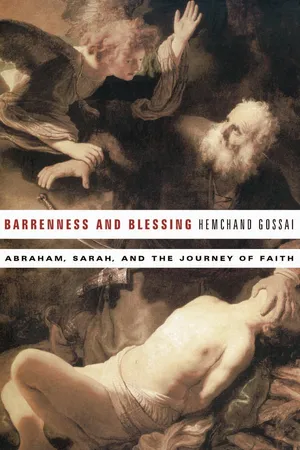
- 136 pages
- English
- ePUB (mobile friendly)
- Available on iOS & Android
eBook - ePub
About this book
Information
1
The Challenge of Barrenness
Barrenness is likely to tell us more about the way God proceeds than about the human who feels trapped in various states of barrenness. If indeed barrenness represents the end of a future or a death of sorts, God, as we see in these narratives, is unafraid to begin from this point. Barrenness is established as a possible place for yet another starting point for newness. Barreness also poses for the human being a challenge to believe beyond what is immediately apparent—certainly a challenge not to be taken lightly.
When taken either literally or figuratively, the idea of barrenness bodes ill for the future. Whether it is the barrenness of a land that is parched and dry with no prospects for life, or the barrenness of Sarah and Abraham who, now in their elderly years, have resigned themselves to not having offspring. Barrenness ultimately leads to resignation and to the belief that the present reality is the way things will always be, and there is no vision for the unfolding of a future beyond one’s capacity to see. Thus, hope dies in the face of barrenness. The challenge of barrenness then is not only to accept a particular reality of the present, but also to imagine that it is not the last word, that the final divine word is yet to be spoken and eventuated.
The fact that the Abraham narrative begins with an iteration of Sarah’s barrenness establishes that this will be a persistent challenge to the future of Abraham and Sarah. That the challenge of barrenness comes on the heels of the genealogy of Terah, Abraham’s father (Gen 11:10–29), makes clear that if barrenness continues for Abraham and Sarah, then their story and lineage will indeed come to an end. Yet, ironically, as if to set the challenge of the promise of descendants in sharp relief against the genealogy, the narrator begins the story of Abraham and Sarah with barrenness. Yet, how can barrenness become a door to new life and not, as it is conventionally understood, the final word? This is the challenge.
The reality of Sarah’s barrenness is juxtaposed against the tripartite promise that God makes to Abraham for 1) land, 2) descendants, and 3) blessing (Gen 12:1–3). Notable here is that promises in the face of barrenness are made without a timeline, the very thing most of us would naturally seek. Instead a new future is spoken of, and neither God nor Abraham broaches the “when” question. The language of the text is spare and terse, but the underlying issue is unmistakable. How might these promises be embraced and believed in the face of barrenness? The very pronouncement of the promises establishes a change in Abraham and Sarah’s reality, for these divine words carry the power and force of fulfillment. Can Abraham and Sarah’s faith have a future? Do they have the requisite faith beyond their human vision?
Sarah’s barrenness, however, is but a beginning. To the degree that barrenness might be construed as that which places a “period” after the “sentence” of the present, then Abraham and Sarah’s immediate journey to the land of Canaan, and their discovering a populated land poses another expression of barrenness, in the sense that on the surface, it appears that there is no way toward the promise of attaining the land (Gen 12:6). Without any elaboration, Abraham and Sarah are simply told that the land of Canaan will be theirs, and again in that moment Abraham believes (v. 7). Belief of such extraordinary magnitude under ordinary circumstances is remarkable, but in the face of barrenness, such belief is truly remarkable. The transformation from the present reality of security and settledness had begun, but not without significant hurdles. Whatever glimpses Sarah and Abraham have of the future seem to be blocked. Not only does Sarah and Abraham’s old age defy childbearing, but also old age coupled with Sarah’s lifelong barrenness seem to eliminate any prospect of having children. Further, the irony of the “fullness” of the land poses a particular kind of barrenness, for both descendants and land are prerequisites for nationhood, and the land of promise is already populated. Under these circumstances, the prospects of Abraham being a blessing to others seems to be a particular challenge.
Yet, in view of these many expressions of barrenness, Abraham and Sarah nevertheless begin their journey without objection, without question—a posture remarkable under any circumstances. It is evident from the beginning that this journey will pose for them unique challenges. They cannot of their accord undo the state of barrenness or empty an occupied land. Thus, their journey begins and must proceed on faith. This is a journey that will generate many questions and challenges by Abraham and Sarah, most of which are directed at God. But at the outset, it is God who announces, and humans respond. God, as architect of the promise and journey, is recognized as such when Abraham builds an altar to God and worships (Gen 12:7).
Themes of Barrenness in Genesis and in Contemporary Life
Genesis 11:30 begins with the dramatic pronouncement that Sarah is barren. As in any great narrative beginning, this beginning marks a governing theme in the story. Yet even as the theme of barrenness is mentioned prominently, the narrative seemingly continues in a different direction. Still, it is clear that Sarah’s barrenness is not a detail to be dismissed. The wider narrative of Genesis, which to this point has recounted various genealogies, seems to bring to an end any future prospects for this particular family. Genesis 11 ends with a note of present death (Terah’s demise) and with the death of a future (Sarah’s barrenness). Whatever else will transpire in this narrative, certainly Abraham and Sarah’s journey will not be ordinary, and in no way will it be easy or straightforward. Moreover, by beginning with barrenness, this narrative sensitizes its audience to a new reality: this state of barrenness will not always be the way it is. The double statement in 11:30 (“Now Sarai was barren; she had no child”) emphasizes Sarah’s barrenness, but then this detail remains unattended, as if the narrator intends to plant this seed of barrenness in the minds of the readers, with the hint of what is to come. As one generation comes to an end with the death of Terah, the prospects for Abraham’s generation to end without posterity loom large, and one is sharply reminded that Sarah is barren; Sarah and Abraham do not have a child. The present is clear, and unless something extraordinary happens, the future is also set to end. In the face of such barrenness, then, what might one hope for? The challenge of barrenness takes one beyond the present, to imagine a future that seems impossible in the light of the present circumstances. Certainly the particularity of Sarah’s barrenness is very clear; on a personal level, she will not be able to experience the quintessential expression of motherhood—that defining quality of womanhood in ancient Israel. Yet, as important as this deprivation is, barrenness (as we witness it in this narrative) ushers in a broader and more complex picture for humanity. I suggest that barrenness in the context of this narrative has universal implications. A sharp juxtaposition occurs between, on the one hand, the theme or tone of death at the end of Genesis 11, and, on the other hand, the unexplained, equally surprising pronouncement of newness, and the break from the past as Genesis 12 begins. Newness will happen in the context of barrenness, and this means that human beings’ faith and trust not only will be essential but also will be put to the test.
Even beyond the particularity of Sarah’s barrenness, the promise of land to Abraham and his ancestors is dramatic; the promise of a land brings a more definitive sense of belonging. Indeed the physical barrenness of Sarah clearly relates to the barrenness of landlessness. With the promise of the land comes the distinct possibility of a new sense of belonging. Both the promise of progeny and the promise of land will take enormous faith, as neither seems possible as far as Abraham and Sarah’s horizon extends. Abraham and Sarah’s faithful step in departing Haran indicates willingness and trust; but, as we shall see from the narrative, what will be essential is sustained trust. As if these challenges were not enough, the reality is that both Abraham and Sarah are old. Thus, journeying to land and offspring (both beyond their capacity) will test their trust to the very limit.
Whereas Genesis 1 begins with what some scholars refer to as creatio ex nihilo or order out of chaos, Genesis 12 begins differently; it begins with promise of a future. However, it is the verses that connect the primeval history of Genesis 1–11 to the ancestral narratives of Genesis 12–20 that in fact strike a marked chord of resonance. If, in fact, it would take divine initiative to bring creation out of nothing or order out of chaos, then it would involve equally divine initiative to bring about a people out of barrenness. Such is the dramatic reminder in Genesis 11:30, that indeed it would take nothing less than a divine working. In both Genesis 1 and Genesis 12, God’s presence and active generating are essential. In the case of human understanding, beginning from a state of nothingness is out of the realm of reality. However, in Genesis 1 and 12, God employs barrenness, both literally and metaphorically, as a point of beginning. Without ever stating the obvious, the text establishes that God is able to bring creation into being from any source—including from a source unimaginable to human beings. Moreover, given human finitude, it will take more than humankind’s capacity for reason or knowledge to enter into such a realm of creation.
That is to say, humans will have to envision, imagine, believe, and trust. Indeed barrenness invokes precisely these qualities in humankind, for barrenness is to be seen as a divine comma as opposed to a human period. Indeed the very drama of the Abraham narrative depends overwhelmingly on the role of barrenness. Within human history, it would certainly be conventional to begin something new from a point of strength. By design, God’s hope and plan for a future is planted firmly in a barren context. From a human perspective, this might appear to undermine the establishment of a future. Yet, from the outset, the text has established the nature of hope. Hope receives its finest and sharpest definition in the context of what appears to be hopeless and barren. Indeed hope only has a fullness of meaning when generated from a state of hopelessness. We not only discover that Sarah is barren, but also that the land is inhabited; thus at the very outset, the stark and complex reality is that both emptiness and fullness are expressions of barrenness. Why would God choose to begin at such devastating points? Placement, displacement, and replacement all converge. It is not within the power of Abraham and Sarah to have a child together as it stands, anymore than it is possible for Abraham and Sarah to empty the land of Canaan. While it is the case that “this God does not depend on any potentiality in the one addressed,”1 and thus God establishes God’s self very clearly as the architect of this newness, nonetheless humans play an essential role in its fulfillment. Even as the “spoken word” in Genesis 1 generated a defined universe, also the spoken word to Abraham in the face of barrenness will generate newness. The power of the divinely spoken word is evidenced throughout Scripture: from Moses to Elijah, from Eli to Jeremiah. What we are assured of is that nothing is beyond the scope of God, and that God will use whomever God chooses—even the old and barren and those who cannot envision beyond the present. This is a manner of suggesting that human barrenness in all of its manifestations is tied to faith.
In the crucifixion and resurrection accounts in the Gospels, it was widely believed by those closest to Jesus that the crucifixion is an end. The idea that life might emerge from death seems inconceivable despite the many representations of such emerging life throughout the ministry of Jesus. Throughout the Hebrew Bible and the New Testament, it remains the case that God intentionally begins from a “barren” state. From the physical barrenness of Sarah, Rebekah, Rachel, and Hannah; from David, ill-qualified to be king, to Peter, the Rock; from Rahab to Mary Magdalene. Barrenness, in fact, is the norm for God and thus stands in marked contrast to human conventions for the launching of newness.
Yet, as if Sarah’s barrenness were not enough, the theme of dislocation is introduced. Abraham, Sarah, and others are asked to leave their sense of security, and journey into the unknown. In order for Abraham and his descendants to find a place—a land—it would first mean a sense of displacement, for them to take the extraordinary risk to dislocate, and with no particular idea of what to expect (Gen 12:3–4).
As the narrative begins, two themes become inseparable, namely, heirship and family. Both of these are placed within the context of barrenness. Thus from the beginning, by human standards the progression of the future appears dark and close to ending. The mention of Lot in Genesis 11:27, and the clearly identified barrenness of Sarah (“Now Sarai was barren; she had no child” [11:30]) accentuate the suspense of the future. No explicit indication is given for Lot’s accompanying Abraham except perhaps for the juxtaposition of Lot with the barrenness of Sarai, and the early textual allusion that Lot would become the heir of Abraham—a customary solution to the heirship dilemma. This mention of Lot as Abraham’s heir is a striking allusive note as to the textual plans for the future. Even as the narrative proceeds, it becomes apparent that conventional human constructs, important as they are, will not suffice. Perhaps the lack of specificity in Genesis 12:1–3 about the way that the promised heir will be fulfilled might very well lead readers to conclude that Lot might be the presumptive heir; or readers might be persuaded, more notably, by Genesis 15, where Abraham wonders to God whether Eliezer of Damascus will be his heir (v. 2). Again the divine assurance is given without specifics. With this ongoing pattern, the Abraham narratives are held in a constant state of suspense.
With the call out of barrenness for Abraham and Sarah, we witness a gradual movement to the center of existence. This movement from marginality to centrality is seen in at least two ways. Clearly barrenness as a state of marginality is evident throughout the Abraham narratives. But as Fretheim has noted, “the family . . . enables God’s cosmic purposes...
Table of contents
- Title Page
- Preface
- Introduction
- Chapter 1: The Challenge of Barrenness
- Chapter 2: The Challenge of Wilderness
- Chapter 3: The Challenge of Wrestling with God and Self
- Chapter 4: The Hope of Promise
- Chapter 5: The Hope of Blessing
- Chapter 6: The Hope of Fulfillment
- Bibliography
Trusted by 375,005 students
Access to over 1.5 million titles for a fair monthly price.
Study more efficiently using our study tools.
Frequently asked questions
Yes, you can cancel anytime from the Subscription tab in your account settings on the Perlego website. Your subscription will stay active until the end of your current billing period. Learn how to cancel your subscription
No, books cannot be downloaded as external files, such as PDFs, for use outside of Perlego. However, you can download books within the Perlego app for offline reading on mobile or tablet. Learn how to download books offline
Perlego offers two plans: Essential and Complete
- Essential is ideal for learners and professionals who enjoy exploring a wide range of subjects. Access the Essential Library with 800,000+ trusted titles and best-sellers across business, personal growth, and the humanities. Includes unlimited reading time and Standard Read Aloud voice.
- Complete: Perfect for advanced learners and researchers needing full, unrestricted access. Unlock 1.5M+ books across hundreds of subjects, including academic and specialized titles. The Complete Plan also includes advanced features like Premium Read Aloud and Research Assistant.
We are an online textbook subscription service, where you can get access to an entire online library for less than the price of a single book per month. With over 1.5 million books across 990+ topics, we’ve got you covered! Learn about our mission
Look out for the read-aloud symbol on your next book to see if you can listen to it. The read-aloud tool reads text aloud for you, highlighting the text as it is being read. You can pause it, speed it up and slow it down. Learn more about Read Aloud
Yes! You can use the Perlego app on both iOS and Android devices to read anytime, anywhere — even offline. Perfect for commutes or when you’re on the go.
Please note we cannot support devices running on iOS 13 and Android 7 or earlier. Learn more about using the app
Please note we cannot support devices running on iOS 13 and Android 7 or earlier. Learn more about using the app
Yes, you can access Barrenness and Blessing by Hemchand Gossai in PDF and/or ePUB format, as well as other popular books in Théologie et religion & Critique et interprétation bibliques. We have over 1.5 million books available in our catalogue for you to explore.