- 166 pages
- English
- ePUB (mobile friendly)
- Available on iOS & Android
eBook - ePub
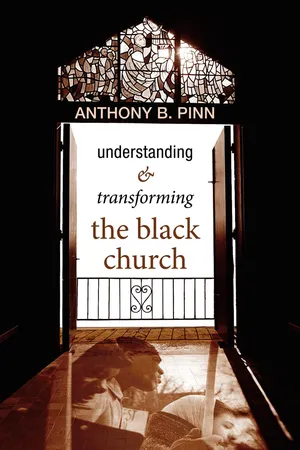
Understanding and Transforming the Black Church
About this book
What is the nature and purpose of the Black Church? What is the relationship of the scholar of religion to the Black Church? While black churches have been a major component of the religious landscape of African American communities for centuries, little critical attention has been given to these questions outside an apologetic stance. This book seeks to correct this trend by examining some of the major issues facing black churches in the twenty-first century. From a challenge to traditional ways of addressing sexism within black churches to African American Christianity's relationship to popular culture, this set of reflections seeks to offer new perspectives on what it might mean to be Black and Christian in the United States.
Information
Topic
Theology & ReligionSubtopic
Christian ChurchPart I
Understanding the Black Church
1
Who Are the People in the Pews?
Black Theology on Black Bodies . . . in Church1
Black churches are populated with Black bodies. This rather basic claim on some level is recognized in and gives shape to studies on African American religious thought and life over the past several decades. Unfortunately within much of this scholarship Black bodies are a “shadow,” or inferred (assumed) reality. That is to say, attention has been given to the consequences of living within a Black body—racism and so on. But what of the very nature and meaning of these bodies?
In this chapter I give attention to a new movement within Black and Womanist theologies meant to address the question above. I accomplish this through a turn to four recent and key texts related to the construction and presentation of Black bodies. The first two texts, by Mark Smith and Michael D. Harris, provide theoretical context, and the books by Kelly Brown Douglas and Dwight Hopkins suggest particular ways to think about these Black bodies within the context of Black churches. Ultimately, through an interrogation of these texts, I offer a way of framing a plausible understanding of who is in the church pew as a necessary precondition for any other work. It is only after this discussion that proper groundwork is in place for interrogation of the issues and concerns presented in the remaining chapters.
Constructing and “Sensing” the Raced Body
Allow me to begin this study with a simple claim that harkens back to the first several sentences of this chapter: Bodies represent contested terrain.2 Black bodies have played this role in rather unique ways. Many who study Black churches think of this construction and deconstruction of Black bodies in terms of how they occupy economic, and political contexts as well as social time and space.3 This posture is to be expected to the extent Black religious studies is concerned with liberative responses to socioeconomic injustice framed by an ontological understanding of Blackness harnessed to the written text with the visible as the basis of analysis and activism. To narrow the focus, this thinking is in keeping with the theological lineage of Black theology and Womanist theology, as they grow out of theological liberalism and its concern with the humanity of Christ in addition to consequential attention to the nature and substance of humans on the level of existential realities. However, current research suggests a question: Is such an approach adequate to the task? Is racial construction and racism based merely on physical vision? What of the other senses?
Mark Smith, in How Race Is Made,4 suggests that slavery and segregation as basic examples of racial discrimination are not premised strictly on the observable in that the physical appearance of a slave, “Blackness” as the visual marker of servitude and inferiority, loses its force through, for example, the physical appearance of offspring of enslaved Africans and Whites. As race is a social construct, the manner in which those ‘raced’ bodies are marked and distinguished is also a matter of social construction—and the increasingly messy nature of discrimination required attention to more than what the eye revealed. Consequently, other human senses such as smell, touch, hearing, and taste were used to distinguish categories of existential and ontological value in ways vision did not match since the eye often could be deceived. In an ironic twist, this process of “sensing” the world as a raced context was predicated on the very “privileges” of contact and control upon which the institution of slavery rested, and upon the assumed infrastructures of discrimination qua segregation. As Smith puts it, “people sensed their worlds—heard sounds they did not want to hear (we are without ear lids, after all), had to smell smells they did not want to smell, used the putatively premodern, proximate, nonvisual senses to invent ‘modern’ racial stereotypes—we begin to understand the historically conditioned, visceral, emotional aspect of racial construction and racism.”5
In the early stages of modern race relations there was an important connection between “race-thinking and gut-feeling.”6 Smith suggests attention to race as defined beyond the visual allowed for a certain comfort with the social world as it existed in that one could associate negative sensations with “Blackness” without having to give a great deal of thought to the ramifications of this making of Black bodies.
Sensory marking of Blackness is an old enterprise, gaining its most demonic dimensions during the eighteenth and nineteenth centuries. During that period, racists pushed the inferiority of Africans based on sensory arguments that Africans had a distinctively tough skin best suited for hard work. And, furthermore, it was argued that the presence of Black bodies could be noted without appeal to vision through the overwhelmingly unpleasant smell associated with those bodies.
Blacks not only presented themselves to the senses of Whites in an unpleasant manner, but Blacks also sensed the world differently—with less refinement and without the type of reasonableness that marked the behavior and capabilities of Whites. What is more, Whites supporting the slave system suggested at times that sensory capabilities of Blacks were similar to those of various domestic animals. “Planters,” Smith writes, “summoned slaves as they summoned animals. Some thought dogs and blacks understood whistles by means of sharp ears, although slaves, as humans, earned a slightly different tone than dogs.”7 Appeal to the senses also allowed a cushion against the graphic need for punishment in that, for example, Black skins assumed thickness and odd texture meant limited sensation. Hence, beatings were pedagogically useful but of limited pain. Such a rationale might, for a limited period at least, subordinate the visible signs of punishment such as maimed bodies and thick scar tissue on Black backs.
While there was ongoing debate concerning the religious-theological rationale for enslavement, smell, touch, taste, and hearing provided a respite of sorts for slavery sympathizers in that these senses could be used to bracket pressing demands for rationale arguments. The senses provided modalities of differentiation that did not require the hard work of thought; rather, they justified “gut-feeling.” What is more, sensory perception provided rules of engagement and cartography of difference that did not require years of experience. Even small children could learn and employ the sense-based arrangement of beings. What must be remembered, however, Smith notes, is that the ability to sense the nature of this difference was also a matter of geography in that some southerners argued northerners opposed to slavery might have the same forms of sensory perceptions as southern Whites but their lack of sociocultural familiarity with the South prevented them from fully appreciating the sensory otherness of Blacks.
Whites were not alone in sensing the presence of the “other.” Enslaved Africans and their descendents also marked the parameters of whiteness through more than the visual appearance of bodies. Yet Blacks could not, without reenforcing the logic of discrimination, suggest the legitimacy of “an innate sensory dimension to whiteness.”8 Rather, Blacks tended to challenge racial discrimination and identification by giving socioeconomic mandates for particular sounds and smells. For example, many Blacks argued the smell they carried on their bodies resulted from hard work and such smells were not inherent but were a matter of social and economic constructions beyond their control. While whiteness was also sensed, the sensual markers of this social construct were mild in comparison—even when sensing the bodies of poor Whites. Although not well dressed, smelling of hard work, and sounding unrefined, these Whites, the argument goes, did not have negative sensual indicators understood as markers of inherent inferiority. Rather, less than pleasant sensual experience of their presence was typically understood as the consequences of poverty. After all, they were not well presented, not pleasing to the ear; but they did not have Black bodies. In reviewing this sensory distinction between Black and White bodies, it is important to recognize that Blackness posed a threat, according to the stratagems of sensory perception, to all Whites regardless of their socioeconomic standing.
Sensory information was always funneled through sociopolitical considerations that meant a continuing distinction between Blackness and Whiteness regardless of what might appear to the senses as overlap. Based on sensory perception, Blackness was understood as an e...
Table of contents
- Title Page
- Acknowledgments
- Introduction
- Part 1: Understanding the Black Church
- Chapter 1: Who Are the People in the Pews?
- Chapter 2: (Un)Churched
- Chapter 3: The Parameters of the Black Church
- Part 2: Transforming the Black Church
- Chapter 4: Si(g)nful
- Chapter 5: Mishaps and Wrong Turns . . . but Always in Your Best Interest
- Chapter 6: Hitting Where It Hurts
- Concluding Thoughts
- Bibliography and Index
Trusted by 375,005 students
Access to over 1.5 million titles for a fair monthly price.
Study more efficiently using our study tools.
Frequently asked questions
Yes, you can cancel anytime from the Subscription tab in your account settings on the Perlego website. Your subscription will stay active until the end of your current billing period. Learn how to cancel your subscription
No, books cannot be downloaded as external files, such as PDFs, for use outside of Perlego. However, you can download books within the Perlego app for offline reading on mobile or tablet. Learn how to download books offline
Perlego offers two plans: Essential and Complete
- Essential is ideal for learners and professionals who enjoy exploring a wide range of subjects. Access the Essential Library with 800,000+ trusted titles and best-sellers across business, personal growth, and the humanities. Includes unlimited reading time and Standard Read Aloud voice.
- Complete: Perfect for advanced learners and researchers needing full, unrestricted access. Unlock 1.5M+ books across hundreds of subjects, including academic and specialized titles. The Complete Plan also includes advanced features like Premium Read Aloud and Research Assistant.
We are an online textbook subscription service, where you can get access to an entire online library for less than the price of a single book per month. With over 1.5 million books across 990+ topics, we’ve got you covered! Learn about our mission
Look out for the read-aloud symbol on your next book to see if you can listen to it. The read-aloud tool reads text aloud for you, highlighting the text as it is being read. You can pause it, speed it up and slow it down. Learn more about Read Aloud
Yes! You can use the Perlego app on both iOS and Android devices to read anytime, anywhere — even offline. Perfect for commutes or when you’re on the go.
Please note we cannot support devices running on iOS 13 and Android 7 or earlier. Learn more about using the app
Please note we cannot support devices running on iOS 13 and Android 7 or earlier. Learn more about using the app
Yes, you can access Understanding and Transforming the Black Church by Anthony B. Pinn in PDF and/or ePUB format, as well as other popular books in Theology & Religion & Christian Church. We have over 1.5 million books available in our catalogue for you to explore.