- 262 pages
- English
- ePUB (mobile friendly)
- Available on iOS & Android
eBook - ePub
About this book
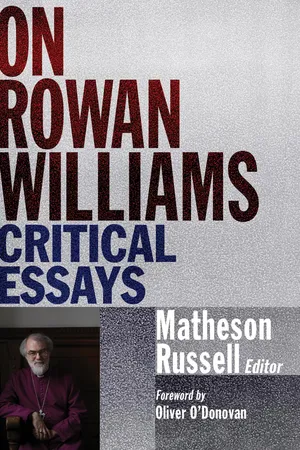
Theologian, poet, public intellectual, and clergyman, Rowan Williams is one of the leading lights of contemporary British theology. He has published over twenty books and one hundred scholarly essays in a distinguished career as an academic theologian that culminated in his appointment as Lady Margaret Professor of Divinity at Oxford University. Williams left this post to serve in the Anglican Church, first as Bishop of Monmouth, then Archbishop of Wales, before finally being enthroned in 2003 as the 104th Archbishop of Canterbury.
In this collection of essays, a talented younger generation of Australian theologians critically analyzes the themes that bind together Williams's theology. These sympathetic yet probing essays traverse the full breadth of Williams's work, from his studies on Arius, the Desert Fathers, Hegel, and Trinitarian theology to his more pastoral writings on spirituality, sexuality, politics, and the Anglican Church.
Information
Topic
Teología y religiónSubtopic
Iglesia cristiana1
The Ecclesiology of Rowan Williams
Rhys Bezzant
It has been said that Rowan Williams’ ecclesiology is Rowan Williams’ theology.1 Though he has not composed a comprehensive systematic theology,2 Williams’ disparate writings (scholarly monographs, sermons, dedications, forewords, afterwords, journal articles, opinion pieces in church newspapers, speeches, letters, and book reviews) nevertheless adumbrate systematic concerns, and because they are in the main occasional in nature they inevitably refract current issues, questions, debates, or schisms addressed in the church. It seems that ecclesiology is precisely everywhere even if only suggestively in his written work.
Williams’ concern for the church is seen not just in his theological opinions. He also exemplifies in his own career path a commitment to ecclesial life. His decision to relinquish his chair as Lady Margaret Professor of Divinity in Oxford to take up a calling as the Bishop of Monmouth in South Wales (his native county and country) in 1991, with its seat in the less than salubrious port-town of Newport, demonstrates this. His ministry was later stretched when he accepted the additional role of Archbishop of Wales (1999); he was translated to Canterbury in 2002, amidst cries of dismay particularly from the evangelical wing of the Church, in England, and abroad. Williams’ broader concern for social justice is attested through a conversation in 1984 between ethicist Oliver O’Donovan and theologian John Macquarrie, who, upon the announcement of Williams’ appointment to Oxford, remarked that Rowan Williams would make an excellent Oxford don, “if only he’s out of jail at the time.”3 Williams had just been arrested for trespassing on an American air force base in England to protest the strategy of nuclear deterrence.
Deep streams of Williams’ theological thought come to the surface as he engages with contemporary issues, often creating unexpected crosscurrents that prove difficult to traverse. This survey will sketch an outline of the Archbishop’s ecclesiological practice and thinking in reference to some current challenges within the Anglican Communion, from the viewpoint of a fellow Christian and fellow Anglican, who has been nurtured in the evangelical wing of the Australian church.
Ecclesiological Case Studies
The Windsor Process
Williams’ translation to Canterbury came at a critical juncture in the life of the international Anglican Communion. Despite the conservative Resolution 1.10 on human sexuality, which had been overwhelmingly endorsed by the Lambeth Conference of Bishops in 1998, the integrity of the Communion has been more recently challenged by the decisions of the Diocese of New Westminster in western Canada, the Diocese of New Hampshire in the US, and the Diocese of Oxford in the UK to affirm at some level the validity of same-sex relationships. These breaches of the resolution emboldened breaches of Anglican polity by, for example, the Dioceses of Uganda, Singapore, and Brazil, who affirmed the propriety either of extra-territorial ordinations, or of entering without permission into an episcopal relationship with a parish or clergyperson in another diocesan’s jurisdiction.
To find some constructive way forward through such internecine debates, a new process was instituted by the Archbishop of Canterbury as an adjunct to the established mechanisms for coordinating the ministry and life of the international Anglican Communion.4 This new strategy consisted of four initiatives: the Listening Process established at the Lambeth Conference in 1998, both to learn more of the struggles of homosexual Christians and to appease those bishops present who were alarmed by the conservative turn of the resolution on human sexuality; the Lambeth Commission on Communion, called by Archbishop Rowan in October 2003, which was responsible for producing the report on the future of the Communion; the Panel of Reference to advise Canterbury and disputants as to the mind of the Communion; and the Covenant Design Group. This last working party has the responsibility of drafting a document that would find a real basis of unity among as many dioceses and provinces as possible, and of creating a structure, if not federal, then at least more intentional than the bonds of friendship between world-wide Anglicans left over from the British Empire. Together these initiatives have become known as the Windsor Process.
It has been necessary to expedite this process given the break-down of order within the Episcopal Church in the United States in the last five years, with parishes removing themselves from a bishop’s ministry, the General Convention suing parishes, churches being planted across diocesan boundaries, and multiple Anglican organizations and networks being constituted or realigned. Williams recently addressed the General Convention’s House of Bishops meeting in New Orleans, encouraging gratitude for the gift that each is to the other as the basis for being church and to temper appeal to legal solutions:
We are indebted to one another. I am indebted for your existence. Because I would not be myself without you. And a society, a community, a city that can get to that level of recognition, is one that lives from a deeper place than one that simply talks about contract or even respect. And it’s this perspective which I believe, this perspective above all that the church brings to bare. Because the church is a community which lives from and in gratitude.5
He has also had to write to an individual diocesan to affirm that the basic unit of the church is the diocese and not the province to encourage parishes to remain within their diocesan jurisdiction, though he affirms the necessary canonical and organizational functions of the province.6
Significantly, Rowan Williams’ role in the present fissiparous disputes has been to broker conversation, to correct theological and historical misunderstandings, and to provide some kind of missiological edge for the Communion.7 He is not a member of the Lambeth Commission, nor of the Panel of Reference, and has played no formal part in the drafting of a potential covenant for the Anglican Church. He does of course have formal responsibilities in each of the Instruments of Communion, as Archbishop, as Primate of all England, as President of the ACC, and as convener of the...
Table of contents
- Title Page
- Foreword
- Chapter 1: The Ecclesiology of Rowan Williams
- Chapter 2: The Hidden Center: Trinity and Incarnation in the Negative (and Positive) Theology of Rowan Williams
- Chapter 3: Disruptive History: Rowan Williams on Heresy and Orthodoxy
- Chapter 4: Krisis? Kritik?: Judgment and Jesus in the Theology of Rowan Williams
- Chapter 5: Dispossession and Negotiation: Rowan Williams on Hegel and Political Theology
- Chapter 6: The Humanity of Godliness: Spirituality and Creatureliness in Rowan Williams
- Chapter 7: Desire and Grace: Williams and the Search for Bodily Wholeness
- Chapter 8: Rowan Williams on War and Peace
- Chapter 9: The Beauty of God in Cairo and Islamabad: Rowan Williams as Apologist
- Bibliography
- Contributors
Trusted by 375,005 students
Access to over 1.5 million titles for a fair monthly price.
Study more efficiently using our study tools.
Frequently asked questions
Yes, you can cancel anytime from the Subscription tab in your account settings on the Perlego website. Your subscription will stay active until the end of your current billing period. Learn how to cancel your subscription
No, books cannot be downloaded as external files, such as PDFs, for use outside of Perlego. However, you can download books within the Perlego app for offline reading on mobile or tablet. Learn how to download books offline
Perlego offers two plans: Essential and Complete
- Essential is ideal for learners and professionals who enjoy exploring a wide range of subjects. Access the Essential Library with 800,000+ trusted titles and best-sellers across business, personal growth, and the humanities. Includes unlimited reading time and Standard Read Aloud voice.
- Complete: Perfect for advanced learners and researchers needing full, unrestricted access. Unlock 1.5M+ books across hundreds of subjects, including academic and specialized titles. The Complete Plan also includes advanced features like Premium Read Aloud and Research Assistant.
We are an online textbook subscription service, where you can get access to an entire online library for less than the price of a single book per month. With over 1.5 million books across 990+ topics, we’ve got you covered! Learn about our mission
Look out for the read-aloud symbol on your next book to see if you can listen to it. The read-aloud tool reads text aloud for you, highlighting the text as it is being read. You can pause it, speed it up and slow it down. Learn more about Read Aloud
Yes! You can use the Perlego app on both iOS and Android devices to read anytime, anywhere — even offline. Perfect for commutes or when you’re on the go.
Please note we cannot support devices running on iOS 13 and Android 7 or earlier. Learn more about using the app
Please note we cannot support devices running on iOS 13 and Android 7 or earlier. Learn more about using the app
Yes, you can access On Rowan Williams by Matheson Russell, Russell in PDF and/or ePUB format, as well as other popular books in Teología y religión & Iglesia cristiana. We have over 1.5 million books available in our catalogue for you to explore.