eBook - ePub
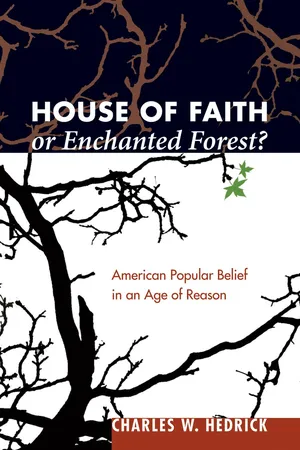
House of Faith or Enchanted Forest?
American Popular Belief in an Age of Reason
- 116 pages
- English
- ePUB (mobile friendly)
- Available on iOS & Android
eBook - ePub
About this book
Since the Renaissance of the 14th through 17th centuries, and particularly since the Enlightenment of the 18th century, the ancient creeds of faith have been under serious fire, and the struggle has not gone well for popular religion in America. The rapid advances made by the physical sciences in the 19th and 20th centuries and the corresponding reliance on scientific accomplishments in American life have been matched by the growing influence of reason in the way Americans think about religion. Except for pockets of resistance, these developments have negatively influenced the practical role of traditional religion in American life.
These essays-published over a twenty-year period as newspaper editorials addressed to the general public-confront popular beliefs and morals with the challenge of human reason. At issue in this meeting of faith and reason is nothing less than the nature of religion in the twenty-first century. Will faith embrace reason to create a House where both dwell in harmony or will faith ignore the claims of reason and continue to live in an Enchanted Forest? Each essay, written in the practical language of the streets, attempts to dialogue with the general reader and gently provoke critical thinking on sensitive issues of belief.
Information
Topic
Theology & ReligionSubtopic
Christian Church1. God in the American Streets
Belief in the existence of God remains constant in American culture. For most Americans, God, however conceived, is creator of all and has endowed the universe with balance and regularity. For religious people, balance and regularity in the universe lead to the idea of a designing “intelligence” behind the universe. Even those who are not particularly religious would likely agree, because they share the traditional view that God created the universe. After all, things had to begin somewhere—so the popular rationale would go. Unfortunately, disturbing events in the modern world raise questions about the idea of a “Designer.” For example, What is the “intelligence” in intelligent design?
Clearly the universe has regularity; yet things do not always work exactly the same. For example, light sometimes acts like waves and sometimes like particles, the scientists tell us. Most physicists recognize both regularity and randomness in the universe. But to describe its regularity as the “design” of a particular “intelligence” is essentially a confessional, not a scientific, statement. The “confession” derives in part from observable reality, and in part from religious ideas, and it is not the only way to account for the universe. A religious physicist, working with strict standards for scientific statements, might make a religious “confession” about the origins of the universe but would not pass it off as scientific—unless he or she had a particular agenda.
“Designs” are not always deliberate or intelligent. For example, anyone who has ever made an ink blot knows that the particular design one achieves is not deliberate but only accidental, produced by the amount and consistency of the ink and the way pressure is applied—a purely fortuitous product, it would seem. Cancers also have design—but what kind of intelligence would deliberately design a cancer into the fabric of the universe?
The idea that our universe is, more or less, regular does not lead inevitably, or even necessarily, to an intelligent designer—and certainly not to a benign intelligence. Some could well conclude that the intelligence behind the universe is careless, capricious—or worse, devious. What sort of intelligence would design a universe purposely hostile to life? Yet we seem to have such a universe. Debilitating disease (cancer, birth defects, cerebral palsy, arthritis, Alzheimer’s, etc.) and natural “acts of God” (like tornados, hurricanes, and floods) are apparently designed into our present universe.
In antiquity, some groups opposed the idea that a benevolent God fashioned the universe. Mindful of the suffering in the world, they argued that the fashioner was flawed, stupid, or even evil. How could caring intelligence deliberately produce a universe so frightfully hostile to humanity? Christians and Jews argued back that the designer did not originally create such a world. God created a world suitable for, and beneficial to, humankind (Genesis 1:31). As a result of willful creaturely rebellion, however, the designer then deliberately “cursed” the world to punish humanity (Genesis 3:17–19). But this does not solve the problem, for, like it or not, the “designer” is still left with responsibility for our hostile world. Cursing a world hospitable to human life over one infraction hardly seems the act of a caring intelligence. In arguing “intelligent design” the problem is how to distance the designer from the present world.
Could one also surmise that the designer simply abandoned the universe? Possibly, and without the designer’s oversight, creatures abandoned in a hostile world must adapt or perish, and, that seems to be the situation in which we find ourselves. In this world, as presently ordered, we either adapt or perish—as Mr. *Darwin argued nearly 150 years ago.
✿
We usually describe God in terms of the attributes with which we endow him.1 For instance, he gets angry with sin (wrath), he punishes the evildoer (retribution), he loves his creatures, he is patient, he forgives (merciful), etc. We don’t reflect on God as an entity with “personhood,” but rather only in terms of how we think God reacts to us. We don’t think God is a blind force, but rather as a deliberative deity who reflects the very best of our own human characteristics. At least we use our best features to describe him, so it is surprising we don’t inquire into God’s mind, and ask questions like does God ever muse about things?
What does God think about when he has time on his hands (so to speak)? Is God introspective or curious? Does he ever daydream? Has he ever had a new thought—an “Aha” experience? The question is not far fetched, since the Bible portrays God in the first account of creation giving himself a reflective pat on the back (“he saw that it was good,” Genesis 1:4, 10, 12, 18, 21, 25, 31), and kicking back for a rest on the seventh day (Genesis 2:2). In a second account of creation, he takes time off for a relaxing walk in *Eden “in the cool of the day” (Genesis 3:8)—still the custom in the modern Mediterranean world. I know some will object: “metaphors”! These are just figures of speech—the biblical writer is not speaking literally. Still, even to use such images begs the question: does God ever take time off from the business of running the world, curing disease, punishing the wicked, and the like, or is his divine mind always occupied with the cosmos and its creatures?
Does it really matter? Well, perhaps not to you, but it mattered a great deal to some of the ancient philosophers. For them, the ideal state for a God was “at rest.” God existed in silence, singularity, solitariness, and stillness—he even moved “motionlessly”! Movement, or thought, changed the deity, and change was a flaw. Deity, as they conceived it, was truly the same yesterday, today, and forever—without beginning, without end.
On the other hand, the popular view in ancient Mediterranean culture conceived of the Gods actively involving themselves in human affairs—destroying and protecting cities, devising plagues, working miraculous cures, discoursing with human beings, and much more. Today God is conceived more like the ancient popular view than the philosophical view. God is constant motion 24/7, everywhere at the same instant, juggling myriads of activities, starting plagues, performing miraculous cures, creating hurricanes, answering prayers, winning ball games—to mention just a few.
The philosophers would say about my curiosity, “what a nerdy question. Of course God does not dream, because his dreams, like his words, would be divine ‘things’ existing apart from him, and his former singularity would devolve into a duality—or worse.” They thought of God as an irreducible singular entity—a *Monad.
Today in western culture, we also think of God as Monad—on our best days we are not *polytheistic. On the other hand, Christianity is mostly *Trinitarian—the affirmation of three distinct persona in one God-head. This concept would strike the ancient philosophers as theoretically improbable because it employs plurality to explain God’s nature.
I prefer to think of God as sentient—a thinking being. And if God thinks, he is apt to be curious, think new thoughts, and even daydream. The philosophers would rightly object: if so, he is not “the same yesterday, today, and forever.” Others might object that I am simply inventing God in my own image! Perhaps so, but doesn’t everybody?
✿
During droughts in the American Midwest believers of all stripes will turn to God petitioning for rain for the crops. Indeed, petitioning God for a variety of things we humans find necessary for life is pretty much general practice in America. We seem to think that God, however we conceive him, is interested in the minutiae of each human life. It does not matter whether a person regularly and formally prays or not about such matters, in the streets people generally assume that God does control nature and natural occurrences. But certain events do seem to challenge such an idea.
The wake of destruction and death left by the *tsunami in Indonesia in 2004 and category-four hurricane Katrina in 2005 beg the question: who controls the weather, God or Mother Nature? The Bible does not portray *Yahweh, God of Jewish and Christian faith, directly administering the day-to-day routine of nature, as ancient nature Gods are portrayed. The regularity of their cult rituals was believed to ensure both the benevolence of the natural processes and the fertility of fields and flocks—though not even they were always able to control the weather (1 Kings 18:17–29). The *Canaanite God *Ba‘al, for example, was portrayed as the God of storms. Ruling over wind and clouds, his power was manifested in thunder and lightening. Yahweh, on the other hand, “earned his spurs” and made his reputation controlling history (Exodus 4:22–23; 15:21) and managing the religious welfare of the Israelites. He was far more interested in their religious obedience than directly maintaining the harmony and rhythm of the natural order. Rather than ensuring annual harvests by day-to-day hands-on (so to speak) management of nature, Yahweh is portrayed managing people by using nature to reward obedience and punish disobedience (Deuteronomy 28:1–46). Thus it seems more proper to say: Yahweh used nature when it served his purpose, but he is not generally portrayed directly juggling the daily routine of the physical elements, which was the nature God’s primary concern.
Whether Yahweh used nature wisely, or morally, however, is an open question. For example, he is portrayed as authorizing the killing of Job’s children (with a great wind, Job 1:19) as part of a bargain with Satan (1:9–12). Because of human “wickedness” (Genesis 6:5), he flooded the earth, obliterating every living thing (Genesis 6:17)—he thought better of it later, however (Genesis 8:21; 9:11). He destroyed the cities of Sodom and Gomorrah and everyone in them by means of fire and brimstone (Genesis 19:24–25—was it a volcanic eruption?), and he was also known to use hurricanes (Psalm 83:13–15). Hence, it appears that his periodic use of nature in the Bible is consistent with the recent tragedies in Indonesia and the Gulf.
Apparently God can control weather when he chooses, but he seems less inclined to regulate nature directly day by day, preferring to manipulate it from time to time for reasons known only to him. When we do know his reasons for interfering in the natural processes, he seems (from our perspective) to be a bit heavy-handed. The biblical record raises two questions: does God actually govern nature in a hands-on way (so to speak), or has he set an unregulated system in place, leaving to “Mother Nature” its day-to-day operation, which he manipulates from time to time? The more serious question is this: is it moral to use weather to reward and punish? Even we morally-challenged humans know degrees of evil exist in the world, and justice demands that they draw different degrees of punishment appropriate to the crime. But no such discrimination exists in “natural” disasters. The innocent suffer along with the guilty. If God uses storms to punish evildoers—such as using Katrina “to get those damn casinos” (as some suggested)—then in the process he is also taking out hospitals, seminaries, and orphanages! Describing “natural disasters” as “acts of God” makes God look incompetent or immoral; it seems best to chalk up such disasters to Mother Nature and revise your personal theology.
✿
Of course, maybe God has nothing to do with weather at all and the climate of a given region is a natural phenomenon and as such is simply due to luck, a comment that begs the question, What controls our lives: divine providence or “lady” luck? At some point everyone has said: “What a great stroke of luck,” or “We survived by the providence of God.” As a Baptist, I understand “divine providence” but what is “luck” and how do I reconcile it to the dominant idea in western culture that God somehow regulates the universe?
My brother-in-law had a great game of golf one weekend—even for him. He shot 67 for 18 holes including a hole-in-one. His wife chalked up the hole-in-one to his skill with the clubs. But he insisted “No, anytime you shoot a hole-in-one, it’s luck.” I thought about it for a moment and had to agree. If holes-in-one were due to skill there would be more of them. So I suggested: “Perhaps it was divine providence.” He replied: “No, it’s luck; God doesn’t care about golf.” My brother-in-law is a Baptist deacon, so I had to take him seriously. After all, golf is a game where you play against yourself, so the only plausible reason for God to intervene in his game and “bless” him with a hole-in-one was to lower his golf score and make him feel rather smug. We usually like to think God has bigger...
Table of contents
- Title Page
- Preface
- Introduction
- Chapter 1. God in the American Streets
- Chapter 2. The Bible in American Culture
- Chapter 3. Religion, Self, and Life in America
- Chapter 4. Does Absolute Truth Exist?
- Chapter 5. Superstition, Magic, and Modern Faith
- Chapter 6. Death and Dying
- Chapter 7. Holy Days and Religious Feasts
- Chapter 8. Postscript: Reason and Faith
- Endnotes
- Glossary
- Selected Bibliography
Trusted by 375,005 students
Access to over 1.5 million titles for a fair monthly price.
Study more efficiently using our study tools.
Frequently asked questions
Yes, you can cancel anytime from the Subscription tab in your account settings on the Perlego website. Your subscription will stay active until the end of your current billing period. Learn how to cancel your subscription
No, books cannot be downloaded as external files, such as PDFs, for use outside of Perlego. However, you can download books within the Perlego app for offline reading on mobile or tablet. Learn how to download books offline
Perlego offers two plans: Essential and Complete
- Essential is ideal for learners and professionals who enjoy exploring a wide range of subjects. Access the Essential Library with 800,000+ trusted titles and best-sellers across business, personal growth, and the humanities. Includes unlimited reading time and Standard Read Aloud voice.
- Complete: Perfect for advanced learners and researchers needing full, unrestricted access. Unlock 1.5M+ books across hundreds of subjects, including academic and specialized titles. The Complete Plan also includes advanced features like Premium Read Aloud and Research Assistant.
We are an online textbook subscription service, where you can get access to an entire online library for less than the price of a single book per month. With over 1.5 million books across 990+ topics, we’ve got you covered! Learn about our mission
Look out for the read-aloud symbol on your next book to see if you can listen to it. The read-aloud tool reads text aloud for you, highlighting the text as it is being read. You can pause it, speed it up and slow it down. Learn more about Read Aloud
Yes! You can use the Perlego app on both iOS and Android devices to read anytime, anywhere — even offline. Perfect for commutes or when you’re on the go.
Please note we cannot support devices running on iOS 13 and Android 7 or earlier. Learn more about using the app
Please note we cannot support devices running on iOS 13 and Android 7 or earlier. Learn more about using the app
Yes, you can access House of Faith or Enchanted Forest? by Charles W. Hedrick in PDF and/or ePUB format, as well as other popular books in Theology & Religion & Christian Church. We have over 1.5 million books available in our catalogue for you to explore.