eBook - ePub
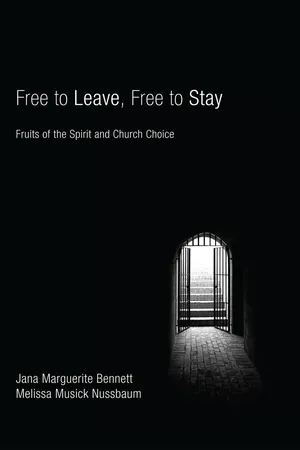
Free to Leave, Free to Stay
Fruits of the Spirit and Church Choice
- 122 pages
- English
- ePUB (mobile friendly)
- Available on iOS & Android
eBook - ePub
Free to Leave, Free to Stay
Fruits of the Spirit and Church Choice
About this book
Our known world, the world of twenty-first century Americans, is shaped and defined by consumer choice. The premise of consumer choice is that somewhere the perfect fit between product and purchaser exists. In the books on changing traditions the consumerist tone prevails--fundamentalists looking for an even more literal interpretation of Scripture, Protestants "going home" to Rome, feminists heading to the womyncentric sacred grove, conservatives fleeing inclusive rites, Catholics embracing the independent seeker church. But the consumerist impulse masks the kind of prayer and discernment necessary for living in Christian community and for following God. Twenty-first century Christians do make choices, but the hope is that they do so because they follow God. How then is one to answer the question of whether to stay or leave? Through meditating on the fruits of the Spirit that Paul addressed to the church at Galatia, a community that had several of its members wondering whether to stay or leave, Bennett and Nussbaum offer sage reflections about what it means to be led into and out of Christian communions.
Information
Topic
Theology & ReligionSubtopic
Biblical Studies1
Choice
The Lord says, is what you want
The terrible free? And I say
To the Lord, Lord speak
—Mia Nussbaum, “The Chapter of the Rending in Sunder”
The Galatian church should have split in two. There were those in the church who believed that circumcision, the ancient sign of Jewish male identity, was the legitimate sign of Christian male identity as well. There were those, like the apostle Paul, who believed no Gentile convert needed to undergo circumcision in order to join the Christian church. Imagine a world with neither reliable anesthesia nor antibiotics, and the dimensions of the crisis are clear. This is no public acknowledgement of a creed or a going down into the waters of baptism; this is surgery.
The Galatians to whom Paul writes were not Jewish converts to Christianity. They were pagan converts and Paul’s own disciples. Other Christian missionaries had come after Paul, preaching the necessity of male circumcision. These “Judaizers,” as Paul called them, argued that the way to Christ ran through the Jerusalem temple, with all its laws and practices. Paul argues that, for Gentile converts, the Jerusalem temple, with all its laws and practices, led not to Christ, but to slavery.
The Galatians have a choice: become Jews first, and then followers of Christ, like the original apostles and brothers in Jerusalem, or follow what Paul calls “the gospel I preach to the Gentiles” (Gal 2:2b). Paul’s gospel begins not with the flesh, as suggested by the physical mark of circumcision born by Jews, but with the Spirit. He asks the Galatians, “After beginning with the Spirit, are you now ending with the flesh?” (Gal 3:3b).
Paul is making his argument against those he says “who are disturbing you and [who] wish to pervert the gospel of Christ” (Gal 1:7b). He rails, “O stupid Galatians!” (Gal 3:1a) and pleads ill health (Gal 4:12a–15). He defends his position as God’s position.
Now I want you to know, brothers, that the gospel preached by me is not of human origin. For I did not receive it from a human being, nor was I taught it, but it came through a revelation of Jesus Christ. (Gal 1:1–12)
He works mightily to win, or win again, these believers to his side.
Paul knows they have a choice, to follow him or the Judaizers. He acknowledges this in the letter when he writes,
I had been entrusted with the gospel to the uncircumcised, just as Peter to the circumcised, for the one who worked in Peter for an apostolate to the circumcised worked also in me for the Gentiles . . . (Gal 7b–8a)
There are devout Christians who are both circumcised and not, and Paul clearly wants to keep the Galatian converts he has won both Christian and uncircumcised.
Paul knows the Galatians have a choice, but he does not want to suggest that the choices are of equal value. Why can’t pagan converts submit to Jewish law as long as they believe in the crucified and risen Christ? Paul answers by way of another question:
Now that you have come to know God, or rather to be known by God, how can you turn back again to the weak and destitute elemental powers? Do you want to be slaves to them all over again? (Gal 4:9)
He is comparing the slavery of idolatry to the slavery of the Jewish law and offers only two positions: Christ and freedom or the Law and slavery.
How are the Galatians to make a choice? How are they to act in true liberty, as “freeborn sons”? With either choice, there will be a rendering, a tearing apart from beloved leaders and from beloved brothers and sisters.
Despite Jesus’ prayer in the Gospel of John that “They may be one, as we are one, I in them and you in me” (John 17:21a), these painful splits and leave-takings, accompanied by the recriminations Paul heaps upon rival evangelists, have been part of the church since the first century.
The question is not, Will Christians leave one denomination, or tradition, for another? The question is, How does a Christian distinguish between the pew fatigue—insipid hymnody, uninspired preaching, parish snits—that makes every church-goer want to run screaming from the assembly, and the true leading of the Holy Spirit, a leading that may bring one to go, or stay? How should the choice—to leave or to remain—be made?
Theologian R. R. Reno has defended both sides of the divide. In his book, In the Ruins of the Church, he makes the argument for staying in the Anglican Communion.1 Three years later, he chronicles his reception into the Catholic Church in an article, “Out of the Ruins,” published in the theological journal First Things. Reno sees his original decision “to fight for orthodoxy in mainline Protestantism” as a stand for truth and against a culture he describes as “one of leave-taking [that] champions the seeker as the hero of the spiritual life.”2 He contrasts the mythical seeker with Benedict’s Rule and its vow of stability. Reno writes,
The sinful soul will twist and turn to elude God’s grasp, and for monks, this is manifest in the all-too-human tendency to wander from place to place in an effort to find a congenial community and a sympathetic abbot.3
The layman’s question, Reno argues, is very like the monk’s:
What are we to do in this jungle of denominationalism? Are we sinful men and women equipped to embark on a project of deciding which churches are best? When church becomes a choice, will we not guide ourselves to our own self-destruction?4
And yet, church does become a choice for Reno, when he leaves the Anglican Communion and is received into the Roman Catholic Church. But “choice,” even as he freely makes one, is the concept Reno rejects:
I put myself up for reception into the Catholic Church as one might put oneself up for adoption. A man can no more guide his spiritual life by his own ideas than a child can raise himself on the strength of his native potential.5
Reno uses the language of adoption, and the language of powerlessness. Infants, and more rarely, children, are adopted. Adults are almost never adopted, and yet Reno is an adult, chronologically and in Christ. An infant may not be able to raise himself “on the strength of his native potential,” but an adult can, and does. Reno is no infant, no child. He is a mature believer, one of Paul’s “freeborn sons” who has made a choice in liberty.
Why is “choice” such a scary word? The very freedom God offers to Adam in the Garden of Eden attracts and repels us.
You are free to eat from any of the trees of the garden except the tree of knowledge of good and bad. From that tree you shall not eat; the moment you eat from it you are surely doomed to die. (Gen 2:16a–17)
“You are free.” Free to choose. Those are haunting words, containing, as they do, the choices we make for life or for death.
In Mere Christianity, C. S. Lewis addresses the terror and delight of human freedom:
God created things which had free will. That means creatures which can go either wrong or right. Some people think they can imagine a creature which is free but had no possibility of going wrong; I cannot.
If a thing is free to be good it is also free to be bad. And free will is what made evil possible. Why, then, did God give them free will? Because free will, though it makes evil possible, is also the only thing that makes possible any love or goodness or joy worth having. A world of automata—of creatures that worked like machines—would hardly be worth creating. The happiness which God designs for His higher creatures is the happiness of being freely, voluntarily united to Him and to each other in an ecstasy of love and delight compared to which the most rapturous love between a man and a woman on this earth is mere milk and water. And for that they must be free.6
Part of the problem may be linguistic. Even for Christians who accept the teaching of God’s gift of free will and the choice such a gift implies, common usage affects our understanding. Certain nouns are wedded to certain modifiers. “Choice” in the twenty-first century is either “pro” or “consumer,” both troublesome notions for orthodox Christians. Those modifiers cover the full range from life issues to justice issues.
“Pro-choice” means the license, for example, to choose to accept or reject the humanity of an unborn child or a comatose adult based on the needs, not of the unborn child or the comatose adult, but of the caretaker whose life will be burdened by their care.
“Consumer choice” means the license to arrange one’s life according to material preference or desire. If prison ...
Table of contents
- Title Page
- Authors’ Note
- Introduction
- Chapter 1: Choice
- Chapter 2: Self-control
- Chapter 3: Faithfulness
- Chapter 4: Gentleness
- Chapter 5: Kindness
- Chapter 6: Goodness
- Chapter 7: Patience
- Chapter 8: Peace
- Chapter 9: Joy
- Chapter 10: Love
- Conclusion: There Is Life after Conversion
- Bibliography
Trusted by 375,005 students
Access to over 1.5 million titles for a fair monthly price.
Study more efficiently using our study tools.
Frequently asked questions
Yes, you can cancel anytime from the Subscription tab in your account settings on the Perlego website. Your subscription will stay active until the end of your current billing period. Learn how to cancel your subscription
No, books cannot be downloaded as external files, such as PDFs, for use outside of Perlego. However, you can download books within the Perlego app for offline reading on mobile or tablet. Learn how to download books offline
Perlego offers two plans: Essential and Complete
- Essential is ideal for learners and professionals who enjoy exploring a wide range of subjects. Access the Essential Library with 800,000+ trusted titles and best-sellers across business, personal growth, and the humanities. Includes unlimited reading time and Standard Read Aloud voice.
- Complete: Perfect for advanced learners and researchers needing full, unrestricted access. Unlock 1.5M+ books across hundreds of subjects, including academic and specialized titles. The Complete Plan also includes advanced features like Premium Read Aloud and Research Assistant.
We are an online textbook subscription service, where you can get access to an entire online library for less than the price of a single book per month. With over 1.5 million books across 990+ topics, we’ve got you covered! Learn about our mission
Look out for the read-aloud symbol on your next book to see if you can listen to it. The read-aloud tool reads text aloud for you, highlighting the text as it is being read. You can pause it, speed it up and slow it down. Learn more about Read Aloud
Yes! You can use the Perlego app on both iOS and Android devices to read anytime, anywhere — even offline. Perfect for commutes or when you’re on the go.
Please note we cannot support devices running on iOS 13 and Android 7 or earlier. Learn more about using the app
Please note we cannot support devices running on iOS 13 and Android 7 or earlier. Learn more about using the app
Yes, you can access Free to Leave, Free to Stay by Jana Marguerite Bennett,Melissa Musick Nussbaum in PDF and/or ePUB format, as well as other popular books in Theology & Religion & Biblical Studies. We have over 1.5 million books available in our catalogue for you to explore.