- 404 pages
- English
- ePUB (mobile friendly)
- Available on iOS & Android
eBook - ePub
About this book
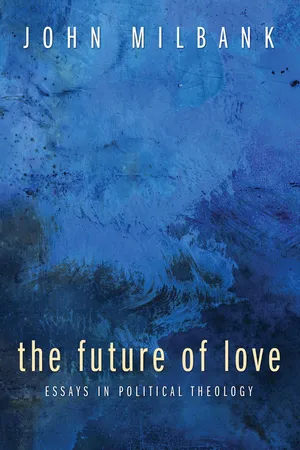
With a newly written preface relating his theology to the current global situation, The Future of Love contains revised versions of eighteen of John Milbank's essays on theology, politics, religion, and culture--ranging from the onset of neoliberalism to its current crisis, and from the British to the global context. Many of the essays first appeared in obscure places and are thus not widely known. Also included are Milbank's most important responses to critiques of his seminal work, Theology and Social Theory. Taken together, the collection amounts to a "political theology" arrived at from diverse angles. This work is essential reading for all concerned with the current situation of religion in the era of globalization and with the future development of Radical Orthodoxy.
Information
Topic
Theology & ReligionSubtopic
Christian Churchpart i
Theology and English Culture
1
Divine Logos and Human Communication
A Recuperation of Coleridge
Coleridge’s writings can be interpreted as a series of fragmentary notes for his great unwritten work On the Communicative Logos. As this title indicates, Coleridge sought a single doctrine embracing both a metaphysical theology and a theory of language and literature. Yet in addition to this, “communication” was for Coleridge also a political matter. So if the development of this central theme is to be adequately understood, one must trace the constant interweaving of political concerns with aesthetic-cultural and philosophical-cum-religious ones. Coleridge’s work constitutes—at least in its aspiration—a sort of theological-political-poetic tractatus.
In this chapter I shall argue that if one resists abstraction from this complexity, then Coleridge’s intellectual development must be divided into three integrated phases. The first phase is here represented especially by the Lectures on Revealed Religion, the second by The Friend, and the third by the Lay Sermons. In the early phase I shall outline Coleridge’s biblically based political radicalism, and in the middle period the lapse into political conservatism that coincides with his conversion to Kantian idealism. The late phase I describe as that of the “imperfectly emergent” Coleridge, and here I trace the resurgence of a political biblicism in an altered form, which remains of relevance to contemporary theology.
The Circles of the Lake
In his early poem Religious Musings, when he is giving an account of the development of human civilizations, Coleridge writes:
O’er waken’d realms Philosophers and Bards Spread in concentric circles; they whose souls Conscious of their high dignities from God Brook not wealth’s rivalry.1
One might almost say that these lines indicate the most constant structure of Coleridge’s entire thought. There is a class of inspired people who can be variously considered as poets, prophets, philosophers, or legislators; a class which existed most perfectly in antiquity in the times of a precise coincidence of all these roles, but a class whose function must be constantly revived if true human culture is to continue. These philosopher-poets “spread in concentric circles” because they are able to mediate continuities both in space and time. They establish a process of communication, of human interchange, which represents a constant counterpoise to the economic exchanges of the marketplace.
The image of the concentric circles occurs again in The Lectures on Revealed Religion. Coleridge compares the processes of human cultural and moral development to “the expanding circles of a lake.”2 Here the immediate context is his defense of privileged familial and friendly affections against William Godwin’s demand for an indifferent rational benevolence. In accordance with his own associationist psychology, the early Coleridge stresses that morality is a matter of social instincts that can only grow from the imaginative ties to particular places and persons arising in childhood. It is the empirical contingency of the route towards a general ethical concern that allows both the early Coleridge and the early Wordsworth to insist on the fundamental moral role of poetry and the imagination. As Hans Aarsleff has argued, one has here to see the positive role of the Lockean tradition as mediated by thinkers like Condillac in the evolution of the Romantic outlook.3 Locke’s “way of ideas” had already led him to argue that there were radical differences between various human cultures because they were based on a series of contingent and arbitrary associations, able to persist only because of the uniquely conserving role of language.
The drawback of the Lockean analysis from the point of view of a Coleridgean aesthetics would be that that while it indicated a pre-eminent role for linguistic creativity in relation to cultural idiosyncrasies, it could not show that this creativity was linked to a growth in real knowledge. By contrast, Hartley’s necessitarianism at first provided a far more beguiling model for Coleridge the poet, for here it was argued that a succession of purely empirical associations, unregulated by any pre-given rational norm, was nonetheless part of a providentially guided process leading to the highest possible knowledge.
Coleridge applied the theories of Hartley and his follower Priestley to the narratives of the Bible, and thereby tried to see “the expanding circles of the lake” in terms of the cultural becoming of the human race, and not just the development of the individual. However, this biblical engagement also caused him to modify the necessitarian perspective, well before his engagement with idealism. The series of influences to which primitive human beings are subject is now seen in terms of a primary divine language to which human beings are capable of a free response, but on which they depend for their future growth. Coleridge probably takes over from Warburton the notion that all the “irrational” features of the Old Testament—miracles, prophecies, and sacrifices, which were so ridiculed by the deists—are really evidence of the divine providential wisdom in accommodating himself to primitive intellects which are only able to think by means of a “real language” of concrete symbols, taken from nature.
The Hebrews were thought by Coleridge to share this language with other primitive peoples. It is linked to a predominance of greed, fear, superstition, and envy. However, with the Hebrews, these aspects are muted because of their political constitution that has been directly instituted by God. The law of Jubilee, the law of tithes, and the distribution of the land place limits on the role of material accumulation. The injunctions against idols ensure that there are no arbitrary and bloodthirsty gods who require propitiation, and this, thinks Coleridge, is politically significant. He takes his notions of the ideal character of the Hebrew theocracy from Moses Lowman,4 but places especial stress on the role of the Levites and the Nabim, the priestly and prophetic classes who are sustained by the contribution of tithes.
For Coleridge, the great contrast between the Hebrews and other peoples is that, whereas in the latter case the prophetic class arose later, as an outcome of the achievements of civilization, in Israel they were from the beginning the initiators, and thus Israel was always a culture. Here Coleridge’s emphasis, both in the early and middle periods of his writings, is always frankly Platonic—the initiators are first and foremost prisci philosophici rather than priscae poetae.
Within Israel the priestly and prophetic classes are considered to have played two important functions. First of all they were the recipients of surplus wealth and therefore functioned as a kind of safety valve preventing the growth of usury or inequitable accumulation.
Secondly, they were instituted by God as a providential substitute for the lack of writing among ancient peoples. Their role was to ensure continuity, to preserve the records. In this function as historians they were also, naturally, the legislators. And also poets, in so far as imagistic discourse was the language of primitive humanity, and peculiarly well-adapted to mnemonic tasks. Prophecy is understood by Coleridge to be in direct continuity with this legal “provision for the future,” though at this stage Coleridge still thinks of prophecy in characteristically eighteenth-century “dogmatic-rationalist” terms as purely a matter of a providential provision of “evidence of Christianity” for later peoples.
This clerical class exists then, to uphold the Hebrew theocracy, which means, precisely, to guard against the growth of a market economy, for the early Coleridge identified original sin with private property that led to possessiveness, and he insisted (because of this associationist stance) on precisely that order of causation. Nevertheless this picture was not a statically utopian one. The Hebrew theocracy existed to educate people out of the need for private property and for coercive law altogether. The full possibility of a society based upon the sharing of goods, and on perfect collective agreement, was finally proclaimed, according to Coleridge, by Jesus. It was this ideal which the young Coleridge sought to realize firstly in his “Pantisocracy,” and secondly in his domestic rural retreats.
Two things must now be said about Coleridge’s early politics to conclude this section. First, as has been shown by Kelvin Everest and David Aers, his desire for retirement was not an escape from politics.5 To understand this one must realize that his “Christian Socialist” vision was much more radical than that of even his revolutionary contemporaries. There was no working-class movement with which Coleridge could have identified, because at this time what movements there were were dominated by a Painite version of capitalist ideology. Coleridge considered that the “spirit of trade” had corrupted the language and culture of every class, and that in consequence the only hope consisted in the educative work that might be done by those still in touch with positive values. The ...
Table of contents
- Title Page
- Preface
- Acknowledgments
- Part 1: Theology and English Culture
- Chapter 1: Divine Logos and Human Communication
- Chapter 2: Religion, Culture, and Anarchy
- Chapter 3: What Is Living and What Is Dead in Newman’s Grammar of Assent
- Part 2: Theology and British Politics
- Chapter 4: Were the “Christian Socialists” Socialists?
- Chapter 5: The Body by Love Possessed
- Chapter 6: On Baseless Suspicion
- Part 3: Theology and Social Theory: Responses to Responses
- Chapter 7: Enclaves, or Where is the Church?
- Chapter 8: On Theological Transgression
- Chapter 9: The Invocation of Clio
- Part 4: Political Theology Today
- Chapter 10: Sovereignty, Empire, Capital, and Terror
- Chapter 11: Liberality versus Liberalism
- Chapter 12: Stale Expressions
- Part 5: Theology and Pluralism
- Chapter 13: The End of Dialogue
- Chapter 14: The Conflict of the Faculties
- Chgapter 15: Faith, Reason, and Imagination
- Part 6: Theopolitical Agendas
- Chapter 16: Postmodern Critical Augustinianism
- Chapter 17: The Transcendality of the Gift
- Chapter 18: The Future of Love
- Bibliography
Trusted by 375,005 students
Access to over 1.5 million titles for a fair monthly price.
Study more efficiently using our study tools.
Frequently asked questions
Yes, you can cancel anytime from the Subscription tab in your account settings on the Perlego website. Your subscription will stay active until the end of your current billing period. Learn how to cancel your subscription
No, books cannot be downloaded as external files, such as PDFs, for use outside of Perlego. However, you can download books within the Perlego app for offline reading on mobile or tablet. Learn how to download books offline
Perlego offers two plans: Essential and Complete
- Essential is ideal for learners and professionals who enjoy exploring a wide range of subjects. Access the Essential Library with 800,000+ trusted titles and best-sellers across business, personal growth, and the humanities. Includes unlimited reading time and Standard Read Aloud voice.
- Complete: Perfect for advanced learners and researchers needing full, unrestricted access. Unlock 1.5M+ books across hundreds of subjects, including academic and specialized titles. The Complete Plan also includes advanced features like Premium Read Aloud and Research Assistant.
We are an online textbook subscription service, where you can get access to an entire online library for less than the price of a single book per month. With over 1.5 million books across 990+ topics, we’ve got you covered! Learn about our mission
Look out for the read-aloud symbol on your next book to see if you can listen to it. The read-aloud tool reads text aloud for you, highlighting the text as it is being read. You can pause it, speed it up and slow it down. Learn more about Read Aloud
Yes! You can use the Perlego app on both iOS and Android devices to read anytime, anywhere — even offline. Perfect for commutes or when you’re on the go.
Please note we cannot support devices running on iOS 13 and Android 7 or earlier. Learn more about using the app
Please note we cannot support devices running on iOS 13 and Android 7 or earlier. Learn more about using the app
Yes, you can access The Future of Love by John Milbank in PDF and/or ePUB format, as well as other popular books in Theology & Religion & Christian Church. We have over 1.5 million books available in our catalogue for you to explore.