- 242 pages
- English
- ePUB (mobile friendly)
- Available on iOS & Android
eBook - ePub
About this book
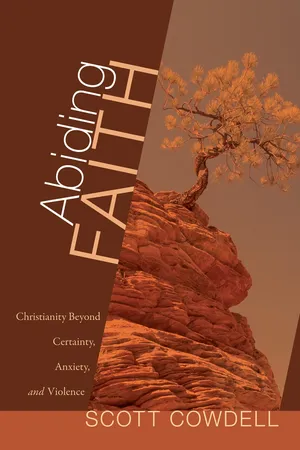
Australian theologian Scott Cowdell explores how "having faith" has changed under the influence of modernity and post-modernity in the West. He returns faith from pious sentimentality and arid philosophy of religion to the realm of "participating knowing," "paradigmatic imagination," and personal transformation where it belongs as a "form of life," shaped by encounter with Jesus Christ and worked out through the Eucharistic community. This is shown to have been the typical understanding of faith from Saint Paul to the Fathers to the medieval monastic theologians. Since the rise of nominalism, however, modern individuals reflecting a God newly remote from the world have struggled to maintain this participatory vision of faith as a formative habitat. Mysticism is as close as modernity got, while "officially" faith was annexed by modern Western culture, coming to share its anxious need for certainty and control--systemic, exclusive, and violent-tending.
Scott Cowdell has written a wide-ranging book, bringing together several normally separate debates while tackling the problem from a distinctive perspective. He explores faith against the backdrop of secularization, the collapse of community, and the encroachment of an intentionally destabilizing consumer culture. He expounds the nature of desire in terms of imitation and rivalry, and the violent false-sacred roots of cultural formation evident in the modern West's many victims, all according to the uniquely comprehensive vision of Rene Girard. Finally, he dismisses today's growing mood of militant religious skepticism as philosophically outdated and out of its depth before the resilient confidence of a genuine living faith. What Cowdell calls "abiding faith" emerges as a venerable yet strikingly contemporary possibility. This is good news for today's "homeless hearts"--there is the gift of a secure identity and a mature spirituality on offer, within a liberating, inclusive, world-affirming, ecclesial form of life.
Information
Topic
Theology & ReligionSubtopic
Christian ChurchPart I
Faith in the Crucible of Modernity
1
Homeless Hearts
Faith and the Modern Self
In 2007 many wondered why anyone would sit in a near-silent cinema for nearly three hours to watch a documentary film about Carthusian monks. Into Great Silence (in German, Die Grosse Stille) took us inside the mother house of this most austere of the Catholic orders, La Grande Chartreuse, over six months. A community of two dozen contemplatives live as hermits, spending up to eighteen hours a day in their self-contained hermitage (or cell), aside from daily mass and strenuous night offices together in the Abbey Church. Carthusians gather only on Sundays for a fixed period of relaxation and chatting, and on Mondays for a long ramble together during which they alternate talking in pairs. Meals are shared like other monks only on Sundays and feast days of the Church year and only then in silence, with a reader. Once a year there is a full-day community hike with a picnic lunch. No wonder the Carthusian website makes clear that no one really chooses this life, but that it chooses them.1
The film was profound and moving, and I know I was not the only one who saw it twice. The faces of the monks, on which the camera dwelt from time to time, were serene and hence beautiful, even the less photogenic ones. The patience, deliberateness, and collectedness of the life were plain, evoked by the loving attention of the camera to minutiae of the daily round, also the external elements. Long takes of the monks praying and reading, also still-life scenes lingering on the few items in a monk’s fruit bowl, or the dish draining on his sink in a shaft of sunlight, recalled the intensity of the Dutch painter Vermeer’s simple interiors, while the heavy snow of these remote, high alps starkly set off the wood fire-heated cells, and the inconceivable spiritual adventure taking place within them.
Thomas Merton, the Trappist, wrote about Christian faith today from the perspective of a strict monastic life in his poem “The Quickening of St John the Baptist,” and his words came to mind as I sat in the dark and took in the even stricter vision of his Carthusian cousins.
Beyond the scope of sight or sound we dwell upon the air,
Seeking the world’s gain in an unthinkable experience.
We are exiles in the far end of solitude, living as listeners,
With hearts attending to the skies we cannot understand,
Waiting upon the first far drums of Christ the Conqueror,
Planted like sentinels upon the world’s frontier.2
But not all were moved by Into Great Silence. Some Protestant friends of mine refused to see it, while David Stratton, Australia’s leading film critic, referred in his review to the monks’ “wasted lives.” Stratton is certainly agnostic if not atheist. He was struck by the film at the level of cinematography (certainly) and curiosity (probably), but at bottom he just could not fathom it. Clearly these men “planted like sentinels upon the world’s frontier” ought to be doing something more useful—more self-justifying perhaps. Stratton was disappointed that “what the monks really did,” obviously the manufacture of their signature green Chartreuse liqueur, was not on show—apart from a glimpse of the Prior handling an invoice at one point!3 Here I detect the imaginative patrimony of Richard Dawkins—and Ebenezer Scrooge. Here is the brave new world of our modern West standing before the mystery of faith with incomprehension, and a measure of frustrated annoyance.
Many others were intrigued and affected by this film, however, drawn through it to a sense of something that is presently “an unthinkable experience.” Into Great Silence challenges our modern, secularized Western self. This is a self that began to emerge from the late Middle Ages, and especially since the Enlightenment, which nowadays is ill at ease before the horizon of mystery—a little irritated, perhaps, but maybe also a little fascinated.
In this chapter I am going to begin exploring the religious and spiritual transformations that have brought us to this state of affairs—transformations that have given us a modern world vastly better that what went before in so many ways, yet at the expense of leaving many of us with what I am calling homeless hearts. I will focus on a tight cluster of related trends. First, and most obviously, there is secularization, understood as the disembedding of faith from an encompassing religious culture. Second, in tandem with secularization, we experience a widespread and fundamental loss of community. Third, the rise of consumer culture to become the imaginative horizon of our late-modern West has significantly shaped human identity and aspiration. Then, fourth, we will consider the profound impact consumer culture has had on religion and spirituality, shaping certain standard options for faith. From these beginnings I want to go on in chapter 2 to consider how God has been culturally annexed by the agenda of secular modernity. And from there, in chapter 3, I consider how modernity’s drive toward certainty and closure has become a new sacred reality requiring the repression or exclusion of whatever is unsure and errant.
The monks of Into Great Silence make a highly contemporary statement. They demonstrate an abiding faith that is more personal than the undifferentiated religious belonging of pre-modern Western life, but also more integrated than the religious individualism to which modern Westerners have become accustomed. But before we seek the roots, test the intellectual credentials, and draw the consequences of that abiding faith in part 2 of the book, we need first to understand how faith is faring in the crucible of modernity.
Secularization and the Disembedding of Faith
Our story begins with the break up of an integrated religious civilization and the emergence of religion as a discrete category among other social institutions and private lifestyle options, in modern Western nations committed as never before to the life of this world. This break up has a technical name: secularization. And it could be said to have begun with a democratizing of the monastic ideal.
Even before Martin Luther left the cloister to marry and unleash the great secularizing flood of Protestantism, the Catholic reformer Erasmus was calling every Christian to be as serious as the monks of his day were supposed to have been. In The Manual of a Christian Knight (his Enchiridion, of 1501), Erasmus—himself an Augustinian priest—chides a layman for excusing himself by saying “I am not a priest, I am not a monk.” “Yes,” comes the retort, “but are you not a Christian?” Erasmus commends to the laity a measure of detachment towards personal property and a generous spirit, seeing this as the properly universal meaning of monastic poverty.4 In this sober and serious spirit the early-modern European turn toward everyday life began with its universal trend towards responsible “individualized faith,” away from a less-differentiated “tribal faith.”
A century ago, Max Weber famously identified secularization with the passing of a baton from monasticism to Calvinism. The monks’ rational asceticism was effectively handed on in new, Protestant dress to become the basis of a disciplined, secular workforce serving a this-worldly human good, and focused on the creation of wealth. In the booming economies of new nation-states, this became the spirit of modern capitalism. There were more pious Methodist, Baptist, and Quaker versions, with some Protestant groups adapted to lowlier niches in the economy, along with the more assertive Calvinistic mood of Puritanism, all of which gave rise to a widespread, purposeful, unostentatious vocation in the realm of business and affairs. This redefined sense of a calling in life further secularized into a conception of innate “sacred” order and obligation to be found in society, business, and family, though no longer with any necessary place for God, grace, Church, or worship. Weber points to the “utilitarian prudentialism” of Benjamin Franklin, for instance, secure in his own moral superiority, as a type still clearly recognizable in our own day.5
Franklin’s Enlightenment contemporary, the Scots philosopher David Hume (1711–1776), was explicit in his condemnation of other-worldliness in religion, and “the monkish virtues” in particular. The great historian of ideas Charles Taylor helpfully points out just how
much of the historical practice of Christianity ran afoul of the new ethic of purely immanent human good: all striving for something beyond this, be it monasticism, or the life of contemplation, be it Franciscan spirituality or Wesleyan dedication, everything which took us out of the path of ordinary human enjoyments and productive activity, seemed a threat to the good life, and was condemned under the names of “fanaticism” or “enthusiasm.” Hume distinguishes the genuine virtues (which are qualities useful to others and to oneself) from the “monkish virtues” (“celibacy, fasting, penance, mortification, self-denial, humility, silence, solitude”), which contribute nothing to, even detract from human welfare. These are rejected by “men of sense,” because they serve no manner of purpose; neit...
Table of contents
- Title Page
- Acknowledgments
- Introduction
- Part 1: Faith in the Crucible of Modernity
- Chapter 1: Homeless Hearts
- Chapter 2: Faith in “the System”
- Chapter 3: The False Sacred
- Chapter 4: At Home in Jesus Christ
- Part 2: Belonging, Believing, and Behaving
- Chapter 5: Faith’s Knowledge
- Chapter 6: Behold, I Make All Things New
- Conclusion
Trusted by 375,005 students
Access to over 1.5 million titles for a fair monthly price.
Study more efficiently using our study tools.
Frequently asked questions
Yes, you can cancel anytime from the Subscription tab in your account settings on the Perlego website. Your subscription will stay active until the end of your current billing period. Learn how to cancel your subscription
No, books cannot be downloaded as external files, such as PDFs, for use outside of Perlego. However, you can download books within the Perlego app for offline reading on mobile or tablet. Learn how to download books offline
Perlego offers two plans: Essential and Complete
- Essential is ideal for learners and professionals who enjoy exploring a wide range of subjects. Access the Essential Library with 800,000+ trusted titles and best-sellers across business, personal growth, and the humanities. Includes unlimited reading time and Standard Read Aloud voice.
- Complete: Perfect for advanced learners and researchers needing full, unrestricted access. Unlock 1.5M+ books across hundreds of subjects, including academic and specialized titles. The Complete Plan also includes advanced features like Premium Read Aloud and Research Assistant.
We are an online textbook subscription service, where you can get access to an entire online library for less than the price of a single book per month. With over 1.5 million books across 990+ topics, we’ve got you covered! Learn about our mission
Look out for the read-aloud symbol on your next book to see if you can listen to it. The read-aloud tool reads text aloud for you, highlighting the text as it is being read. You can pause it, speed it up and slow it down. Learn more about Read Aloud
Yes! You can use the Perlego app on both iOS and Android devices to read anytime, anywhere — even offline. Perfect for commutes or when you’re on the go.
Please note we cannot support devices running on iOS 13 and Android 7 or earlier. Learn more about using the app
Please note we cannot support devices running on iOS 13 and Android 7 or earlier. Learn more about using the app
Yes, you can access Abiding Faith by Scott Cowdell in PDF and/or ePUB format, as well as other popular books in Theology & Religion & Christian Church. We have over 1.5 million books available in our catalogue for you to explore.