- 120 pages
- English
- ePUB (mobile friendly)
- Available on iOS & Android
eBook - ePub
About this book
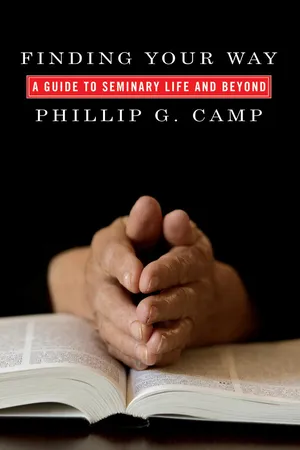
Your time in seminary can be a period of great blessing and adventure, on the one hand, but also a time of great confusion and doubt, on the other. How do you navigate the challenges, questions, and even frustrations of seminary life? Am you the only one who is confused in your classes or struggling with what you believe? What does all this theological stuff have to do with serving Christ? Finding Your Way was written to help you with these questions and perhaps with others that you didn't even know you had. This little book will help you see that seminary education is not a hoop to jump through or a burden to bear on the way to "real" ministry. Rather, your theological education is an important part of your vocation and spiritual formation now and for your future service. To this end, this book serves as a guide to the ins and outs of seminary life, to fostering a loving relationship with the church, and to developing spiritual habits that will bless you throughout your ministry.
Information
Topic
Theology & ReligionSubtopic
Christian Church1
Needing Directions
Why I Wrote This
I do not possess an innate sense of direction. When I know where I need to be, I can generally get there, though often in a roundabout way. I make wrong turns, go the opposite way I am supposed to, circle back, and drive until something looks familiar. It also does not help that I am slightly near-sighted, making street signs difficult to see, but I am too vain to wear my glasses. Likewise, I am too embarrassed or vain (two sides of the same coin?) to stop and ask for directions (yes, I fit the stereotype). Even if I have been there before, or if someone has given me directions, it is no guarantee that I will get to where I am going very quickly. When I finally find my way to a place, I will continue to take the same route even if it is the long way around, simply because it is now familiar.
My struggle with finding my way while driving is an apt metaphor for my theological education, and I suspect for many others’ as well. When I started the study of Scripture, theology, practical theology, church history, and so on, I had a general sense of where I needed to go but little clue about how to find my way there. I often found myself lost in twists and turns of jargon and presuppositions that were unfamiliar to me. I saw things in a particular, and admittedly at times distorted, way. I was often embarrassed to ask questions or get help because I assumed everyone else was way ahead of me and were already headed in the right direction.
I remember vividly my first day in my first seminary class, which was on the Corinthian letters. A guy next to me was reading out of his Greek New Testament with no English Bible in sight. The danger alert in my head began to sound: “Warning! Warning! Entering hostile territory with alien life forms!” Shortly into that first class, the same student asked a question—one of those questions where you sensed he already knew the answer—that went something like, “Is this an example of over-realized eschatology in Paul?” Over-realized what?! Is that in the Greek? I felt at that moment that I was way out of my league and did not belong there, despite a sense of call to ministry. Either God or I had made a mistake. It turned out, upon eventually engaging in conversation with other students in the class, that this Greek-reading, jargon-spouting student was the exception rather than the rule. Still, that sense of lostness often dogged me during my theological education. Perhaps my upbringing in a conservative church (in most every sense of the word) enhanced that feeling, since the issues raised in my classes challenged many of my dearly held assumptions about the Bible and the church. If any of this sounds familiar, then I am writing for you.
After two master’s degrees (master of arts in religion at a more theologically conservative institution and master of divinity from a mainline denomination’s seminary) and a doctorate in Old Testament from a mainline seminary, I have moved to the other side of the podium. I now teach at the school where I earned my first master’s degree. Here I frequently see in my students the same lostness and confusion that I had experienced. (Admittedly, it could be that I am losing and confusing them). On the other hand, I often see a confidence in other students, who believe they know exactly what they need to function in the ministry they intend to practice. So, in my classes, I find myself repeatedly offering the same advice, trying to build confidence in some of my students while challenging the unhealthy cockiness of others. Since I keep saying the same things over and over, I thought it might be helpful to write some of it down. If I experienced these things and if my students experience them, then I suspect that other theological students do as well.
Therefore, this book is written for theological students and those teaching theological students. Mostly I have in mind seminarians, but since, in some denominations, ministerial education is primarily received on the undergraduate level, I write for those students as well. I realize that not everyone who gets a theological education plans to enter “the ministry.” I certainly do not believe that only those who are in paid, specialized ministry work are ministers. But in this book I have in mind primarily those who will work in congregational, para-church, or other service ministries. However, I hope that there is something helpful here for every theological student.
What follows arises out of my experiences both in my own theological education and as an educator of theology students. I talk about what I found helpful and what, with the benefit of hindsight, I wish I had done. I also draw on the wisdom and experience of my teachers, colleagues, and students, as well as other writers.1 I offer my own little book with the simple intention of helping you find your way through your theological education.
Much of what I say deals directly with the educational experience, but at other times I have my eye on how what is done in school translates into what is done in the churches or other ministries. Therefore, while I consider this primarily an offering for students, I also see it as a gift for the churches if it in any way helps those who will one day serve those churches. Also, by dividing the book into parts dealing with the academic, spiritual, and church sides of seminary life, I do not mean to imply that these can or should be separated. As will be clear in what follows, all three are integrally related.
A final note on style: I generally address you, the reader, directly. That is, I use “you” a lot, which I was taught not to do in academic writing. But this is not academic writing. By doing so, I am not implying that everyone who reads this has all the same issues. Nor am I accusing. Once in my doctoral program I addressed a MDiv class on the prophetic ministry. When I ran a draft of my lecture by the teacher of the class, he suggested I replace “you” with “one” or some similarly non-direct reference. I did so then because it was his class. But here I am imagining that I am addressing my own students directly, so “you” seems appropriate. If one is offended by this, I beg one’s forgiveness and hope it will not cause one to dismiss the whole book out of hand.
Your journey and mine through theological education will not be the same. It can hardly be since we all start at different places and encounter different detours and roadblocks. Still, I pray that this book can at least orient you in a helpful direction as you navigate your own theological journey. I pray that you do not fall asleep at the wheel (or while reading this book!) and, especially, that you do not give up on the journey. Finally, I pray that God will bless you on your own journey through seminary life and beyond.
1. I found Helmut Thielicke’s A Little Exercise for Young Theologians (Grand Rapids: Eerdmans, 1962; reprinted 1998) especially beneficial in my own theological education. If you are familiar with the book, you will no doubt hear echoes of it in my writing here. If you are not familiar with it, I recommend it to you.
part one
Finding Your Way Academically
2
Remember Who You Are Really Working For
Perhaps it is a bit presumptuous here to assume why any given student might enter theological study. Some want to find answers to questions and longings deep within. Others enter theological study to simply spend another few years in school, putting off the repayment of student loans and getting a job. Some may be pressured by family expectations, being the pastor-designate of the family. Perhaps some are looking for faith or a deeper understanding of their faith. But my remarks here are largely addressed toward those who enter theological study out of a sense of calling (even if the calling is not yet defined).
It is easy to lose sight of why you entered this program of study, especially as time wears on. The initial excitement of engaging Scripture and theology, of learning to preach and teach, of dialoguing with other students on intellectually and spiritually stimulating topics often gives way to the toil of study. Greek and Hebrew paradigms, historical figures and dates, and various Christologies have to be learned. A few papers and hundreds of pages of reading are due every week! Exams come along, and lo and behold, they are far more difficult than what you experienced in high school and college.1 Drowning in a sea of books, lecture notes, assignments, and exams, the student may declare concerning his or her call, as the prophet Jeremiah did, “You deceived me Lord, and I was deceived” (Jeremiah 20:7). Or, to paraphrase, “God, when you called me, this is not what I was signing up for.”
It is in these moments that you must remember you are where you are precisely because you are called by God, who is preparing you for a special role in service to his church. Do not understand “special” here as intending a superior or more important role than other roles in the church (see 1 Corinthians 12). However, your calling does require special training. The intense study and demands of your theological education are not simply add-ons or hoops to get through before you can start the real business of the ministry that God has in store for you. They are what you are called to in this moment and are shaping you to continue another phase of your calling once you finish school. Furthermore, it is indeed God who has called you, and so you must respond faithfully to God’s call. Thus, you should understand your theological training as part of your calling or vocation.
Some students forget for whom they are working not because of the burdens of study but because they are driven to succeed academically. I am not denigrating hard work at all, but some students find their whole self-worth in how well they do academically and how well they do in comparison to other students. I know this, because I was one of those students. While I always maintained in my mind that I was studying for Jesus (and on some level I was), honest reflection tells me that I also wanted to be the best student because it would reflect well on me. “This little light of mine, I’m gonna let it shine”—on me! And given the nature of many of our seminaries, where simple academic achievement can be honored more than spiritual formation or service to the church, my grade-driven life was rewarded.
The cost, however, was high as I began to believe my own press, and the focus remained more on me than on God’s calling. I often saw other students, fellow Christians, as competition rather than partners in God’s mission, even resenting those who performed better than I did. My sense of worth rested in my ability to achieve rather than the fact that I am a child of God. I was condescending toward “lesser intellects,” ev...
Table of contents
- Title Page
- Acknowledgments
- Chapter 1: Needing Directions
- Part 1: Finding Your Way Academically
- Chapter 2: Remember Who You Are Really Working For
- Chapter 3: You Do Not Know What You Need
- Chapter 4: Read Your Bible
- Chapter 5: Manage Your Time Well
- Chapter 6: Grades Do and Don’t Matter
- Chapter 7: Be Careful with Labels
- Chapter 8: Ask Questions
- Chapter 9: Think
- Chapter 10: Associate with People Who Don’t Share Your Views
- Chapter 11: Speak Up without Talking Down
- Chapter 12: Respect Your Teachers, but Don’t Idolize Them
- Chapter 13: Own Your Faith
- Part 2: Finding Your Way Spiritually
- Chapter 14: Maintain a Strong Devotional Life
- Chapter 15: Go to Church
- Chapter 16: Find a Mentor
- Chapter 17: Participate in a Covenant Group
- Part 3: Finding Your Way in the Church
- Chapter 18: Love the Church
- Chapter 19: Be Humble
- Chapter 20: Speak Boldly and Confidently
- Chapter 21: Don’t Voice All of Your Thoughts or Doubts
- Chapter 22: Don’t Be a Visionary
- Part 4: Final Exhortations
- Chapter 23: Be Appreciative
- Chapter 24: Charge to a Graduating Class
Trusted by 375,005 students
Access to over 1.5 million titles for a fair monthly price.
Study more efficiently using our study tools.
Frequently asked questions
Yes, you can cancel anytime from the Subscription tab in your account settings on the Perlego website. Your subscription will stay active until the end of your current billing period. Learn how to cancel your subscription
No, books cannot be downloaded as external files, such as PDFs, for use outside of Perlego. However, you can download books within the Perlego app for offline reading on mobile or tablet. Learn how to download books offline
Perlego offers two plans: Essential and Complete
- Essential is ideal for learners and professionals who enjoy exploring a wide range of subjects. Access the Essential Library with 800,000+ trusted titles and best-sellers across business, personal growth, and the humanities. Includes unlimited reading time and Standard Read Aloud voice.
- Complete: Perfect for advanced learners and researchers needing full, unrestricted access. Unlock 1.5M+ books across hundreds of subjects, including academic and specialized titles. The Complete Plan also includes advanced features like Premium Read Aloud and Research Assistant.
We are an online textbook subscription service, where you can get access to an entire online library for less than the price of a single book per month. With over 1.5 million books across 990+ topics, we’ve got you covered! Learn about our mission
Look out for the read-aloud symbol on your next book to see if you can listen to it. The read-aloud tool reads text aloud for you, highlighting the text as it is being read. You can pause it, speed it up and slow it down. Learn more about Read Aloud
Yes! You can use the Perlego app on both iOS and Android devices to read anytime, anywhere — even offline. Perfect for commutes or when you’re on the go.
Please note we cannot support devices running on iOS 13 and Android 7 or earlier. Learn more about using the app
Please note we cannot support devices running on iOS 13 and Android 7 or earlier. Learn more about using the app
Yes, you can access Finding Your Way by Phillip G. Camp in PDF and/or ePUB format, as well as other popular books in Theology & Religion & Christian Church. We have over 1.5 million books available in our catalogue for you to explore.