eBook - ePub
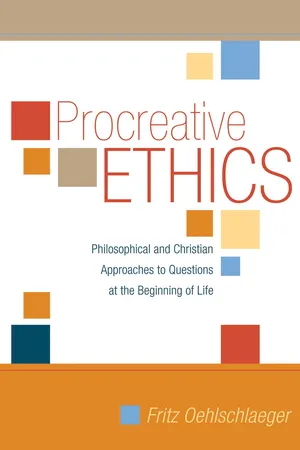
Procreative Ethics
Philosophical and Christian Approaches to Questions at the Beginning of Life
- 380 pages
- English
- ePUB (mobile friendly)
- Available on iOS & Android
eBook - ePub
Procreative Ethics
Philosophical and Christian Approaches to Questions at the Beginning of Life
About this book
Procreative Ethics addresses questions at the beginning of life from a point of view that is alternatively philosophical and Christian. The author seeks to defend philosophically some positions taken partly on Christian grounds while also trying to make the implications of Christian convictions intelligible to those who do not necessarily share those convictions. The author positions himself neither as a "moral friend" nor "moral stranger," preferring instead the role of "moral acquaintance" to his audience. From that position, the goal is to find areas of fruitful agreement while clarifying differences that may lead to truer reconciliations further on in the conversation. The book opens with an attempted natural law defense of artificial contraception; devotes four chapters to criticism of current defenses of abortion; and then takes up, in six remaining chapters, such matters as genetic enhancement of children, the justice or injustice of genetic revision, the harm conundrum or non-identity problem, designing for disability, and reproductive cloning.
Information
Topic
Theology & ReligionSubtopic
Christian Theology1
Can the Use of Artificial Contraception within Marriage Be Consistent with the Natural Law?
The prohibition of artificial contraception occupies a central place in Pope John Paul II’s morality of the acting person and his critique of the contemporary “culture of death.”1 Discussing John Paul’s anthropology and theology of marriage, William E. May, in fact, refers to artificial contraception as the “gateway” to the culture of death.2 For John Paul, the development of a “contraceptive mentality” represents a grave symptom of a falsely dualistic understanding of the human being and a distorted emphasis on subjectivity alone as the defining mark of the person. The danger of artificial contraception lies in its breaking the unity of the person by instrumentalizing the body, which then becomes merely a subhuman means to goods assumed to be personal. What is compromised, perhaps even “annihilated” in the process, is man’s “authentic personal dominion over himself.”3 Implicit in the contraceptive mentality is a falsely dualistic or mentalistic understanding of personhood. Personal autonomy becomes associated with emergence from all dependence; personal dignity is too narrowly associated with “the capacity for verbal and explicit, or at least, perceptible, communication”; and freedom loses its “inherently relational dimension,” becoming instead “absolute in an individualistic way.” “On the basis of these presuppositions,” John Paul argues in Evangelium Vitae, “there is no place in the world for anyone who, like the unborn or the dying, is a weak element in the social structure, or for anyone who appears completely at the mercy of others and radically dependent on them, and can only communicate through the silent language of a profound sharing of affection.”4 John Paul’s alternative to the false subjectivist and dualistic assumptions of modern notions of autonomy has been to insist on personhood’s involving the embodied human being in its entirety. In regard to marriage, this has meant his development of a theology of “mutual donation,” one that treats sexuality as the mutual bodily self-giving of persons-in-love.
Let me begin by saying how thoroughly I accept certain features of John Paul’s description of the contemporary situation, even though I am going to offer a defense of artificial contraception within marriage as consistent with the natural law. The broadly Enlightenment conception of personhood as autonomous from all determining contexts does seem inherently threatening to those “radically dependent on others”; artificial contraception has seemingly given rise to a “contraceptive mentality,” which too often sees children as burdens to be avoided; the aspiration to a comprehensive medical control over all natural processes does tend to devalue suffering and undermine human solidarity in suffering. Suffering becomes simply a problem to be solved, a scandal that ought not to exist, rather than a mystery that must be confronted and lived through in mutual dependence. Against this so-called “culture of death,” recent Popes have sought to build a civilization of love, one of whose most basic affirmations insists that sexual acts must be “open,” in all cases, to children. The fact that we even contemplate genetic engineering of children for enhancement suggests the degree to which children have become projects of their parents’ wills, acceptable only on condition of their meeting certain standards of quality. This commodification of children lends weight to John Paul’s contention that sexuality has become “depersonalized and exploited: from being the sign, place and language of love, that is, of the gift of self and acceptance of another, in all the other’s richness as a person, it increasingly becomes the occasion and instrument for self-assertion and the selfish satisfaction of personal desires and instincts” (EV 43). It is of immeasurable importance for Christians to insist on parenthood as a matter of self-giving, of fundamental generosity. The child who understands herself as the free gift and outpouring of her parents’ generosity is one who will be able to freely give herself in love. The free gift of self from parent to child will be, for many, the realest analogy of—and pointer to—God’s free gift of himself in Christ.
Thus it is with the greatest respect that I hope to enter into dialogue with the Catholic tradition on the matter of artificial contraception. I do so as one who is not a Catholic but as a Protestant Christian who confesses faith in “one holy, catholic, and apostolic church” and also, I hope, as one of good will. I mention this last point because the encyclical Humanae Vitae addresses itself specifically to “all Men of goodwill,” and discussion of that encyclical must, of course, be at the heart of any consideration of contraceptive matters.5 The point I will attempt to make is that artificial contraception within marriage can be consistent with the natural law understood as opus rationis, a work or ordering of the practical reason. For this understanding of the natural law as articulated by Thomas Aquinas, I am indebted to Martin Rhonheimer’s magisterial Natural Law and Practical Reason. Thus it is crucial here to explicate briefly Rhonheimer’s understanding of natural law as practical reason. I should say, in advance, that Rhonheimer does not draw conclusions similar to mine from his understanding of natural law. Indeed he specifically examines the teaching of Humanae Vitae and Pope John Paul II and concurs fully with it. Nevertheless I believe his understanding of natural law does make dialogue possible with the tradition regarding artificial contraception, and this I will attempt to foster.
A critical point to understand is that the “natural law is not primarily and per se a collection of normative statements that the practical reason simply finds ‘already there’ to ‘follow.’”6 It is not simply a matter of our reading off laws that are somehow established in nature. Rather the natural law is constituted by acts of the practical reason as it pursues the good. The good is the “object of the practical reason,” which “constitutes commands, norms, duties, and so on under the aspect of the good, that is, it forms statements in the form of ‘ought’ or ‘should’” (59). The “application (applicatio) of this normative knowing to concrete behavior” involves acts of the conscience (“con-scientia, ‘knowing-along-with’”). These acts of practical judgment and conscience take place on one level, one directly concerned with the carrying out of acts; the natural law is formulated at a second level of reflection upon the acts of the practical reason in pursuit of the particular goods within various “field[s] of action” (58). “The acts of the practical reason itself do not have the natural law for their object”; rather they provide the subject matter for reflection, thus “in fact constitut[ing] the natural law” (58). Perhaps it will help to clarify what this means by considering the status of statements like the “‘good is to be done’ (bonus est faciendum)” or “‘evil is to be avoided’ (malum est vitandum)” (59). These clearly are not statements “made by the practical reason at the level where it actually makes” precepts or commands; rather they are the fruits of “reflection upon” particular “preceptive act[s] of the practical reason” (59). Rhonheimer is very concerned to prevent a reading of Thomas that “establishes the ‘autonomy’ of the natural law in contradistinction to the so-called ‘natural order’” (63). Thomas’s Lex naturalis est aliquid per rationem constitutum—“the natural law is something constituted by the reason”—does not point to “a full metaphysical disjunction between nature and reason,” as it might in a Kantian sense. Such a disjunction “has its ultimate origin in an attempt to oppose reason to a thoroughly naturalistic (“physicalistic”) interpretation of the ‘order of nature.’” “Such a reason would have the character of unlimited freedom vis a vis the natural” and would make impossible the establishment of natural law norms.7
Rhonheimer discusses the “model of married love” at length both in order to “illustrate the comprehensive personal structure of human willing or loving” and to defend the prohibition of artificial contraception affirmed by Humanae Vitae and John Paul II. He insists first that the “natural inclination toward the ‘joining of male and female’” is not to be understood as “an ‘incarnation’ of human love”: to do so is to suggest that human love is originally a spiritual phenomenon that only secondarily becomes bodily (96–97).8 Neither is the “marital act” simply an “act of the power of procreation” or generation that can also serve “as an expression of love” (100). Married love unites “sensuality and spirituality” as the act of bodily entities “‘ensouled’ and endowed with reason, according to the classical and precise formulation: animal rationale” (97). The inclinatio naturalis lies at the basis of married love, but that love comes about only when this inclination is carried out in a specifically human manner, in accord with the natural law. To ask about the “object of the ‘marital act,’” then, is to “inquire into the object or ‘objective significance’ of the love between husband and wife, and not into the ‘natural end’ (finis naturalis) of the procreative power” (100). Thomas presents a “personal and integral anthropology and ethics” that recognizes “bodiliness and sensation” to be the “foundation for all spiritual acts” (102) but which also sees these as ordered to fulfillment in distinctively personal acts and consistent, in the case of sexuality, with responsible parenthood and the dignity of the human person (personal “love between man and woman” being “the only form of the transmission of human life that is worthy of the human person” [101]). We must not understand the natural law to be simply the moralization of certain laws of nature in a biological or scientific sense. Humanae Vitae opposes artificial contraception not in order to maintain the “integrity of the ‘natural order’” but rather to preserve “the integrity of human love, which is at once an ordo rationis, as well as an ordo virtutis” (114).
Rhonheimer points out the wrongheadedness of criticisms of the encyclical that claim its argument for the immorality of artificial contraception “rests upon preserving the biological integrity of the act, and upon the (likewise biological) laws of cyclical fertility” (113). He finds instead the central statement of Humanae Vitae to be the teaching on the “inseparable connection, willed by God and unable to be broken by man on his own initiative, between the two meanings of the conjugal act: the unitive meaning and the procreative meaning.”9 For him the “key to the argument” lies in the “concept of responsible parenthood” (114). The difference between natural and artificial birth control is not simply a difference in method. Responsible parenthood is present only where the limitation of the number of children has its “origin in an act of the virtue of chastity” (114). The ordo virtutis is closely connected to the ordo rationis, as noted above in Rhonheimer’s language about preserving the integrity of human love. Developing the habitus to integrate action from moral precepts with reflection on the natural law involves also understanding the virtues involved in particular actions and arriving at a rational ordering of them. Marital chastity or continence is the virtue particularly suited to responsible parenthood, and to rely on artificial contraception is to destroy the very conditions within which this virtue can be developed. In Familiaris Consortio, John Paul draws a very strong distinction between periodic abstinence and artificial contraception, arguing that the difference “is much wider and deeper than is usually thought” and ultimately connected with “two irreconcilable concepts of the human person and of human sexuality.”10
In her study of Humanae Vitae: A Generation Later, Janet E. Smith has drawn attention to the stress John Paul lays on the virtue of self-mastery in his interpretation of the encyclical. The narrow meaning of self-mastery pertains to chastity, but the broad designation points to that “mastery of any passion” that is essential to the development of the moral virtues and thus “to the p...
Table of contents
- Title Page
- Introduction
- Chapter 1: Can the Use of Artificial Contraception within Marriage Be Consistent with the Natural Law?
- Chapter 2: Abortion, the Sacred, and Sacrifice
- Chapter 3: In Defense of the “Conception Criterion”
- Chapter 4: Abortion as Letting Die, Bad Samaritanism, or Just War
- Chapter 5: Why David Boonin’s Defense of Thomson Fails to Persuade the Abortion Critic
- Chapter 6: The Ethics of Genetic Enhancement
- Chapter 7: Why Designing the Subjects of Justice Is Likely to Be Unjust
- Chapter 8: Giving Our Children Bread
- Chapter 9: Why Genetic Therapy May Need Something “Very Much Like the Church”
- Chapter 10: On Peter Singer’s Silencing in Germany
- Chapter 11: Repugnance, Frankenstein, and Generational Injustice
- Bibliography
Trusted by 375,005 students
Access to over 1.5 million titles for a fair monthly price.
Study more efficiently using our study tools.
Frequently asked questions
Yes, you can cancel anytime from the Subscription tab in your account settings on the Perlego website. Your subscription will stay active until the end of your current billing period. Learn how to cancel your subscription
No, books cannot be downloaded as external files, such as PDFs, for use outside of Perlego. However, you can download books within the Perlego app for offline reading on mobile or tablet. Learn how to download books offline
Perlego offers two plans: Essential and Complete
- Essential is ideal for learners and professionals who enjoy exploring a wide range of subjects. Access the Essential Library with 800,000+ trusted titles and best-sellers across business, personal growth, and the humanities. Includes unlimited reading time and Standard Read Aloud voice.
- Complete: Perfect for advanced learners and researchers needing full, unrestricted access. Unlock 1.5M+ books across hundreds of subjects, including academic and specialized titles. The Complete Plan also includes advanced features like Premium Read Aloud and Research Assistant.
We are an online textbook subscription service, where you can get access to an entire online library for less than the price of a single book per month. With over 1.5 million books across 990+ topics, we’ve got you covered! Learn about our mission
Look out for the read-aloud symbol on your next book to see if you can listen to it. The read-aloud tool reads text aloud for you, highlighting the text as it is being read. You can pause it, speed it up and slow it down. Learn more about Read Aloud
Yes! You can use the Perlego app on both iOS and Android devices to read anytime, anywhere — even offline. Perfect for commutes or when you’re on the go.
Please note we cannot support devices running on iOS 13 and Android 7 or earlier. Learn more about using the app
Please note we cannot support devices running on iOS 13 and Android 7 or earlier. Learn more about using the app
Yes, you can access Procreative Ethics by Fritz Oehlschlaeger in PDF and/or ePUB format, as well as other popular books in Theology & Religion & Christian Theology. We have over 1.5 million books available in our catalogue for you to explore.