- 240 pages
- English
- ePUB (mobile friendly)
- Available on iOS & Android
eBook - ePub
About this book
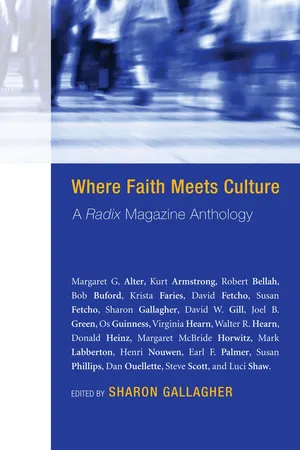
Where Faith Meets Culture is a Radix magazine anthology. What does Radix usually contain? Interviews and features. Reviews of significant books, films, and CDs. Informed opinions in "The Last Word." Eye-catching graphics. Mind-stretching prose. Image-rich poetry.
Radix assumes that Christians live in the real world and takes lay Christians seriously. As one subscriber wrote: "Radix is a more worldly magazine than one would expect from its deep commitment to Christ." Radix monitors the cultural landscape, questions assumptions, and introduces new voices, remaining deeply rooted in Christ.
Sociologist Robert Bellah wrote in a Radix article: "Though social scientists say a lot about the self, they have nothing to say about the soul and as a result the modern view finds the world intrinsically meaningless." Radix continues to talk about meaning and hope in a culture that has lost its way.
The articles in this volume reflect the magazine's wide-ranging interests: literature, art, music, theology, psychology, technology, discipleship, and spiritual formation. They're written by some of the outstanding authors whose work has graced our pages over the years:
Peggy Alter, Kurt Armstrong, Robert Bellah, Bob Buford, Krista Faries, David Fetcho, Susan Fetcho, Sharon Gallagher, David W. Gill, Joel B. Green, Os Guinness, Virginia Hearn, Walter Hearn, Donald Heinz, Margaret Horwitz, Mark Labberton, Henri Nouwen, Earl Palmer, Susan Phillips, Dan Ouellette, Steve Scott, and Luci Shaw.
Information
Topic
Theology & ReligionSubtopic
Christian ChurchI
The Good Life
Wholeness and Meaning
1
Intimacy, Fecundity, and Ecstasy
Henri Nouwen
In John’s Gospel Jesus speaks about the vine and the branches. He says, “Make your home in me as I have made mine in you. When you remain in me, with me in you, you will bear ample fruit. And I told you so, so that my joy can be in you and your joy can be complete.” I would like to reflect on those words.
About a year or two ago I met a man named Jean Vanier. Jean was a professor of philosophy in Toronto. He came from an aristocratic family and studied in Paris. His father, a man with great prestige, was governor-general in Canada and had been Canadian ambassador to France. Jean, his son, was a man who might have followed in his father’s footsteps. But one day Jean met a priest who worked with severely handicapped people. He was so impressed by the intimate contact this priest had with those people that he, too, decided he wanted to live his life with severely mentally handicapped people. He formed a small community called L’Arche (The Ark) and invited nonhandicapped people to live in households with handicapped people.
Something very deep happened there to Jean and to the others. They began to discover more fully what it means to live a life in Christ, a spiritual life. That one L’Arche community became many communities and they are now all over in France, the United States, Africa, Haiti, and other places. One community is in Mobile, Alabama, and another in Erie, Pennsylvania. They are being organized in Boston and Washington, D.C.
Out of that experience of living with severely handicapped people, Jean Vanier came to a conclusion, a kind of vision, that all human beings have three rights, or three privileges. They are the right and privilege of intimacy, the right and privilege of fecundity, and the right and privilege of ecstasy. He told me this when we were having a retreat together and I really liked the words: intimacy, fecundity, ecstasy. I sort of carried them around with me, not deliberately thinking much about them, until I was reading the text from John which I just mentioned. There, when Jesus said, “Make your home in me as I have made mine in you,” I realized he was speaking about intimacy. “And when you remain in me, with me in you, you will bear ample fruit.” There he was speaking about fecundity. “And I told you this so that my joy can be in you and your joy can be complete.” That is ecstasy.
I was very moved that Jean Vanier had discovered these qualities through living with people who are weak, vulnerable, and broken. In their brokenness they revealed what the spiritual life is all about. With those broken people Jean had a real encounter with the Lord.
Intimacy
I am going to talk first about intimacy. I invite you to struggle with me, because what I want to do first is describe to you how I have been experiencing life here in the U.S., particularly in the schools in which I’ve been teaching, and see if we can make some inner connection.
First I would like to share some of my impressions. One thing that has struck me is that the people with whom I live as well as I myself are struggling with strong needs. We have real neediness for affection, for attention, for having some influence, for power, for being recognized and acknowledged. I am overwhelmed by those needs at times. I keep realizing how intense they are. Sometimes those needs keep me, and others, wondering if we are really loved, if we are really accepted, if we are really cared for.
One tragedy is that when those needs are satisfied, often it’s for a very short time. People keep looking for more affirmation. It is frightening that those who have received a lot of praise and acknowledgment sometimes are the most fearful people. They are afraid that maybe tomorrow it won’t be so good. “Oh yes, you praised me yesterday, but what about today?” “Oh yes, that show went well, but having to do the next show makes me nervous again.” Sometimes you see people, who are famous and highly acclaimed, killing themselves out of fear of not being able to hold on to that acknowledgment.
I see that need not only in people who have secular professions, but also in the ministry and in myself. When I give a wonderful sermon about humility, I want to know what everybody thinks about it. Did you like my sermon? What did you think about it? So that need is always there.
So I’ve been asking myself, “Where do those needs come from?” When I started identifying them, I realized that quite often needs are born out of wounds, out of an experience of not being fully accepted, not being really loved, not being fully cared for. A lot of our attention and searching is trying to identify those wounds. What happened somewhere in the past that made me so needy? In counseling or psychoanalysis sometimes a lot of energy is invested in identifying the culprit. “Yes, mother didn’t really love me fully, or the church didn’t, or the people I was living with didn’t.”
Something went wrong that gives a person that sense of not being fully welcomed in life. That feeling keeps us going around and around to find that sense of belonging that we still don’t really have. Sometimes we think that even when we have identified the culprit the explanation becomes an excuse. We explain where the needs come from and then excuse ourselves with “Well, that’s who I am. Something went wrong, and that’s why I’m still doing all this.’’
Looking at this network of wounds and needs, you realize that it can reach far back into history as well as extend far into the future. If you wonder why you were wounded, you realize that those who wounded you also had needs. Their needs were born out of their wounds—and on and on it goes. You can say to yourself, “I’m not going to hurt anybody.” But just wait awhile. Somebody will accuse you of not understanding them, not really caring for them, or not really loving them. Against our best desire to be a really good person we still find that we hurt people. And so there is that interlocking network of wounds and needs that stretches out. It is what Jesus called the world.
Jesus said, “If you love those who love you, what thanks can you expect? If you loan to those who are going to give you back the same amount, what is special about that? If you care for those who care for you, what news is that?”
How do we live in this world, entangled in that network? Is there another way of living? Jesus said, “Make your home in me, as I have made mine in you.”
Now that is an incredible statement; it means that we have a home. God has given us a home. The problem may be that we are never there. The tragedy of life is that although we have a home, we always question it and are looking for one in the world, in that network of wounds and needs, hoping to come to a sense of home. But we don’t have to look for it, because it’s there. “Make your home in me as I have made my home in you.”
That image of home is very central in the Old and New Testaments. There are many words about home, house, tent, dwelling place, temple, refuge. The Lord often speaks about his home: “Come to my home; see where I live; in the house of my Father are many dwelling places.” There are also many references to home in the Psalms.
Jesus said, “I have made my home in you, I have decided that you are going to be my home. Are you willing to claim that home as yours? Are you willing to make your home there too? Are you willing to live there, where I have made my dwelling place?” Jesus spoke about home as the place of love, the first love. “I have made my home in you so that you can hear the voice of the first love.” We can receive and give love only because we have been loved first. We can receive acceptance and give acceptance only because we have been accepted, because Jesus has built a home for us, a home of love, a home of full, unconditional, unlimited acceptance. That is the home we have to claim as ours, so that we don’t have to stay in that network of needs and wounds, but can realize that there is a home where we belong.
To claim our home where the Lord has built his is an essential quality of the spiritual life. Jesus said to the disciples, “You do not belong to the world, just as I do not belong to the world. Therefore, I am sending you into the world as my Father sends me into the world.” The great paradox of the spiritual life is that precisely because we have a home and belong to the Lord, we can be in the midst of the network of wounds and needs without being pulled apart and destroyed. We are firmly anchored in the house of God.
The contemplative life and the prayerful life are both lives in which you slowly descend with the mind into the heart. The idea that God has made his home in us so that we can make our home in him should be more than just a nice idea. It sounds good, but can we start to experience that at-homeness and make it a personal truth? Or is it just a wonderful idea that in fact does not motivate us? Prayer is to descend with the mind into the heart, so the idea that we have a home in God becomes a spiritual knowledge, a knowledge of the heart (heart meaning the center of the whole person).
Prayer and silence and Scripture reading and meditation are all part of that movement from the head into the heart, so that the Word, the knowledge of God, can become flesh in us, in an ongoing incarnation. The idea that God has built his home in us becomes so real that when we preach or teach or minister or help “in the name of the Lord” it means something. That name has become our dwelling place, our home. If I say something to you “in the name of the Lord,” it means that the name is the place. It is the home. “Where are you?” “I am in the name.” “Where are you living?” “In the name.” So whatever you do—speak, eat, drink, play, work, or teach—do it in the name. That is the space where it’s happening, and that has to become a spiritual truth.
To the degree that this truth becomes true spiritual knowledge for us, we will come to experience that the Lord whom we encounter in the center of our heart is the Lord who embraces all human beings in his love. The closer we come to encounter the Lord who became flesh, the more we realize that the Word who became flesh took on all human flesh, all humanity, in time and space. The mystery is that the closer we come to the heart of God, the closer we come to the heart of the people of God. We will discover that precisely when we are in the most intimate corner of our being, we find ourselves most intimately connected with the people of the world. That is the mystery of the Incarnation.
It is a profound experience to realize that what is most intimate is most universal, that what is most personal is most all-embracing, and that the intimacy of prayer leads to an intimacy of solidarity with the people of the world. When we pray to the Lord it is not Henri Nouwen or Mary or John or any one individual who prays, but the Spirit of God prays in you, and the Spirit is the spirit of all people. In the instant of encounter with the Lord, it’s not just you who prays, but in you all humanity prays, and if God hears your prayer he touches not just you individually, but you who stand there in the name of all people.
The great mystical truth of the spiritual life is that the more intimately connected you are with the Lord, the more in solidarity you are with all the suffering people of the world. And that solidarity, that intimacy with God’s people, leads you to all sorts of places you have never dreamed of. Suddenly you find yourself moving to inner places and outer places depending on where the Voice sounds. That’s an incredible experience. You aren’t goi...
Table of contents
- Title Page
- Acknowledgments
- Part 1: The Good Life
- Chapter 1: Intimacy, Fecundity, and Ecstasy
- Chapter 2: Reflections on a Meaning-Filled Life
- Chapter 3: Wounds of Childhood and the Grace of God
- Part 2: Discipleship Call and Response
- Chapter 4: The Constellation of God’s Call
- Chapter 5: Knowing Means Doing A Challenge to Think Christianly
- Chapter 6: The Earth Is the Lord’s Stewardship in an Age of Crisis
- Part 3: Contemporary Challenges
- Chapter 7: Modern Technology Servant and Master
- Chapter 8: Finding Your Way in Science and Faith
- Chapter 9: Why Love Will Always Be a Poor Investment
- Part 4: The Word Speaks to Life
- Chapter 10: Guess Who’s Coming to Dinner Sitting at the Table with the Prodigal Son
- Chapter 11: Theological Themes in the Fiction of C. S. Lewis Good and Evil in the Chronicles of Narnia
- Chapter 12: Care of Souls in Today’s America
- Part 5: Art and Soul
- Chapter 13: The Need to Pay Attention Darkness, Light, and the Visionary Eye
- Chapter 14: The Rich Legacy of Christian Music
- Chapter 15: The Art of Worship Breaking Our Tools to Receive God’s Gifts
- Part 6: Spiritual Formation
- Chapter 16: Sabbath Living
- Chapter 17: East Meets West The Distinctives of Christian Meditation
- Chapter 18: Journal-Keeping The Poor Person’s Art
- Part 7: Media
- Chapter 19: It’s a Wonderful Life Charles Dickens’s A Christmas Carol and Frank Capra’s Film
- Chapter 20: The Gospel Songs of Bob Dylan and Mavis Staples
- Chapter 21: Why Harry Potter Is Not the Chronicles of Narnia
- Contributors
- Bibliography
Trusted by 375,005 students
Access to over 1.5 million titles for a fair monthly price.
Study more efficiently using our study tools.
Frequently asked questions
Yes, you can cancel anytime from the Subscription tab in your account settings on the Perlego website. Your subscription will stay active until the end of your current billing period. Learn how to cancel your subscription
No, books cannot be downloaded as external files, such as PDFs, for use outside of Perlego. However, you can download books within the Perlego app for offline reading on mobile or tablet. Learn how to download books offline
Perlego offers two plans: Essential and Complete
- Essential is ideal for learners and professionals who enjoy exploring a wide range of subjects. Access the Essential Library with 800,000+ trusted titles and best-sellers across business, personal growth, and the humanities. Includes unlimited reading time and Standard Read Aloud voice.
- Complete: Perfect for advanced learners and researchers needing full, unrestricted access. Unlock 1.5M+ books across hundreds of subjects, including academic and specialized titles. The Complete Plan also includes advanced features like Premium Read Aloud and Research Assistant.
We are an online textbook subscription service, where you can get access to an entire online library for less than the price of a single book per month. With over 1.5 million books across 990+ topics, we’ve got you covered! Learn about our mission
Look out for the read-aloud symbol on your next book to see if you can listen to it. The read-aloud tool reads text aloud for you, highlighting the text as it is being read. You can pause it, speed it up and slow it down. Learn more about Read Aloud
Yes! You can use the Perlego app on both iOS and Android devices to read anytime, anywhere — even offline. Perfect for commutes or when you’re on the go.
Please note we cannot support devices running on iOS 13 and Android 7 or earlier. Learn more about using the app
Please note we cannot support devices running on iOS 13 and Android 7 or earlier. Learn more about using the app
Yes, you can access Where Faith Meets Culture by Sharon Gallagher, Gallagher in PDF and/or ePUB format, as well as other popular books in Theology & Religion & Christian Church. We have over 1.5 million books available in our catalogue for you to explore.