eBook - ePub
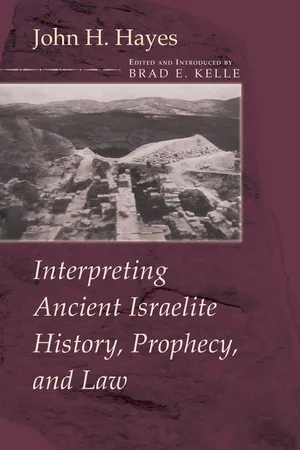
Interpreting Ancient Israelite History, Prophecy, and Law
- 320 pages
- English
- ePUB (mobile friendly)
- Available on iOS & Android
eBook - ePub
Interpreting Ancient Israelite History, Prophecy, and Law
About this book
Contents
The History of the Study of Israelite and Judean History
Wellhausen as a Historian of Israel
The Twelve-Tribe Israelite Amphicyony: An Appraisal
The Final Years of Samaria (730-720 BC)
The History of the Form-Critical Study of Prophecy
The Usage of Oracles against Foreign Nations in Ancient Israel
Amos's Oracles against the Nations (1:2--2:16)
Restitution, Forgiveness, and the Victim in Old Testament Law
Covenant
Covenant and Hesed: The Status of the Discussion
Information
1
The History of the Study of Israelite and Judean History
The Earliest Treatments of Israelite and Judean History
The writing of history as a narrative about past events is a very ancient undertaking. Its roots, so far as Western historiography is concerned, are anchored in the cultures of Israel and Greece.
History, as a genre or literary type, is found in much of the Hebrew Scriptures where events are understood in a theological or, to use Collingwood’s terminology,1 “theocratic” perspective. In spite of this perspective, much of the narrative material in these Scriptures is historiographical in intent in so far as it attempts a narrative account of past events. To suggest, as is frequently done, that Israel was the creator of historical writing2 probably goes beyond the evidence. Egyptian, Mesopotamian, and Hittite inscriptions, annals, chronicles, narratives, and art in many ways approach genuine historical thought and writing3 and tend to moderate extravagant claims about the originality and priority of Israelite historical writing. In addition, the origins and character of historical writing in Israel, especially with regard to the materials in the Pentateuch remain a much debated and unsettled issue.4 Since the Hebrew Scriptures have been and remain the primary sources for reconstructing the history of Israel and Judah, questions regarding the nature, character, and antiquity of these traditions will be discussed in various places in the following chapters.5
The first discussions of Israelite and Judean history, apart from the biblical traditions, stem from the Hellenistic Age and were the products of both Jewish and non-Jewish authors. In the early Greco-Roman period, Jewish–Roman relations and Jewish apologetic concerns engendered several treatments of Jewish history and life. From the second to the fifth century CE, with the emergence and dominance of rabbinic Judaism and the growth and state recognition of Christianity, concern with and interpretation of earlier Israelite and Judean history passed into the hands of Christian historians and theologians whose assumptions and descriptions set a pattern that remained basically unchallenged throughout the Middle Ages. These three phases of the discussion are the concern of this section.
Much of the literature dealing with Israelite and Judean history from the Hellenistic Age either did not discuss the subject in any great detail or, more probably, has been irretrievably lost. Except for the biblical book of Daniel and the apocryphal books of 1 and 2 Maccabees, only the fragments of this Hellenistic literature preserved in the works of Josephus, in Eusebius’s Praeparatio Euangelica, and in a few other Greco-Roman writers survive.6 Nonetheless, it is highly probable that most Hellenistic universal historians included a section on the history of the Jews in their works.
Among pagan authors, discussions of the origin of the Jews and the figures of Abraham and Moses dominate. Both favorable and slanderous treatments appear. Hecataeus of Abdera (about 300 BCE), in his work on the culture, history, politics, and religion of ancient Egypt, discussed the origins of the Jews in terms of their expulsion from Egypt at divine urging and their subsequent colonization of Judea. Josephus (Contra Apionem 1.183–204) quotes from a work by Hecataeus which was wholly concerned with the Jews, although Josephus’s passage only contains miscellaneous material about Jewish matters during the early Hellenistic Age. Hecataeus’s treatment of the Jews and their history was generally favorable and, while praising Moses as a cult founder and lawgiver, he shows little, if any, direct knowledge of the Jews and their sacred writings. Hecataeus’s description of Moses and subsequent Jewish history that tended to telescope everything around Moses was highly influential upon practically all Hellenistic and even Greco-Jewish writers.7
Over against the material in Hecataeus (and Theophrastus, Megas-thenes, and Clearchus), which took a favorable attitude towards the Jews, one finds widespread use of a version of the exodus and the career of Moses that heaps calumny upon the Jews. Utilizing an old story form that told of a foreign invasion of Egypt,8 a reign of terror by outsiders, and a triumph over this dominance by a hero-king,9 these descriptions of Jewish history depicted the Hebrews as an impure people, Moses as a polluted Egyptian priest, and portrayed Jewish life and practices as hostile to everything non-Jewish.10 This hostile propaganda was basicaly centered in Alexandria and reflects the tension between Jews of the Egyptian diaspora and the native, especially priestly, Egyptian population. The roots of this anti-Jewish polemic were no doubt multiple,11 and the tension is already reflected in Aramaic papyri of the fifth century BCE from Egypt. Variations on this theme of Jewish origins are reflected in Egyptian literature for over six centuries12 and no doubt formed a vital part of the arsenal of anti-Jewish propaganda offering a supportive rationale for repressive measures.
Perhaps the most significant example of this anti-Jewish version of Moses and the origins of the Jews is that attributed to Manetho (third century BCE) by Josephus (Contra Apionem 1.73–91, 93–105, 228–52), who claims to be quoting from Manetho’s Aegyptiaca, although Josephus seems to retell Manetho’s treatment in two different versions.13 Manetho’s phil-Egyptian version or Josephus’s interpretation of it identified or associated the expulsion of the Hyksos with the biblical account of the Hebrew departure from Egypt, an interpretation sometimes found in modern histories of ancient Israel.
Among the materials preserved by Eusebius from the collective work of Alexander Polyhistor (Concerning the Jews) are fragments of a historical work by the so-called Pseudo-Eupolemus (Praeparatio Evangelica 9.17–39). This writer was apparently a Samaritan and on...
Table of contents
- Title Page
- Preface
- Introduction
- Abbreviations
- Chapter 1: The History of the Study of Israelite and Judean History
- Chapter 2: Wellhausen as a Historian of Israel
- Chapter 3: The Twelve-Tribe Israelite Amphictyony
- Chapter 4: The Final Years of Samaria (730–720 BC)
- Chapter 5: The History of the Form-Critical Study of Prophecy
- Chapter 6: The Usage of Oracles against Foreign Nations in Ancient Israel
- Chapter 7: Amos’s Oracles against the Nations (1:2—2:16)
- Chapter 8: Restitution, Forgiveness, and the Victim in Old Testament Law
- Chapter 9: Covenant
- Chapter 10: Covenant and Hesed
- Acknowledgments
Trusted by 375,005 students
Access to over 1.5 million titles for a fair monthly price.
Study more efficiently using our study tools.
Frequently asked questions
Yes, you can cancel anytime from the Subscription tab in your account settings on the Perlego website. Your subscription will stay active until the end of your current billing period. Learn how to cancel your subscription
No, books cannot be downloaded as external files, such as PDFs, for use outside of Perlego. However, you can download books within the Perlego app for offline reading on mobile or tablet. Learn how to download books offline
Perlego offers two plans: Essential and Complete
- Essential is ideal for learners and professionals who enjoy exploring a wide range of subjects. Access the Essential Library with 800,000+ trusted titles and best-sellers across business, personal growth, and the humanities. Includes unlimited reading time and Standard Read Aloud voice.
- Complete: Perfect for advanced learners and researchers needing full, unrestricted access. Unlock 1.5M+ books across hundreds of subjects, including academic and specialized titles. The Complete Plan also includes advanced features like Premium Read Aloud and Research Assistant.
We are an online textbook subscription service, where you can get access to an entire online library for less than the price of a single book per month. With over 1.5 million books across 990+ topics, we’ve got you covered! Learn about our mission
Look out for the read-aloud symbol on your next book to see if you can listen to it. The read-aloud tool reads text aloud for you, highlighting the text as it is being read. You can pause it, speed it up and slow it down. Learn more about Read Aloud
Yes! You can use the Perlego app on both iOS and Android devices to read anytime, anywhere — even offline. Perfect for commutes or when you’re on the go.
Please note we cannot support devices running on iOS 13 and Android 7 or earlier. Learn more about using the app
Please note we cannot support devices running on iOS 13 and Android 7 or earlier. Learn more about using the app
Yes, you can access Interpreting Ancient Israelite History, Prophecy, and Law by John H. Hayes, Dr. Brad Kelle, Kelle in PDF and/or ePUB format, as well as other popular books in Theology & Religion & Biblical Criticism & Interpretation. We have over 1.5 million books available in our catalogue for you to explore.