- 190 pages
- English
- ePUB (mobile friendly)
- Available on iOS & Android
eBook - ePub
About this book
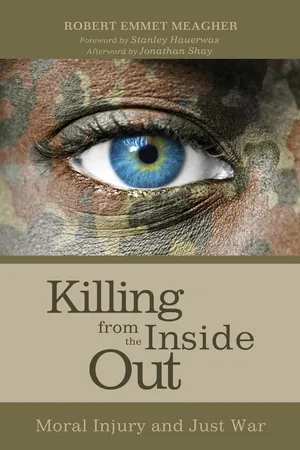
Armies know all about killing. It is what they do, and ours does it more effectively than most. We are painfully coming to realize, however, that we are also especially good at killing our own "from the inside out," silently, invisibly. In every major war since Korea, more of our veterans have taken their lives than have lost them in combat. The latest research, rooted in veteran testimony, reveals that the most severe and intractable PTSD--fraught with shame, despair, and suicide--stems from "moral injury."
But how can there be rampant moral injury in what our military, our government, our churches, and most everyone else call just wars? At the root of our incomprehension lies just war theory--developed, expanded, and updated across the centuries to accommodate the evolution of warfare, its weaponry, its scale, and its victims.
Any serious critique of war, as well any true attempt to understand the profound, invisible wounds it inflicts, will be undermined from the outset by the unthinking and all-but-universal acceptance of just war doctrine. Killing from the Inside Out radically questions that theory, examines its legacy, and challenges us to look beyond it, beyond just war.
Information
Topic
Theology & ReligionSubtopic
Christian Theology1
Introduction
Moral Injury Then and Now
That we live today in an age of endless war is a mantra intoned so often as to keep an easily distracted nation ever-mindful that it needs to be vigilant, even preemptive, and above all aggressively armed. War has become our natural posture, our national default position, and we are more or less comfortable with it and its consequences. After all, our lives go on as we feel they should without grave risk or injury, provided we belong to the 99 percent who never see the face of war up front. That honor, as we like to think of it, belongs to our men and women in arms, our heroes, whom we thank for their service and for whom we tie yellow ribbons and all too often lower our flags halfway.
It is a more careless than truly grateful nation, however, that watches and applauds its sons and daughters as they go off to war and return, and yet fails to notice or care for long that they come back different and often desperate. The fact that the majority of their wounds are invisible is no excuse. What we cannot see we can still come to know through listening.
Fortunately, not all combat veterans return from war with wounds to their bodies or to their souls. But many do, too many. Those who come back without limbs or eyes, those who will never work or even walk again, often or maybe even most of the time receive the care they deserve; but those who come back without a scar—silent, hollowed out, shadowed, and overlooked until they take their agony out on themselves or others—rarely find recognition, much less healing. Yet what would healing mean for them? For the most part, we as a nation haven’t a clue, and there are reasons for that. One of the central tasks of this book will be to examine the reasons why the moral torment of so many veterans mostly falls on deaf ears.
It may be that the question simply makes no sense to those who have thought little and experienced even less of war. How, for example, can those who have served their country, risked death and injury, observed the rules of war, and followed orders—in what the president of the United States, Barack Obama, in his 2009 Nobel Peace Prize acceptance speech labeled a morally justified use of violence—be in need of spiritual healing or “repentance”? Repentance for what? The clergy, and their congregations with them, regardless of faith or denomination,1 rarely perceive the possibility of sin in national service. Most of them long ago accepted one or other version of the traditional just war theory, regularly revised and recalibrated across the centuries to certify the moral legitimacy of lethal violence, provided certain conditions are met. Meeting those conditions is, most everyone assumes, the responsibility of the White House and the Pentagon, not that of individual citizens who need to take their government at its word. In general, pastors on the home front, like chaplains in the combat zone, support the troops, as they should, as well as everything the troops are commanded to do, which they arguably should not. The truth is that a great many combat veterans, having followed all the rules, are haunted more by what they have done than by what they have endured in war. Those who work with veterans to help heal their inner, invisible wounds know that the deepest and most intractable PTSD (post-traumatic stress disorder) has its roots in what veterans perceive as the evil they have done and been a part of. They all too often see themselves as criminals, not because they have committed war crimes but because they have become convinced by their own experience of the essential criminality of war. Needless to say this is a conviction that neither the military nor the government is prepared to hear and take seriously.
To whom, then, if not to the clergy, can the morally injured, spiritually desolate veteran turn? The ranks of secular caregivers attending to those suffering from invisible wounds are filled by therapists and counselors with one or other cluster of qualifying letters after their names—psychiatrists, clinical psychologists, and social workers and psychiatric mental health nurses. Armed with the latest edition of the DSM, The Diagnostic and Statistical Manual of Mental Disorders, and informed by the vast clinical literature addressing battle trauma, what they see in and hear from their patients more often than not looks like and sounds like classic, standard, well-documented PTSD (post-traumatic stress disorder) or TBI (traumatic brain injury), and they proceed accordingly in weighing their treatment options. Some of these caregivers, however, especially those who have listened longer and more openly to their patients, have begun to question whether they truly grasp the source and extent or even the nature of their patients’ suffering. When combat veterans speak to them of the impenetrable darkness in which they now live out their days, much less their nights, or try to convey the shame and guilt that consumes them, psychiatrists may well and often do question whether the most appropriate solution is to whip out their Rx pads. When veterans, even those not previously or particularly religious, report that their souls are dead or that they have lost their humanity and want it back, many MDs and PhDs on the frontlines of veteran care rightly wonder why they are the ones to be hearing this. But if not they, then who? With no ready answer to this question at hand, they do their best, often generously overstepping their professional training and/or personal beliefs and disbeliefs to acknowledge the obvious suffering of others and to just be there to listen.
The inner damage and pain that even the most qualified and concerned caregivers hesitate to address is what many today diagnose as “moral injury.”2 Moral injury is not a new concept, much less a new reality, as will become painfully clear in the course of this book. All that is relatively recent is the term “moral injury,” freshly minted in the minds of psychiatrists, therapists, and counselors. Today we find it in wide circulation among veterans and their professional caregivers, as well as in psychiatric journals, government reports, church pulpits, and the national media. More to our present purpose, it facilitates an inquiry and discussion such as this one, providing a common point of entry into a place that is both dark and painful, a place where many veterans find themselves suffering in confusion and despair, a place where nearly everyone else is reluctant to go. “Moral injury” has most commonly come to mean the transgression, the violation, of what is right, what one has long held to be sacred—a core belief or moral code—and thus wounding or, in the extreme, mortally wounding the psyche, soul, or one’s humanity. As with so many concepts for which definitions fall short, moral injury is most clearly seen and understood in stories.
The story to which we first turn to illustrate and understand moral injury is but one of countless tragic stories of war and return, past and present. It is also a possibly familiar story made public in a number of media accounts and notably featured in a recent (2011) documentary titled Wartorn 1861–2010. It is the heartbreaking story of Noah Pierce3 who, with his mother’s reluctant consent, enlisted in the U.S. Army at the age of seventeen and less than two years later found himself in the vanguard of the March 2003 Iraq invasion. Four years later he sat alone in his pickup truck in Gilbert, Minnesota, put a gun to his head, and ended the life that had for him become unendurable. Scribbled on the back of an NRA pistol-safety certificate were these words to his mother:
Mom, I am so sorry. My life has been hell since March 2003 when I was part of the Iraq invasion. . . . I am freeing myself from the desert once and for all. . . . I am not a good person. I have done bad things. I have taken lives. Now it’s time to take mine.4
In the words of a close family friend, Noah was “too sensitive” and “too caring” to go to war and ever come back whole. Those words proved prophetic. He came back different, darkened, broken, haunted. In his letters home, Noah had described many of the “bad things” that he had witnessed and done in Iraq, as fear turned to anger and anger turned to hatred. He took some lives by accident, like the child he crushed under his Bradley Fighting Vehicle, but others he took deliberately, like the unarmed man he shot in the forehead at point-blank range or the last person he killed, a doctor, at a checkpoint. “He couldn’t forgive himself for some of the things he did,” explains his mother:
And he thought of himself as a murderer, and a bad person, because he still had the urge to hurt people, kill people. The United States Army turned my son into a killer. They trained him to kill to protect others. They forgot to un-train him, to take that urge to kill away from him.5
Noah Pierce was not a war criminal, only a warrior who served his country as well as he knew how. After two deployments in Iraq he was given an honorable discharge from the army and returned home to a grateful nation. In the eyes of those who knew little or nothing of what he knew, he was a hero, an accolade he wanted no part of. “So tell me,” he wrote to his mother while still in Iraq, “how we are heroes.”6 Until he shot himself, Noah Pierce bore no physical wound, no sign of injury. His kind of wound, his mother explains, “kills you from the inside out.”7 His kind of wound is what we mean by moral injury, and although this book will not pretend to probe the psychological layers of moral injury, much less prescribe therapies for its healing, it will reveal its roots. And to do that we must trace the Western history of moral injury in war back to its recorded beginnings in ancient Greece and follow its path through the Christian centuries to modern Europe and contemporary America.
The tragedy of Noah Pierce finds an early precursor in a war drama written and enacted twenty-five centuries ago about a war that was already at the time ancient history. I have in mind a seldom read and still more seldom staged play entitled Philoctetes that the classical Greek playwright Sophocles wrote in his old age, at eighty-seven to be exact, after a long life not only in the theater of Dionysus but also in the theater of war. He had so far survived several wars on Greek soil and served in at least two of them, twice elected to the rank of strategos or “general.” This is to say that in depicting war and its wounds Sophocles knew well what he was talking about. More specifically, he could not have been a stranger to moral injury; for he knew firsthand the intimate face-to-face savagery of ancient warfare, especially the protracted Greek-on-Greek civil warfare of the Peloponnesian War, notorious for its indiscriminate brutality and civilian carnage.
As Sophocles composed and staged Philoctetes, the Peloponnesian War was in its twenty-second year. Although he set the action of the play in the hoary past of the Trojan War, Sophocles wrote to the current war that Athenians knew all too well. It was conventional and convenient for tragic playwrights to don the masks of myth and legend when confronting their contemporaries with inconvenient truths. The past was, or seemed, safe, even entertaining, until like a mirror it reflected its audience. Stories worth telling are like that. They take us up and away into another reality before bringing us back to ourselves, eyes wide open. They promise escape, and give us truth instead. “The truth,” wrote the Greek philosopher Heracl...
Table of contents
- Title Page
- Foreword
- Preface
- Chapter 1: Introduction
- Chapter 2: Ancient Greece
- Chapter 3: Killing
- Chapter 4: Imperial Rome
- Chapter 5: Christian Rome
- Chapter 6: Medieval Christianity
- Chapter 7: Early Modern Europe
- Chapter 8: Conclusion
- Afterword
Trusted by 375,005 students
Access to over 1.5 million titles for a fair monthly price.
Study more efficiently using our study tools.
Frequently asked questions
Yes, you can cancel anytime from the Subscription tab in your account settings on the Perlego website. Your subscription will stay active until the end of your current billing period. Learn how to cancel your subscription
No, books cannot be downloaded as external files, such as PDFs, for use outside of Perlego. However, you can download books within the Perlego app for offline reading on mobile or tablet. Learn how to download books offline
Perlego offers two plans: Essential and Complete
- Essential is ideal for learners and professionals who enjoy exploring a wide range of subjects. Access the Essential Library with 800,000+ trusted titles and best-sellers across business, personal growth, and the humanities. Includes unlimited reading time and Standard Read Aloud voice.
- Complete: Perfect for advanced learners and researchers needing full, unrestricted access. Unlock 1.5M+ books across hundreds of subjects, including academic and specialized titles. The Complete Plan also includes advanced features like Premium Read Aloud and Research Assistant.
We are an online textbook subscription service, where you can get access to an entire online library for less than the price of a single book per month. With over 1.5 million books across 990+ topics, we’ve got you covered! Learn about our mission
Look out for the read-aloud symbol on your next book to see if you can listen to it. The read-aloud tool reads text aloud for you, highlighting the text as it is being read. You can pause it, speed it up and slow it down. Learn more about Read Aloud
Yes! You can use the Perlego app on both iOS and Android devices to read anytime, anywhere — even offline. Perfect for commutes or when you’re on the go.
Please note we cannot support devices running on iOS 13 and Android 7 or earlier. Learn more about using the app
Please note we cannot support devices running on iOS 13 and Android 7 or earlier. Learn more about using the app
Yes, you can access Killing from the Inside Out by Robert Emmet Meagher in PDF and/or ePUB format, as well as other popular books in Theology & Religion & Christian Theology. We have over 1.5 million books available in our catalogue for you to explore.