- 136 pages
- English
- ePUB (mobile friendly)
- Available on iOS & Android
eBook - ePub
About this book
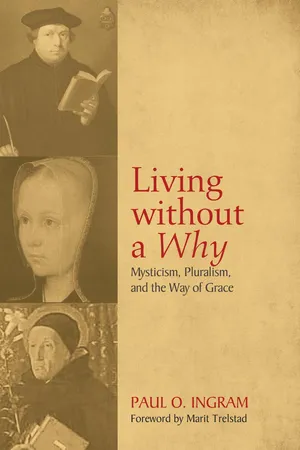
In this book Paul O. Ingram adds his voice to a long list of writers seeking to relate Christian tradition to the hard realities of this post-Christian age of religious and secular pluralism. As a Lutheran, Ingram thinks grace flows over this universe like a waterfall. So he brings Christian mystical theology into a discussion of the meaning of grace.
Alfred North Whitehead's philosophical vision provides a language that serves as a hermeneutical bridge by which historians of religions can interpret the teachings and practices of religious Ways other than their own without falsification, and by which theologians can appropriate history-of-religions research as a means of helping Christians advance in their own faith journeys.
The purpose of the journey of faith is what Whitehead called "creative transformation." The contemporary theological tradition that has most systematically and coherently followed Whitehead's lead in its reflection on non-Christian Ways is process theology, which is perhaps the only liberal or progressive theological movement now active in the twenty-first century.
Information
Subtopic
Religionone
Introduction
On November 8, 2000, I preached a sermon titled “The Epiphany of Jesus” at a morning chapel service at Pacific Lutheran University in Tacoma, Washington.1 My chosen text for that morning was Mark 9:33–40. Since the topic of each chapter in this book is inspired by my theological reflection on these verses in Mark’s gospel contextualized by my reading of Marguerite Porete’s Mirror of Simple Souls, I thought it best to include this sermon as my beginning point. I have broken Mark’s text into two sets of verses for reasons I hope will be clear. First, Mark 9:33–37:
And they came to Capernaum; and when he was in the house he asked them, “What were you discussing on the way?” But they were silent; for on the way they had discussed with one another who was the greatest. And he sat down and called the twelve; and he said to them, “If any one would be first, he must be last of all and servant of all.” And he took a child, and put him in the midst of them; and taking him in his arms, he said to them,” Whoever receives one such child in my name receives me; and whoever receives me, receives not me, but him who sent me.
Jesus’s question to Peter—“Who do you say that I am?”—is the heart of Christian self-understanding and must be answered differently in every age. We do not live in the first century or the Middle Ages or the nineteenth century. Clinging to past images of Jesus and his relation to God simply will not do in our contemporary, global context of religious and cultural pluralism. This is not surprising, since Christians have been practicing faith within globally pluralistic contexts for two thousand years.
We still haven’t got it right, even though the answer to Jesus’s question to Peter is right in front of us, as it was for the disciples: stalking us like a cougar after prey. According to Mark’s gospel, the disciples didn’t get it right either, even though they followed Jesus around Palestine for perhaps a year. Jesus tried to tell them, yet even they didn’t see the answer staring them in the face until after Jesus was killed, and even then only vaguely.
In Mark’s text, Jesus and the disciples have returned to his home in Capernaum after an extended journey. On the way to Caesarea Philippi Jesus had questioned the disciples about his identity. Now on the way back home, the disciples are arguing about their own self-images. When Jesus questions them again, they fall silent with embarrassment because they have been arguing about the preeminence of self—over who is the greatest. They are like fundamentalists everywhere in all times and in all places in all religious traditions: trapped in the conventional categories of their religious systems. They, like Jesus, are practicing Jews. But unlike Jesus, they cling to their culture’s conventional Judaism so tightly they can’t hear the music behind the lyrics of either Jewish practices or Jesus’s teachings. Like legalists and fundamentalists of all ages in all religious traditions, their path is one of fabricating verbal argumentation, of imaging a self—or a particular community of selves—exalted above others at the center of their conventional world. Their journey with Jesus has not awakened them. Instead, they see Jesus as their ticket to glory, to permanent selfhood exalted.
So once more Jesus instructs them about discipleship. His teaching method is to consistently subvert their notions of discipleship as a preeminence of position. “He who would be first must be last,” he says. To make one’s self last means negating the absolute nature of one’s self, of one’s persona. This is why receiving Jesus and the one who sent him in Mark and elsewhere in other gospel texts is exemplified as the receiving of a little child—of one who has not yet developed a strong self-image, of one who has no rank or importance beyond their particular families. It is Jesus who approaches the disciples and the readers of Mark as a child, with no rank or importance whatsoever. It is God who sent Jesus, who approaches the disciples and us as a child, not as the romanticized image of sweet innocence, but the weakest of the weak.
Our first response as readers of Mark’s text is to disassociate ourselves from the egotistical disciples. In previous verses Jesus had just been speaking about the inevitability of his suffering and dying. And the disciples’ insensitivity to Jesus’s fate, combined with their crass egoism, is not a stance a reader is likely to willingly embrace. But by a rhetorical sleight of hand, the Markan Jesus directly addresses the reader—meaning us—through a series of paradoxical “if” and “whoever” statements: “If anyone would be first, he must be last of all and servant of all”; “Whoever receives one such child in my name receives me”; “whoever receives me, receives not me but him who sent me.”
The experience of paradox is the experience of being bracketed between seemingly incompatible but nevertheless coexisting pairs of opposites. Even Mark’s language about God is paradoxical. Who is the “who” that sent Jesus? Why does Mark not explicitly identify God as Jesus’s sender? The Markan Jesus simply says that to receive the weakest of the weak is to receive him and “him who sent me.” In the same way, the voice of God speaks from the heavens at Jesus’s baptism in chapter 1, verse 1, and again from a cloud at Jesus’s transfiguration. Yet Mark fails to mention just whose voice is speaking. And again, when the Markan Jesus addresses his Father in Gethsemane, in response no voice is heard at all. But Jesus is portrayed as the Son of God and our assumption that the voices Mark allows us to hear are from God is not mistaken. What is mistaken is that we know what this means. Not only is Jesus impossible to identify in clear definitions, God is too. What, then, could it mean to be great?
Now Mark 9:38–40:
John said to him, “Teacher, we saw a man casting out demons in your name, and we forbade him, because he was not following us.” But Jesus said, “Do not forbid him; for no one who does a mighty work in my name will be able soon after to speak evil of me. For he who is not against us is for us.”
Now the disciple John changes the question by latching onto the name of Jesus to bring up the issue of just who can be said to belong to the Jesus movement. After all, throughout Mark’s gospel, Jesus harshly criticizes various groups of people—the Pharisees, the scribes, the Jerusalem temple priests. Who could blame John for concluding that the disciples constitute a well-defined, exclusive group over against outsiders? Indeed, defining a social identity was an important issue for the early church, as it still is today. But party spirit does not come from receiving Jesus and God as one would receive a child, but from a conventionally fearful mind that draws artificial boundaries around people as a religious prophylaxis to protect one’s community from coming into contact with whatever one regards as threatening. These very boundaries Jesus has been at pains to undermine.
Jesus does not recommend party identity, but opens up community to anyone who is not against him. There are no fixed criteria for membership in the Jesus community—beyond the requirement that one not be against it. There is no imagined pattern of Christian self-identity, no gold card of membership. Jesus’s teachings in Mark are pluralist, not exclusivist: they apply to all who are not against Jesus, not only Christians, but also non-Christians: Buddhists who revere Jesus as an awakened person (that is, a Bodhisattva); Muslims, who revere Jesus as one of the greatest prophets; Jews, who see Jesus as a reformer calling people to a renewed practice of the Torah.
Of course, these non-Christians do not accept Christian ideas about Jesus. Yet Jesus’s teaching recorded here in Mark makes no such stipulation. To be for Jesus does not necessarily mean accepting ideas about Jesus. Ideas about Jesus—creeds, doctrines, theological constructions in general—flow out of conventional wisdom and are tied to historical and cultural contexts and are empty of unchanging essence and once-and-for-all timeless meanings. Note that Mark himself gives no clear definitions, because the author of Mark is the first deconstructionist of the Jesus movement. His Jesus and the God who sent Jesus shy away from self-definition. The messiah is not the glory figure of the disciples’ conventional expectations, but one who experiences the sufferings, sorrows, and joys of a lived life. The follower of Jesus is not one who belongs to the proper group. Anyone who is not against Jesus is a follower of Jesus; this makes for a very pluralistic community indeed.
So what does Mark teach us about following the way of Jesus two thousand years after the disciples tried and failed? I think Mark teaches us negative and positive lessons. Negatively, Mark’s deconstructs human pretensions about who is greatest, along with claims that any single group of followers of Jesus has an exclusive claim on truth about Jesus and the one who sent Jesus. Mark’s deconstruction tells us that Christian faith is not about ripping biblical texts out of context as a means of proving who’s really Christian and who’s not. Mark teaches us that no human being and no religious community is greater than another human being or religious community. Mark teaches us that God doesn’t give a damn about religion, but cares very much about human beings and the rest of creation. Mark teaches us that faith is not adherence to a set of doctrinal propositions about Jesus and the one who sent Jesus. Mark teaches us that Jesus and the one who sent him cannot be contained by ritual and theological systems. Mark teaches us that clinging to conventional practices and conventional understandings that try to lock God within the safe boundaries of our cultural expectations while excluding those who do not see things our way is not faith but unfaith. Mark teaches us that we should never transform faith into a set of ideological propositions. We should never confuse theological reflection, which Saint Anslem called “faith seeking understanding,” with ideology.
Positively, Mark teaches us that we find Jesus and the one who sent Jesus incarnated in the ordinary; in loving relationships between people; in the struggle against economic, political, gender and racial injustice; in the struggle for ecological justice that frees nature—God’s creation—from human exploitation. We meet Jesus and the one who sent Jesus wherever and whenever persons work for justice. Following the way of Jesus is not a matter of membership in a particular Christian group or of wearing a particular Christian label like Lutheran or Roman Catholic or Presbyterian or Baptist. The Jesus community that Mark envisioned includes anyone who is not against Jesus: the socially engaged Buddhist layman Sulak Sivaraksa, who has time and again placed his life in danger for his criticism of the Thai government’s financial involvement in the drug trade and sex trade of his country; Dr. Cecil Murray, retired senior pastor of the First AME Church in Los Angeles, whose educational vision and social outreach to the poor and homeless has become a model for similar social programs throughout the counties of Southern California; Mahatma Gandhi, who followed the principle of nonviolence in his struggle to free his people from British colonialism; Gandhi’s Muslim friend Badhsha Khan, who transformed the Qur’an’s teaching of jihad or “struggle” into nonviolent resistance against the injustices of British colonialism; Martin Luther King Jr., who apprehended Jesus and the one who sent Jesus in his fight against American racism. All of these are followers of Jesus, as are each of us, when we feed the poor; when we refuse to oppress people because of gender, ethnicity, or race; when we do not confuse membership in the Jesus community with membership in any particular form of the institutional church. We are followers of Jesus and the one who sent Jesus when we refuse to destroy nature through unbridled consumerism. The Markan Jesus teaches us that we find Jesus and the one who sent Jesus incarnated in the kingdom of God that is the kingdom of nobodies.
So, inspired by these verses in Mark’s gospel and Marguerite Porete’s Mirror of Simple Souls, each chapter of this book is the theological refection of a historian of religions who specializes in Japanese Buddhism, Buddhist–Christian dialogue, and the current dialogue between science and religion in general, and Christian theology in particular. Accordingly, the thesis of chapter 2, “History of Religions: Methodology as Metaphor,” is that the separation between historical studies of religious experience and theological reflection about the meaning of religious experience is a Cartesian dualism that needs to be rejected. That is, the usual separation between descriptive questions (e.g., what religious persons do and why they do it) and normative theological questions (e.g., the meaning and truth of what religious persons do) actually distorts the experiences of religious human beings.
My intention in chapter 3,”The Difficult Path,” is to add my voice to a long list of writers seeking to relate Christian tradition to the hard realities of this post-Christian age of religious and secular pluralism by bringing Christian mystical theology into a discussion of the meaning of grace that, as a Lutheran, I think flows over this universe like a waterfall. Whitehead’s philosophical vision provides a language that serves as a hermeneutical bridge by which historians of religions can interpret the teachings and practices of religious ways other than their own without falsification, and by which theologians can appropr...
Table of contents
- Title Page
- Foreword
- Preface
- Chapter 1: Introduction
- Chapter 2: History of Religions: Methodology as Metaphor
- Chapter 3: The Difficult Path
- Chapter 4: What’s in a Name?
- Chapter 5: Butterfly in a Mirror
- Chapter 6: A Theological Reflection on Mystical Experience
- Chapter 7: The Jesus Way of Living without a Why
- Chapter 8: Living without a Why: The Way of Grace
- Bibliography
Trusted by 375,005 students
Access to over 1.5 million titles for a fair monthly price.
Study more efficiently using our study tools.
Frequently asked questions
Yes, you can cancel anytime from the Subscription tab in your account settings on the Perlego website. Your subscription will stay active until the end of your current billing period. Learn how to cancel your subscription
No, books cannot be downloaded as external files, such as PDFs, for use outside of Perlego. However, you can download books within the Perlego app for offline reading on mobile or tablet. Learn how to download books offline
Perlego offers two plans: Essential and Complete
- Essential is ideal for learners and professionals who enjoy exploring a wide range of subjects. Access the Essential Library with 800,000+ trusted titles and best-sellers across business, personal growth, and the humanities. Includes unlimited reading time and Standard Read Aloud voice.
- Complete: Perfect for advanced learners and researchers needing full, unrestricted access. Unlock 1.5M+ books across hundreds of subjects, including academic and specialized titles. The Complete Plan also includes advanced features like Premium Read Aloud and Research Assistant.
We are an online textbook subscription service, where you can get access to an entire online library for less than the price of a single book per month. With over 1.5 million books across 990+ topics, we’ve got you covered! Learn about our mission
Look out for the read-aloud symbol on your next book to see if you can listen to it. The read-aloud tool reads text aloud for you, highlighting the text as it is being read. You can pause it, speed it up and slow it down. Learn more about Read Aloud
Yes! You can use the Perlego app on both iOS and Android devices to read anytime, anywhere — even offline. Perfect for commutes or when you’re on the go.
Please note we cannot support devices running on iOS 13 and Android 7 or earlier. Learn more about using the app
Please note we cannot support devices running on iOS 13 and Android 7 or earlier. Learn more about using the app
Yes, you can access Living without a Why by Paul O. Ingram in PDF and/or ePUB format, as well as other popular books in Théologie et religion & Religion. We have over 1.5 million books available in our catalogue for you to explore.