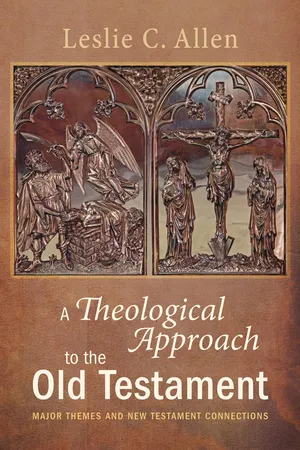
eBook - ePub
A Theological Approach to the Old Testament
Major Themes and New Testament Connections
- 218 pages
- English
- ePUB (mobile friendly)
- Available on iOS & Android
eBook - ePub
A Theological Approach to the Old Testament
Major Themes and New Testament Connections
About this book
The Old Testament has two great themes: creation and covenant. They embrace subthemes: wisdom in the case of creation; Israel's religion and the Davidic covenant under the general umbrella of covenant; and internationalism, which mostly develops the theme of covenant and partly the theme of creation.
These topics cluster around a common center: Yahweh, the God of the Old Testament. This God is portrayed in different roles, which have attached to them role expectations for both Yahweh and those with whom he assumes relationship. Through contextual exegesis of key texts, we come to understand these roles and associated themes.
While the Old Testament has its own distinctive contributions to make to divine revelation, much of its material is reused in the New Testament to explain and validate the New Testament message. By concentrating on the Old Testament, we learn to appreciate the enormous debt the New Testament owes to the Old in clarifying New Testament theological and moral perspectives.
Information
Topic
Theology & ReligionSubtopic
Biblical Studies1
Introduction
“The task of the church is to hear the Old in the light of the New, and the New in the light of the Old.” So Christopher Seitz has well said.1 To fail to accomplish that double task is to ignore the truth for the Christian church that the Old Testament is incomplete without the New, and the New Testament incomplete without the Old. The title Old Testament that Christians give to the Jewish Hebrew Bible (a term short for Hebrew-Aramaic Bible) sends a clear signal.2 It indicates a perspective that finds adequate room for the New Testament as the sequel that depends on the contribution of the Old. To speak of the Old Testament is to utter an unfinished sentence. “‘Old’ is not a temporal term only, but a term pointing to a character understood only in relationship with a second witness.”3 Most Christian treatments of OT theology leave the NT on the edge of their discussion, if they discuss it at all. Indeed, the sheer mass of material in the OT pushes them toward that limited viewpoint. However, trying to take seriously Seitz’s comment obliges us to keep one eye on the NT as we go along, valuing the OT as an essential part of the Christian Bible, even while respecting it for its own sake and studying it on its own terms. There is an obvious tension between staying faithful to the OT’s own concerns and broaching NT developments, but both perspectives are equally necessary. “The use of the OT by the NT is not a substitute for Christian theological reflection on the OT in its own formal integrity.”4 Indeed, John Goldingay has observed that “only when the theologian is not concerned about the contemporary relevance of his study is he likely to do justice to the Bible itself.”5 At the close of the book, we will reverse the process of prioritizing the OT and examine the use of the OT in the NT by placing emphasis on the NT itself in some general conclusions. Overall, in turning from OT to NT, our aim is to show what the NT looks like from an OT perspective.
We should not make our study a purely academic exercise. We must never forget J. S. Whale’s challenge to respond to the Bible in a confessional spirit: “Instead of putting off the shoes from our feet because the place whereon we stand is holy ground, we are taking nice photographs of the burning bush from suitable angles.”6 Nor can we ignore the exhortation of the Victorian poet Alfred Tennyson in the prologue to his poem “In Memoriam”:
Let knowledge grow from more to more, But more of reverence in us dwell, That mind and soul, according well, May make one music.
Such an approach to the OT is vital, for pastors and laity alike. The way Elmer Martens has defined the importance of biblical theology is relevant: “Biblical theology poses for the church the question whether or not the church still adheres to its founding document and functions in keeping with it.”7 In focusing on the OT aspect of biblical theology, it is hoped that this book will especially encourage pastors to preach more from the OT in their services and give it more prominence in the teaching programs of their churches. Christians under their care should come to realize that they cannot live without the OT because they have discovered its depth of meaning and relevance for the life of faith. Over the years I have come to the conclusion that pastors, at least in the United Kingdom and the United States, do not know what to make of the OT and find it easier to stick to the NT, which has the advantage of directly addressing Christians. (I have noticed too that they tend to have an even smaller canon within the NT canon, by restricting themselves to those parts of the NT that accord with traditional faith and contemporary culture.) If I may give a personal testimony, in my early forties, as a lay preacher, I was so appalled by the blatant ignoring of the OT in the pulpits of the churches I knew that I made a vow to God to preach and teach in churches only from the OT as much as possible. When assigned a NT text, I decided I would use it as a window to a corresponding OT text and truth. If I, as an OT specialist, did not do so, who would?
Biblical Theology
Biblical theology is a strange, hybrid creature. It developed historically from Christian systematic or doctrinal theology, while in turn systematic theology was based on the Christian creeds rather than directly on the Bible. As John L. McKenzie provocatively stated, “most of the Bible is irrelevant to systematic theology.”8 Accordingly it does not get reflected there. The hybrid nature of biblical theology is that it presents a synthesis of systematic theology and biblical texts. James Barr has defined biblical theology as “a sort of intermediate activity between normal exegesis of the individual texts and the regulative decision-making of doctrinal theology.” He rightly affirmed that “biblical theology has to depend upon detailed exegesis and submit to its authority.”9 It will not do to subordinate the Bible to systematic theology by simply finding in the Bible proof texts for Christian theology. In fact, biblical theology is more a kind of historical theology than a systematic one.
The Part That Exegesis Plays
How does the synthesis between theology and exegesis work out in practice? The answer varies according to the particular biblical theologian. The two giants of OT theology in the twentieth century, Eichrodt and von Rad, gave different answers. Eichrodt adopted a systematizing approach to the OT and tended to relegate to footnotes lists of texts that backed up his careful conclusions. Von Rad, on the other hand, gave much more space to exegesis of texts in presenting his views and so was able to accommodate the diversity of those texts in his work. Rolf Rendtorff has written approvingly about von Rad’s approach: “The theological interpretation of the OT must not exempt itself from a scholarly examination of the texts; it must be developed and justified in the light of that examination, difficult though this venture may often be.”10 Von Rad himself wrote: “Theology’s interest in exegesis and the methods of understanding used there is a keen one, because it is here that the decisions which are important for it are taken. It cannot unfold itself without constantly referring to detailed exegesis and its results, and it only becomes trustworthy as it constantly allows the reader to see exegesis, which is its proper basis.”11 In turn, our own investigations will give prominence to key OT texts that push theology to the fore and will study them in the light of their contexts. This approach will be of especial benefit to pastors, who habitually use texts as the basis for their sermons, and who encourage their congregations to read and study the Bible for themselves.
Biblical Theology Defined
Robin Routledge has given a helpful definition of biblical theology as having four characteristics:
1. It seeks to engage with the biblical text in its own right, rather than forcing a structure on it.
2. It accepts the text as divine revelation.
3. It focuses on the canonical text as a whole, looking for synthesis a...
Table of contents
- Title Page
- Preface
- Abbreviations
- Chapter 1: Introduction
- Chapter 2: God as Creator of the World
- Chapter 3: Wisdom
- Chapter 4: God in Covenant Relationship
- Chapter 5: Israel’s Religious Life
- Chapter 6: The Davidic Covenant
- Chapter 7: Internationalism
- Chapter 8: The Relation between Creation and Covenant
- Chapter 9: New Testament Factors
- Bibliography
- Author Index
- Scripture Index
Trusted by 375,005 students
Access to over 1.5 million titles for a fair monthly price.
Study more efficiently using our study tools.
Frequently asked questions
Yes, you can cancel anytime from the Subscription tab in your account settings on the Perlego website. Your subscription will stay active until the end of your current billing period. Learn how to cancel your subscription
No, books cannot be downloaded as external files, such as PDFs, for use outside of Perlego. However, you can download books within the Perlego app for offline reading on mobile or tablet. Learn how to download books offline
Perlego offers two plans: Essential and Complete
- Essential is ideal for learners and professionals who enjoy exploring a wide range of subjects. Access the Essential Library with 800,000+ trusted titles and best-sellers across business, personal growth, and the humanities. Includes unlimited reading time and Standard Read Aloud voice.
- Complete: Perfect for advanced learners and researchers needing full, unrestricted access. Unlock 1.5M+ books across hundreds of subjects, including academic and specialized titles. The Complete Plan also includes advanced features like Premium Read Aloud and Research Assistant.
We are an online textbook subscription service, where you can get access to an entire online library for less than the price of a single book per month. With over 1.5 million books across 990+ topics, we’ve got you covered! Learn about our mission
Look out for the read-aloud symbol on your next book to see if you can listen to it. The read-aloud tool reads text aloud for you, highlighting the text as it is being read. You can pause it, speed it up and slow it down. Learn more about Read Aloud
Yes! You can use the Perlego app on both iOS and Android devices to read anytime, anywhere — even offline. Perfect for commutes or when you’re on the go.
Please note we cannot support devices running on iOS 13 and Android 7 or earlier. Learn more about using the app
Please note we cannot support devices running on iOS 13 and Android 7 or earlier. Learn more about using the app
Yes, you can access A Theological Approach to the Old Testament by Leslie Tonkin Allen in PDF and/or ePUB format, as well as other popular books in Theology & Religion & Biblical Studies. We have over 1.5 million books available in our catalogue for you to explore.