eBook - ePub
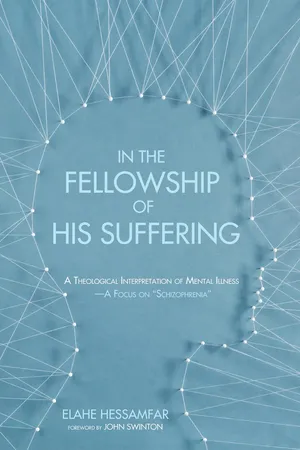
In the Fellowship of His Suffering
A Theological Interpretation of Mental Illness—A Focus on “Schizophrenia”
- 390 pages
- English
- ePUB (mobile friendly)
- Available on iOS & Android
eBook - ePub
In the Fellowship of His Suffering
A Theological Interpretation of Mental Illness—A Focus on “Schizophrenia”
About this book
"Schizophrenia" is by many accounts the most devastating illness of our time. In this book, Elahe Hessamfar uses her personal encounter with her daughter's illness to bring the reader to experience the pain and anguish of those who suffer so intensely. She candidly discusses the gripping and dark realities her family has faced in the midst of this journey and exposes that the ride isn't easy, but it can be fruitful and purposeful, and it can be a journey of joy and peace if understood from the intended perspective.
This is a fascinating and deeply theological portrayal of madness under the mighty hand of God. It challenges and awakens the reader to a heightened awareness about self, community, pain, brokenness, sin, grace, and redemption. This is the first truly biblically based, theological interpretation of madness in conversation with psychiatry and social sciences. Hessamfar passionately discusses the shortcomings of our current medical model of mental illness and directs the reader's attention to the mistreatment of those the medical community labels with "schizophrenia." She argues that not only is "schizophrenia" not pathological but it touches on the most fundamental fragilities of the human soul, and hence, it is a critical pastoral issue. Hessamfar offers tangible, inspiring, and life-changing solutions for those dealing with this most elusive and mysterious phenomenon--solutions that would bring hope and healing to the hopeless people chained in the abyss of madness.
Information
Topic
Theology & ReligionSubtopic
Abnormal Psychology1
A Theological Anthropology
“What is man, that . . . Thou has made him a little lower than God, and dost crown him with glory and majesty!”
Psalm 8:4–5
It is the Spirit who gives life; the flesh profits nothing
John 6:63
In this chapter we will lay down our anthropological foundation, which will shape our analysis of mental illness as a human phenomenon. Throughout history man has been an enigma, and a paradox, not only in the pages of Scripture, but also to himself and his fellow human beings. Although there have been many studies on every detail of a human’s life concerning his social, psychological, economical, political, physiological, and cultural status in life, one seemingly trivial question that has puzzled philosophers, scientists, and laymen alike, driving the fundamental answer to all aforementioned categories, is What is a human being? The answer to this question is fundamental to our understanding of madness. The implied anthropological assumptions we bring to all contemporary settings not only affect our treatment of our modern challenges—whether sociological, economical, psychological, ethical, or even physical—but they also have a profound impact on the formulation of our fundamental theological understanding.36 As Barth commented, “One cannot speak of God without speaking of man.”37
The way we understand the nature of humankind is not merely a product of historical philosophical reflection or a phenomenon emerging out of contemporary scientific and technological debates. In fact, for Christians, these questions are “deeply rooted in the biblical traditions of the people of God.”38 The biblical writers’ focus on human nature primarily pointed the reader toward humanity’s covenantal relationship with God. They did not perceive humanity as an ambiguous entity awaiting conceptual clarity by scientific discoveries. Instead, they pointed to a creature clearly distinguished by his standing in relation to his Creator. A “real man,” says Barth, “is the being determined by God for life with God and existing in the history of the covenant which God has established with him.”39 Our study is guided by this covenantal anthropological picture that receives a greater clarity in the person of Jesus in the New Testament.40 Based on this, we will offer, not a full blown but a contextually-driven, theological anthropology, which will inform our analysis of key issues with regard to how the church should understand and frame “schizophrenia.” While dealing with the subject of mental illness and what a person is experiencing in the midst of madness, the questions about the essence and nature of the human being, who he is, why he is who he is, and whether there are any meanings in the events surrounding his life, make a significant difference as to how his particular situation should be treated.
Scientists such as Bill Joy, Stephen Hawking, and Ray Kurzweil predict that it is conceivable for computer technology to displace human species. They predict that without genetic modification, humans will not be able to keep ahead of technological advancements.41 Are humans merely primitive machines that soon will be replaced with newer and more advanced models? Ray Kurzweil, the famous inventor and technology futurist, predicts that in a few decades, “nanobots will roam our blood streams fixing diseased or aging organs.” He believes it is only a matter of time before humans and computers will intermingle with nanobots—blood cell-sized robots—that will be integrated into our bodies and brains. So, if something goes wrong, the damaged cells can be amended or replaced with the right technology that will correct the problem. It is merely a matter of technical repair! Thus, those who manage to survive for another fifteen to thirty years, Kurzweil predicts, will never die but will have an “eternal life.”42
These predictions bring hope and excitement to many people and fear and despair to many others. But what do these projections mean? Are our lives so meaningless that they could easily be replaced with robots? Are we beings devoid of purpose beyond our physical manifestation? We are reminded by the evidence that technologists in the field of Artificial Intelligence (AI) have traditionally over-claimed and under-delivered. AI has faltered in the past not because of difficult challenges such as solving an astrophysics problem, but it has failed in mimicking what a young child can do, such as identifying a face in a crowd, or appreciating nuances in a simple story requiring a common sense, or experiencing the emotional effects of such a story. It is that level of consciousness, which is able to experience love and hate and beauty of a sunrise, that has been problematic for AI to figure out.43
Then there are those materialists who view humans through a somatic lens made of chemical substances. Not only is a person’s bodily existence dependent on a tiny thyroid-gland secretion, so too is his or her sanity and psycho-spiritual life determined by it. A minor blow on the right spot upon the head, which is considered purely physical damage, could turn a “genius” into an “idiot,” and bring a fruitful life down to a mere survival. It is easy to understand, as Brunner suggests, how a physician who is limited by this reductionist view of human existence, finding that to be the only sphere of influence for him, “constantly falls a prey to the temptation to ignore other aspects” of a person’s being.44 Based on all these scientific observations, are we to accept that we are reduced to mere structured aggregates of physical parts?
The presuppositions about the constitutional nature of human beings that a psychiatrist brings into the treatment determine a great deal. In the absence of a correct conceptual model of a human being, psychiatrists, psychologists, and all those in the field of mental health, are bound to “run up against an inadequate framework for treating” the pe...
Table of contents
- Title Page
- Foreword
- Acknowledgments
- Introduction
- Chapter 1: A Theological Anthropology
- Chapter 2: The Historical Contexts of Psychiatry and Mental Illness
- Chapter 3: A Theology of Illness
- Chapter 4: A Path Forward
- Chapter 5: Conclusion
- Bibliography
Trusted by 375,005 students
Access to over 1.5 million titles for a fair monthly price.
Study more efficiently using our study tools.
Frequently asked questions
Yes, you can cancel anytime from the Subscription tab in your account settings on the Perlego website. Your subscription will stay active until the end of your current billing period. Learn how to cancel your subscription
No, books cannot be downloaded as external files, such as PDFs, for use outside of Perlego. However, you can download books within the Perlego app for offline reading on mobile or tablet. Learn how to download books offline
Perlego offers two plans: Essential and Complete
- Essential is ideal for learners and professionals who enjoy exploring a wide range of subjects. Access the Essential Library with 800,000+ trusted titles and best-sellers across business, personal growth, and the humanities. Includes unlimited reading time and Standard Read Aloud voice.
- Complete: Perfect for advanced learners and researchers needing full, unrestricted access. Unlock 1.5M+ books across hundreds of subjects, including academic and specialized titles. The Complete Plan also includes advanced features like Premium Read Aloud and Research Assistant.
We are an online textbook subscription service, where you can get access to an entire online library for less than the price of a single book per month. With over 1.5 million books across 990+ topics, we’ve got you covered! Learn about our mission
Look out for the read-aloud symbol on your next book to see if you can listen to it. The read-aloud tool reads text aloud for you, highlighting the text as it is being read. You can pause it, speed it up and slow it down. Learn more about Read Aloud
Yes! You can use the Perlego app on both iOS and Android devices to read anytime, anywhere — even offline. Perfect for commutes or when you’re on the go.
Please note we cannot support devices running on iOS 13 and Android 7 or earlier. Learn more about using the app
Please note we cannot support devices running on iOS 13 and Android 7 or earlier. Learn more about using the app
Yes, you can access In the Fellowship of His Suffering by Elahe Hessamfar in PDF and/or ePUB format, as well as other popular books in Theology & Religion & Abnormal Psychology. We have over 1.5 million books available in our catalogue for you to explore.