- 182 pages
- English
- ePUB (mobile friendly)
- Available on iOS & Android
eBook - ePub
About this book
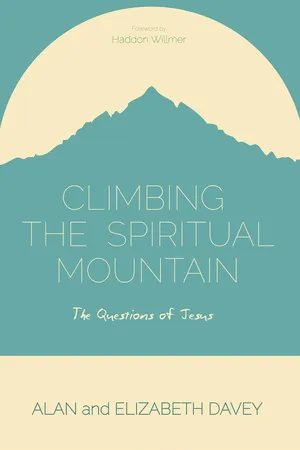
This is a guide for spiritual mountain climbers. In the Scriptures, connecting with Abba often leads to a mountain. Modern spiritual writers have long recognized this scriptural metaphor and explored the nature of this journey of ascent. Drawing on the text of the Bible, works of literature, and the writings of mystics both old and new, Climbing the Spiritual Mountain speaks of the desires and intentions, discipline, and effort involved in developing our intimacy with Christ.
In Jesus' dealings with people in the Gospels, he draws them up the spiritual mountain through dialogue and questions. Like Socrates of old, his teaching method probes our thinking, knowledge, and motives. In the process, he stimulates our longing and desire to reach the summit.
There are challenges, hurdles, and difficult choices to make as we climb the spiritual mountain. But the reward--approaching the beautiful One who is our Abba--far outshines any sacrifice we may make on the climb.
Information
Topic
Theology & ReligionSubtopic
Christian Theologypart I
Preparations for the Ascent
1
Our Deepest Choices
“What are you seeking?”
The next day John again was standing with two of his disciples, and as he watched Jesus walk by, he exclaimed, “Look, here is the Lamb of God!” The two disciples heard him say this, and they followed Jesus. When Jesus turned and saw them following, he said to them, “What are you looking for?” They said to him, “Rabbi” (which translated means Teacher), “where are you staying?” He said to them, “Come and see.” They came and saw where he was staying, and they remained with him that day. It was about four o’clock in the afternoon. One of the two who heard John speak and followed him was Andrew, Simon Peter’s brother. He first found his brother Simon and said to him, “We have found the Messiah” (which is translated Anointed). He brought Simon to Jesus, who looked at him and said, “You are Simon son of John. You are to be called Cephas” (which is translated Peter). John 1:35–42
John the Evangelist begins his story of Jesus in the Jordan valley with John the Baptist preaching a demanding sermon of repentance to his Jewish listeners. As he essentially calls the people to wake up, he invites individuals to come to an awareness of the fundamental beat of life with which hearts resonate and which can be so quickly lost in the round of daily choices. John the Baptist sees Jesus walking by and announces to his own disciples a stunning and unique declaration, “Behold the Lamb of God who takes away the sin of the world” (John 1:29). Speaking to people who recognize the images of the Passover lamb and the submissive servant “lamb led to the slaughter” of Isa 53:7, and in utter simplicity and innocent faith, John is pointing out that the sin of the world—past, present, and future—is absorbed by this Lamb. Jesus brings about reconciliation and peace between God and humankind as the gift of his person is embraced.
Embedded in John the Baptist’s introduction to Jesus is an encouragement for his own disciples to leave him and to follow Jesus. John’s humility sets the tone for the important dialogue to follow. In a world of competition, John sees beyond his own needs and ministry to the greater calling of the kingdom and takes what has been called the downward way to allow the new light of Jesus to shine forth. Andrew and an unnamed disciple (probably the Evangelist himself) respond to John’s announcement as they start to follow Jesus and gain his attention.
What Is Most Essential?
We can imagine the scene: Jesus is walking alone along the worn path leading away from the Jordan. The two disciples are following along behind, wondering how to broach the recommended option of changing teachers. Before they can articulate their desired plan, Jesus turns and utters a statement captured in two Greek words ti zēteite as presented by the Evangelist. In English, it comes across as “What are you seeking?” We know that in the poetic and highly symbolic Gospel of John nothing is a simple, casual thought. There are layers of meaning in individual observations. When Jesus asks, “What are you seeking?” he is not asking simply, “Can I help you?” or “Are you lost?” Jesus is asking something substantially deeper to these prospective followers. His question is more like “What is essential to you?” or “What are you really searching for?” “What is compelling to you?” or “What is your motive force?” These deeper questions are getting closer to the heart of the theme of John’s Gospel. We know this because the language of “seeking” (zēteō) used thirty-four times in John contains a distinct reference to “that which is essential.”1 “Seeking” leads to “believing,” and once again, believing is never simply belief in some body of knowledge (a noun); believing is always presented as a verb leading to an active engagement with Abba. John’s sense of believing is a compelling disposition to seek after the essential reality of Abba.2 The theologian and philosopher Kierkegaard describes this intense and focused seeking as “willing one thing” in his masterpiece Purity of Heart:
Father in heaven! What is a person without thee! What is all that he knows, vast accumulation though it be, but a chipped fragment if he does not know thee! What is all his striving, could it even encompass a world, but a half-finished work if he does not know thee: Thee the One, who art one thing and who art all! So may thou give to the intellect, wisdom to comprehend that one thing; to the heart, sincerity to receive this understanding; to the will, purity that wills only one thing.
The writer goes on to describe how this willing one thing will look:
In prosperity may thou grant perseverance to will one thing; amid distractions, collectedness to will one thing; in suffering, patience to will one thing. Oh, thou that giveth both the beginning and the completion, may thou early, at the dawn of day, give to the young man the resolution to will one thing. As the day wanes, may thou give to the old man a renewed remembrance of his first resolution, that the first may be like the last, the last like the first, in possession of a life that has willed only one thing.3
In the language of the psalmist, this intentionality is referred to as “living with an undivided heart,” that is, to truly keep choosing Abba at every turn (Ps 86:11).
Jesus’ question asks each of us to consider what it is that we really want. What do we really seek? In the award-winning film The Wrestler, the lead character Randy the Ram (played by Mickey Rourke) has lived infatuated by the adoration and applause of the arena crowds. He has forsaken all other commitments, including care for his only daughter Stephanie. As he closes in on the end of his wrestling career he begins to question the wisdom of his choices. “Is this descending spiral of fame, money and adulation really what I want from life?” he wonders. Randy’s questions lead us to consider the desires of our own hearts and if our choices are leading us where we really want to go?
Can we be honest and really penetrate through our defenses to discern what are the deepest desires of our hearts? C. S. Lewis suggests these desires are “part of our inconsolable secret” in his haunting sermon “Weight of Glory.” We want “to be a real ingredient in the divine happiness.” We want “acceptance by God, response, acknowledgment, and welcome into the heart of things.”4 But we fail to recognize these longings; instead, we mistakenly focus our energies and longings on earthly relationships and achievement. We need to consider the import of the question “What are you seeking?” at whatever stage of life and at whatever age. What do I want—whether I am twenty-five, fifty-five, or eighty? What would my life look like if these desires were satisfied? From a spiritual perspective, St. Teresa of Avila muses that our journey with Abba is like coming up to a great castle. Each of its rooms opens up into some new awareness of Abba’s pure love. St. Teresa observes that as long as we focus on our own needs or wants, we never move beyond the front porch or veranda of the castle. Such is the dulling effect of self and its relationship to spiritual awareness and ascending the spiritual mountain.5
Jesus desires to evoke in us a deeper response. Can we escape the subtle draw of the superficial? Perhaps it is the difference between settling for temporary happiness when Jesus intends to give to us true beatitude. He encourages the woman at the well, another potential follower, with the question, “Why settle for regular water when I can give water that springs up gushing to eternal life?” (John 4:14). We pause to reflect on Jesus’ first question, “What do you really seek? Do you really want to climb the mountain or not?” Jesus asks these prospective learners (the root word for “disciple” contains the meaning “to learn”) for a showing of their true colors. He asks us through them, “Do you have the ability or desire or strong determination to pursue the truth?” This question is at the heart of climbing the spiritual mountain.
Risky Business
The two disciples of John answer Jesus with a question of their own, also framed as two Greek words (pou meneis or “you-abiding”): “Where are you staying?” On a casual level, the disciples might be asking, “Can we hang out with you for a while to get to know you better? To put it bluntly, is it worth our time and effort to leave the Baptist? This is a big step, you know.” Even at this level, it is not an insignificant question. Time and effort are required to explore spiritual truths. In the Evangelist’s story this interaction between Jesus and these two disciples takes place over several days. Any relationship takes time. We, in turn, need to ask ourselves, how serious are we about this mountain climbing? What kind of investment are we prepared to make? What adjustments do we need to make in our commitment to our work? Do we leave any space for eternal thoughts in our preoccupation with achievement? What about our leisure? We numb out, watching television, engaging in sports, watching a film or two—all harmless activities—but are we merely drifting? What in our daily routine gets our attention? Do we do anything to deepen the relationship we claim is our most important?
Here, the disciples are focused and called out of their routine activities. Jesus has their attention, and they are contemplating a dramatic turn in their life direction. They are calling Jesus “Rabbi” or “Teacher” at this point in the conversation, the same name they would have been calling their old teacher, John the Baptist. They know it is a risky business to switch teachers. Who knows where it might ...
Table of contents
- Title Page
- Foreword
- Preface
- Introduction
- Abbreviations
- Part 1: Preparations for the Ascent
- Chapter 1: Our Deepest Choices
- Chapter 2: Our Proclivity to Attachments
- Chapter 3: The Acceptance of Jesus
- Chapter 4: Authentic Relationship with Jesus
- Part 2: The Challenges of the Climb
- Chapter 5: Confronting Our Addictions
- Chapter 6: Priorities and Comparisons
- Chapter 7: Spiritual Attentiveness
- Chapter 8: Hope Within Suffering
- Chapter 9: The Invitation to Discipleship and Friendship
- Chapter 10: Possessions and Anxiety
- Chapter 11: Gratitude As Spiritual Discipline
- Part 3: Reaching the Summit
- Chapter 12: Awareness and Prayer
- Chapter 13: The Centrality of Faith and Confidence In God
- Chapter 14: Completing the Journey with Jesus
- Epilogue
- Bibliography
Trusted by 375,005 students
Access to over 1.5 million titles for a fair monthly price.
Study more efficiently using our study tools.
Frequently asked questions
Yes, you can cancel anytime from the Subscription tab in your account settings on the Perlego website. Your subscription will stay active until the end of your current billing period. Learn how to cancel your subscription
No, books cannot be downloaded as external files, such as PDFs, for use outside of Perlego. However, you can download books within the Perlego app for offline reading on mobile or tablet. Learn how to download books offline
Perlego offers two plans: Essential and Complete
- Essential is ideal for learners and professionals who enjoy exploring a wide range of subjects. Access the Essential Library with 800,000+ trusted titles and best-sellers across business, personal growth, and the humanities. Includes unlimited reading time and Standard Read Aloud voice.
- Complete: Perfect for advanced learners and researchers needing full, unrestricted access. Unlock 1.5M+ books across hundreds of subjects, including academic and specialized titles. The Complete Plan also includes advanced features like Premium Read Aloud and Research Assistant.
We are an online textbook subscription service, where you can get access to an entire online library for less than the price of a single book per month. With over 1.5 million books across 990+ topics, we’ve got you covered! Learn about our mission
Look out for the read-aloud symbol on your next book to see if you can listen to it. The read-aloud tool reads text aloud for you, highlighting the text as it is being read. You can pause it, speed it up and slow it down. Learn more about Read Aloud
Yes! You can use the Perlego app on both iOS and Android devices to read anytime, anywhere — even offline. Perfect for commutes or when you’re on the go.
Please note we cannot support devices running on iOS 13 and Android 7 or earlier. Learn more about using the app
Please note we cannot support devices running on iOS 13 and Android 7 or earlier. Learn more about using the app
Yes, you can access Climbing the Spiritual Mountain by Alan Davey,Elizabeth Davey in PDF and/or ePUB format, as well as other popular books in Theology & Religion & Christian Theology. We have over 1.5 million books available in our catalogue for you to explore.