eBook - ePub
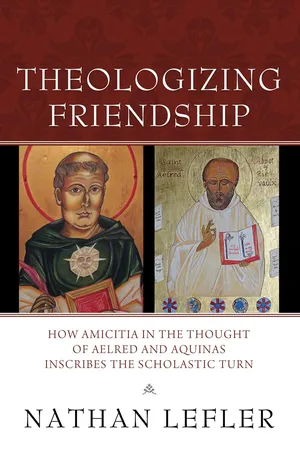
Theologizing Friendship
How Amicitia in the Thought of Aelred and Aquinas Inscribes the Scholastic Turn
- 194 pages
- English
- ePUB (mobile friendly)
- Available on iOS & Android
eBook - ePub
Theologizing Friendship
How Amicitia in the Thought of Aelred and Aquinas Inscribes the Scholastic Turn
About this book
In Theologizing Friendship, the author aims to revitalize Jean Leclercq's defense of monastic theology, while expanding and qualifying some of the central theses expounded in Leclercq's magisterial The Love of Learning and the Desire for God. The current work contributes to a revised and updated status quaestionis concerning the theological relationship between classical monasticism and scholasticism, construed in more systematic and speculative terms than those of Leclercq, rendered here through the lens of friendship as a theological topos. The work shares with Ivan Illich's In the Vineyard of the Text the conviction that the rise of the Schools (Paris, Oxford, etc.) constitutes one of the greatest intellectual watersheds in the history of Western civilization: where Illich's ruminations are largely philosophical and particularly epistemological, the author's are theological and metaphysical.
In his novel proposal that within the monastic and scholastic milieux there obtain parallel threefold analogies among friendship, reading, and theology, the author not only offers an original contribution to current scholarship, but gestures towards avenues for institutional self-examination much needed by the contemporary--modern and postmodern--Academy.
Information
Topic
Theology & ReligionSubtopic
Christian Church1
Differences between the More Experiential Approach of Monastic Theology and the More Conceptual Approach of Scholastic Theology
Contemporary Scholarship
In service of our comparison between the particular theological accounts of friendship given by St. Aelred of Rievaulx and St. Thomas Aquinas, a preliminary description of the relationship between monastic and scholastic theological approaches per se will provide the most helpful point of departure. In this preparatory chapter, our preeminent guide will be the great twentieth-century Benedictine scholar, Jean Leclercq. The conclusions of Leclercq’s extensive and profound researches will be supplemented principally by the work of R. W. Southern, Beryl Smalley, David Knowles and Ivan Illich.
Common Culture
Between the birth of Aelred of Rievaulx in 1110 and the death of Thomas Aquinas in 1274, a substantial homogeneity of culture obtained throughout Western Europe. David Knowles comments that “For three hundred years, from 1050 to 1350, and above all in the century between 1070 and 1170, the whole of educated Western Europe formed a single undifferentiated cultural unit.”26 Jean Leclercq, who tends to insist on the non-monolithic character of medieval life and culture, nevertheless confirms Knowles’s assertion in a somewhat peculiar way when he argues that, “jusqu’alors [xiie siècle], toute la culture médiévale porte l’empreinte monastique, et qu’en ce sens et dans cette mesure elle est une culture monastique.”27 To the extent, then, that medieval culture, at least up until the twelfth century, can be said to be monastic, it necessarily maintains a certain uniformity of character. Moreover, as Knowles’s chronologically broader claim suggests, such a deeply ingrained uniformity of Christian worldview and practice was by no means easily shed, even through Aquinas’s lifetime and well beyond. In The Love of Learning and the Desire for God, Leclercq is furthermore earnestly concerned to stress the fundamental unicity of the Church’s theology, however divergent or even disparate may appear its sundry expressions from one era, or nation, or school, to another:
Fundamentally, as there is but one Church, one faith, one Scripture, one tradition, and one authority, there is but one theology. Theology cannot be the specialty of any one milieu, where it would be, as it were, imprisoned. Like every great personality, every culture, and even more, necessarily, every reflection on the Catholic faith, every theology is, by its essence, universal and overflows the confines of specialization. It is only within the great cultural entities which have succeeded one another in the life of the Church that different currents can be observed; but they cannot be separated.28
In this dissertation, we will be very much concerned with a number of significant differences between monastic and scholastic theology. Precisely for this reason, we must heed attentively Leclercq’s salutary reminder concerning theology, along with the generally acknowledged evidence of broad cultural homogeneity spanning the lifetimes of Aelred and Thomas and the years in between.
Differences between Monastic and Scholastic Theology
Midway through his project of delineating a true “monastic theology,” Leclercq affirms “real continuity between the patristic age and the medieval monastic centuries, and between patristic culture and medieval culture.” He continues:
And it is this continuity which gives medieval monastic culture its specific character: it is a patristic culture, the prolongation of patristic culture in another age and in another civilization. From this point of view, it seems possible to distinguish, from the eighth to the twelfth centuries in the West, something like two Middle Ages. The monastic Middle Ages, while profoundly Western and profoundly Latin, seems closer to the East than to the other, the scholastic Middle Ages which flourished at the same time and on the same soil. Our intention here is by no means to deny that scholasticism represents a legitimate evolution and a real progress in Christian thought, but rather to point out this coexistence of two Middle Ages. To be sure, the culture developed in the monastic Middle Ages differs from that developed in scholastic circles. The monastic Middle Ages is essentially patristic because it is thoroughly penetrated by ancient sources and, under their influence, centered on the great realities which are at the very heart of Christianity and give it its life. It is not dispersed in the occasionally secondary problems discussed in the schools. Above all, it is based on biblical interpretation similar to the Fathers’ and, like theirs, founded on reminiscence, the spontaneous recall of texts taken from Scripture itself with all the consequences which follow from this procedure, notably the use of allegory.29
Bearing in mind Leclercq’s provocative notion of “two Middle Ages,” let us proceed to consider more carefully some of the significant ways in which monastic and scholastic theology diverge, in keeping with the differences between their respective milieux.30
If we begin at the most generic level, already we discover a striking contrast between the metaphors employed by monks and schoolmen to describe their respective theological activities. Thus, R. W. Southern says of the monks that “they liked to think of themselves as bees gathering nectar far and wide, and storing it in the secret cells of the mind.”31 Leclercq recalls St. Bernard’s description of himself and his fellow-monks as “lowly gleaners,” in comparison with those great reapers, Sts. Augustine, Jerome, and Gregory, not to mention the other Fathers.32 And Ivan Illich highlights the medieval characterizations of monks, by themselves and others, as “mumblers and munchers,” ruminating, or chewing, on the divine words of Scripture.33 The scholastics, on the other hand, when compared with the great thinkers of antiquity in the memorable description of Bernard of Chartres, were like “dwarfs perched on the shoulders of giants,” able to see a little farther, however much lesser their stature, than those by whose accomplishments they hoisted themselves up.34 Even more significantly, it was the schoolmen for whom the most compelling image of Heaven came to be the Beatific Vision. We find, then, that whereas the theological enterprise of the monks is depicted by various metaphors of eating, the work of the schools is chiefly conceived under the metaphorical rubric of sight, or vision. The evident privileging of different senses here—the highly concrete sense of taste, and by extension, touch and smell, on the one hand; the most spiritual of the senses, sight, on the other—is not arbitrary. Rather, it proves to be congruent with the contrast between the fundamentally more experiential, ...
Table of contents
- Title Page
- Foreword
- Preface
- Acknowledgments
- Abbreviations
- Introduction
- Chapter 1: Differences between the More Experiential Approach of Monastic Theology and the More Conceptual Approach of Scholastic Theology
- Chapter 2: The Theological Account of Friendship in Aelred of Rievaulx
- Chapter 3: The Theological Account of Friendship in Thomas Aquinas
- Chapter 4: Aelred and Thomas Compared
- Selected Bibliography
Trusted by 375,005 students
Access to over 1.5 million titles for a fair monthly price.
Study more efficiently using our study tools.
Frequently asked questions
Yes, you can cancel anytime from the Subscription tab in your account settings on the Perlego website. Your subscription will stay active until the end of your current billing period. Learn how to cancel your subscription
No, books cannot be downloaded as external files, such as PDFs, for use outside of Perlego. However, you can download books within the Perlego app for offline reading on mobile or tablet. Learn how to download books offline
Perlego offers two plans: Essential and Complete
- Essential is ideal for learners and professionals who enjoy exploring a wide range of subjects. Access the Essential Library with 800,000+ trusted titles and best-sellers across business, personal growth, and the humanities. Includes unlimited reading time and Standard Read Aloud voice.
- Complete: Perfect for advanced learners and researchers needing full, unrestricted access. Unlock 1.5M+ books across hundreds of subjects, including academic and specialized titles. The Complete Plan also includes advanced features like Premium Read Aloud and Research Assistant.
We are an online textbook subscription service, where you can get access to an entire online library for less than the price of a single book per month. With over 1.5 million books across 990+ topics, we’ve got you covered! Learn about our mission
Look out for the read-aloud symbol on your next book to see if you can listen to it. The read-aloud tool reads text aloud for you, highlighting the text as it is being read. You can pause it, speed it up and slow it down. Learn more about Read Aloud
Yes! You can use the Perlego app on both iOS and Android devices to read anytime, anywhere — even offline. Perfect for commutes or when you’re on the go.
Please note we cannot support devices running on iOS 13 and Android 7 or earlier. Learn more about using the app
Please note we cannot support devices running on iOS 13 and Android 7 or earlier. Learn more about using the app
Yes, you can access Theologizing Friendship by Nathan Sumner Lefler in PDF and/or ePUB format, as well as other popular books in Theology & Religion & Christian Church. We have over 1.5 million books available in our catalogue for you to explore.