eBook - ePub
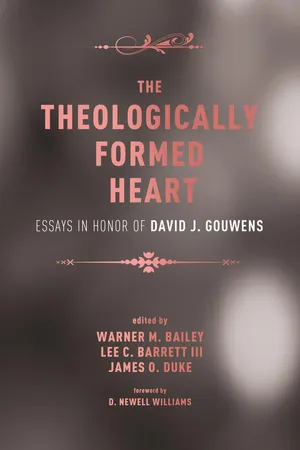
The Theologically Formed Heart
Essays in Honor of David J. Gouwens
- 298 pages
- English
- ePUB (mobile friendly)
- Available on iOS & Android
eBook - ePub
The Theologically Formed Heart
Essays in Honor of David J. Gouwens
About this book
The Theologically Formed Heart invites the reader to consider the role of theology in the formation of virtues and passions, and, conversely, the role of virtues and passions in understanding Scripture, theology, and living a Christian life. The essays in this volume are offered in appreciation of the teaching, scholarship, and service to the church and world of Professor of Theology David J. Gouwens. They are organized in three sections: theological reflections, Reformed theology in service to the church, and studies in the thought of Soren Kierkegaard. Four important issues are explored from multiple perspectives: the Church's coming to terms with religious pluralism in mission, inter-religious dialogue, theological education, and ecclesial life; the gospel's invitation to welcome communities of difference; Reformed aesthetics in Calvin's rhetoric and in contemporary hymnody; and Kierkegaard's contribution to theology and ecclesial practice.
The aims of the book go beyond academic confines. Through reading the different essays, a personality will emerge who illustrates a life of scholarship that yields itself gladly to the God made known in Jesus Christ. Thus, beyond imparting new information, the book may inspire its readers to their own practice of theologically forming their hearts.
Information
Topic
Theology & ReligionSubtopic
Christian TheologyTheological Reflections
1
Passionate Doctrine
David Gouwens and the Role of Subjectivity in the “Yale School”
The publication in 1984 of The Nature of Doctrine by George Lindbeck, a Yale theologian who had previously been known mostly for his participation in Lutheran/Catholic ecumenical conversations and for his encyclopedic knowledge of medieval scholasticism, heralded the advent of an innovative and controversial approach to theological reflection.1 Taking a cue from the slim volume’s subtitle, this novel way of doing theology was promptly labeled “postliberal.” Observers of the theological scene immediately detected parallels with the work of Hans Frei, Lindbeck’s colleague, from the 1970’s. Similarities were even discerned with the so-called “canonical” approach to biblical studies pioneered by Brevard Childs, and with the reflections on scriptural authority by David Kelsey. In some ways, Paul Holmer’s work in philosophical theology also seemed to dovetail with important features of Lindbeck’s book. Because Lindbeck, Frei, Childs, Kelsey, and Holmer all taught at Yale, soon the religious studies world was referring to a “Yale School” of theology. While interpretations of its significance varied, the one common assessment in the early literature about the Yale School was that this alleged movement was intent upon preserving the central theological convictions of the historic Christian tradition. The scholars commonly associated with the movement all sought to protect Christian teachings from over-assimilation to contemporary ideologies and cultural sensibilities. As such, this seemingly novel postliberalism actually appeared to be an extension of many of the concerns of the neo-orthodoxy of the mid-twentieth century. The obvious difference from neo-orthodoxy was that these Yale theologians had been somewhat chastened by the perspectivalism and constructivism associated with the intellectual orientation that was already being dubbed “postmodern.” Some commentators applauded these new theological developments as the antidote to the erosion of Christianity’s identity, while others decried it as a resurgence of a retrograde theological tribalism. I shall argue that this allegedly cohesive movement was never monolithic, and, in fact, had significant internal tensions, paradoxes, and conundrums. I will also argue that the expositions of Kierkegaard by David Gouwens, who studied under the progenitors of the movement, point to a way to resolve these tensions and integrate the trajectories of Frei and Lindbeck on the one hand, and Holmer on the other.
In popular perception, the alleged “Yale School” enjoyed a meteoric career. On the positive side, it was seen as one of the progenitors of a wider “postliberal” mood in theology that included such disparate phenomena as Radical Orthodoxy in Britain and the liturgical turn in much of American neo-evangelicalism.2 By the 1990’s analyses and even histories of this Yale School were being penned, sometimes laudatory, but often excoriating the movement for being fideistic, confessionally authoritarian, and hopelessly sectarian. Cautiously sympathetic but critical responses appeared by more conservative and evangelical authors, such as Alister McGrath and Nancy Murphy, who celebrated the putative movement’s fidelity to historic Christianity, but feared its ostensibly weak commitment to the objective reference of Christian language.3 In spite of the initial furor, by the 2000’s retrospective obituaries of the Yale School were being composed by scholars like Paul DeHart.4 Far from being the most exciting theological development since neo-orthodoxy, postliberalism was being described as a passing fad that had dissipated its energies and fragmented into divergent theological trends.
Assessing the evolution of the so-called Yale School has been complicated by the lack of agreement concerning what exactly it was or continues to be. Some things, however, were clear. Whatever it was, it was clearly non-foundationalist. Lindbeck, Frei, and Holmer all rejected the claim that Christian convictions are grounded in a set of self-evident and universally plausible principles or in a generic and self-authenticating religious dimension of experience. What counts as human rationality is always culturally constructed, and experience comes always already interpreted. The convictions of religious traditions cannot be based upon some primordial, unmediated, raw data provided by reason or experience. Religious teachings cannot be understood by situating them in a metaphysical analysis of the universe or in a phenomenological description of the religious dimension of human experience. Secondly, Lindbeck, Frei, and Holmer eschewed classic apologetics, denying that there is any framework logically prior to Christian belief, in terms of which Christian convictions must be understood and defended. Thirdly, all of them attended to the particularities of Christianity, rather than construing the faith as an instantiation of religion-in-general. Finally, Frei, Lindbeck, and Holmer all emphasized the Bible as the source of the stories, narratives, and concepts by which Christians construe God and their own lives, and resisted efforts to reduce the “meaning” of Scripture to its moral message, or its propositional content, or its capacity to evoke a depth experience, or its symbolization of truths about the cosmos or human nature.
In spite of these commonalities, Frei, Lindbeck, and Holmer were never of a unitary mind. Against the narrative of postliberalism as a monolithic movement, I am proposing that the “Yale School,” if there ever was such a thing, was not a common set of theological affirmations, nor was it a cohesive theological method. Rather, the Yale School was (and is) unified by a concern for a common set of problems and a common set of deep-seated worries about Christianity. Tension always existed between the approaches of its most prominent exponents and even within the works of individual authors. Prominent among the common concerns that united them was a desire to highlight the uniqueness of Christianity, rather than allowing it to be treated as one more variation on the theme of generic human spirituality. Another was a fear that the Bible was no longer being read over against the norms of the prevailing culture, nor as a bearer of good news from beyond the aspirations and values of that culture. It was suspected that the Bible was not being heard as a word from a transcendent source. Closely allied with this was a desire to stabilize the meaning of Scripture and hear it as unified message of hope rather than as a concatenation of religious opinions, experiences, and practices from diverse ancient sources. This concern was symptomatic of an anxiety that the Bible was no longer being construed according to the liturgical and confessional heritage of the church, and therefore its meaning was at the mercy of the vagaries and whims of the academy and popular culture. The Yale theologians fretted that the Bible could become the wax nose that Luther feared, susceptible to being twisted into any shape the contemporary reader chose, if it were left at the mercy of the imperative to be culturally relevant and plausible. In short, these New Haven postliberals shared a concern that the uniqueness, self-identity, coherence, and meaningfulness of the Christian message had become obscured.
The main rift in the group arose out of the tension between Frei and Lindbeck’s deep and pervasive suspicion of the “subjective” turn in theology, and Holmer’s commitment to clarifying Christian passions and dispositions. Both Frei and Lindbeck feared that structuring Christian beliefs according to the drama of the individual’s spiritual development would reduce theology to anthropology, or at least trigger its degeneration into a projection of human needs. Both Frei and Lindbeck sought to foreground the triumph and sovereignty of God’s grace enacted in the Incarnation, and worried that undue attention to human subjectivity would imply some meritorious value to that experience, and therefore lead to Pelagianism. Holmer, however, tended to identify the distinctiveness of Christianity with the distinctiveness of the emotions, passions, dispositions, and attitudes that constitute the Christian life. Consequently, Holmer’s main goal was to illumine the nature of Christian pathos, a project which involved a resistance to the reduction of the faith to any textual or historical objectivities. To Frei at least this concentration on Christian pathos did look suspiciously like a sophisticated variant of the subjective turn. Holmer’s flamboyant enthusiasm for Kierkegaard, often regarded in theological circles as a notorious champion of subjectivity, did not sit well with Lindbeck and Frei’s Barthian sensibilities. Anyone who praised an author who had famously claimed that “truth is subjectivity” would necessarily be suspect in the eyes of the Barth-leaning Yale mainstream. Frei once quipped that Kierkegaard was the most dangerous Pelagian of all time, because he was the most seductive.5 Kierkegaard, Frei alleged, had turned anxiety, despair and guilt into meritorious works, and thereby had valorized the self-absorbed angst of modern individualists. Given Holmer’s attention to emotions and passions, it was inevitable that he, too, would be tarred with the brush of Pelagianism. It was Holmer’s attention to the passional qualities of the Christian that made him the odd man out in New Haven’s theological scene in the late twentieth century. It was this suspicion of any constitutive role for subjectivity in theology, a suspicion that was identified as a hallmark of the Yale School, which led to the marginalization of Holmer in accounts of the so-called movement’s evolution and obscured the extent of his positive impact on his colleagues. It may also have contributed to the actual distancing of his colleagues from Holmer.
When the Yale School is defined as a shared set of worries rather than as a shared set of conclusions or a shared method, Holmer’s role in it, and his attention to subjectivity, can be seen as significant. He cannot be dismissed as a peripheral character, lurking in theological corridors and flirting with the anthropological reduction of theology. Nevertheless, this approach to the so-called Yale School will also show that Holmer’s response to these worries was indeed very different from that of Frei...
Table of contents
- Title Page
- Contributors and Editors
- Acknowledgments
- Foreword
- Part 1: Theological Reflections
- Chapter 1: Passionate Doctrine
- Chapter 2: Reflections on Religious Pluralism
- Chapter 3: “The Church Militant”
- Chapter 4: The Best Friend of Jesus
- Chapter 5: Self-Made Eunuchs as Model Disciples
- Part 2: Reformed Theology in Service to the Church
- Chapter 6: Theological Education in a Secular Age
- Chapter 7: The Aesthetics of Persuasion
- Chapter 8: Hearts Kindled
- Chapter 9: Learning to Live with and Love Our Neighbors
- Chapter 10: World-Filling Word
- Chapter 11: Robert Elliott Speer, Some Transatlantic and Ecumenical Considerations
- Part 3: Studies in Søren Kierkegaard
- Chapter 12: Kierkegaard on Anxiety and Original Sin
- Chapter 13: At The Foot of the Altar
- Chapter 14: Kierkegaard for This World
- Publications of David J. Gouwens
Trusted by 375,005 students
Access to over 1.5 million titles for a fair monthly price.
Study more efficiently using our study tools.
Frequently asked questions
Yes, you can cancel anytime from the Subscription tab in your account settings on the Perlego website. Your subscription will stay active until the end of your current billing period. Learn how to cancel your subscription
No, books cannot be downloaded as external files, such as PDFs, for use outside of Perlego. However, you can download books within the Perlego app for offline reading on mobile or tablet. Learn how to download books offline
Perlego offers two plans: Essential and Complete
- Essential is ideal for learners and professionals who enjoy exploring a wide range of subjects. Access the Essential Library with 800,000+ trusted titles and best-sellers across business, personal growth, and the humanities. Includes unlimited reading time and Standard Read Aloud voice.
- Complete: Perfect for advanced learners and researchers needing full, unrestricted access. Unlock 1.5M+ books across hundreds of subjects, including academic and specialized titles. The Complete Plan also includes advanced features like Premium Read Aloud and Research Assistant.
We are an online textbook subscription service, where you can get access to an entire online library for less than the price of a single book per month. With over 1.5 million books across 990+ topics, we’ve got you covered! Learn about our mission
Look out for the read-aloud symbol on your next book to see if you can listen to it. The read-aloud tool reads text aloud for you, highlighting the text as it is being read. You can pause it, speed it up and slow it down. Learn more about Read Aloud
Yes! You can use the Perlego app on both iOS and Android devices to read anytime, anywhere — even offline. Perfect for commutes or when you’re on the go.
Please note we cannot support devices running on iOS 13 and Android 7 or earlier. Learn more about using the app
Please note we cannot support devices running on iOS 13 and Android 7 or earlier. Learn more about using the app
Yes, you can access The Theologically Formed Heart by Warner M. Bailey, Lee C. Barrett, James O. Duke, Warner M. Bailey,Lee C. Barrett,James O. Duke, Bailey, Barrett in PDF and/or ePUB format, as well as other popular books in Theology & Religion & Christian Theology. We have over 1.5 million books available in our catalogue for you to explore.