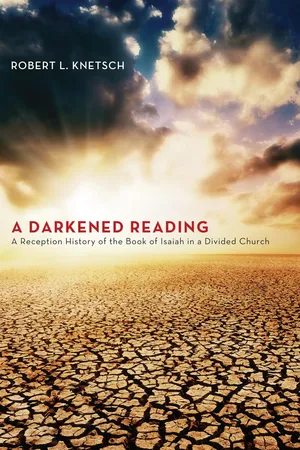
eBook - ePub
A Darkened Reading
A Reception History of the Book of Isaiah in a Divided Church
- 274 pages
- English
- ePUB (mobile friendly)
- Available on iOS & Android
eBook - ePub
About this book
The church in the West has subsisted for five hundred years in a state of ever-increasing multiple identities, many of which claim to be the best representation of the church established by Christ. Often attending novel models of the church are new scriptural interpretive methods that support theological claims. Rarely, however, has an exploration been undertaken to test the impact of this ecclesiological division on the reading of the Bible. A Darkened Reading explores the specific case of the nineteenth-century Church of England and competing interpretations of the book of the prophet Isaiah--a book of great importance in theological history--as a kind of parable of the existential anguish the church has experienced as a consequence of being torn apart.
Information
Topic
Teologia e religioneSubtopic
Teologia cristiana1
The Scriptural Hermeneutic of Early Anglicanism
A Touchstone
Introduction: A Hermeneutical Model
This chapter situates the context of my discussion of an enervated biblical exegesis by describing a uniquely Anglican reading of the Bible. This vision of reading Scripture is the organizing principle, or “touchstone,” for the analysis of various competing exegetical approaches to Isaiah in subsequent chapters. It also provides helpful categories for assessing the similarities and differences within the Church of England as well as that between Anglicans and Roman Catholics. The intent is not to prescribe this hermeneutical vision as normative per se, but to employ it as a heuristic for exegetical analysis, based on historical and theological data. While the vision that emerges in early Anglicanism was a unique one, it did not survive intact; nonetheless, its impact continues to be perceived, however evanescent.
The foundational theological figures who shape this touchstone are Thomas Cranmer (1489–1556), John Whitgift (1530–1604) and Richard Hooker (1554–1600). I attend to each of these insofar as their thought impacts a particular vision of reading Scripture. Three central categories help to define this exegetical touchstone:
(1) the relation between the Bible, the Church, and the individual;
(2) the way that each book of the Bible participates in the canon of Scripture as the one word of God; and
(3) the nature of a christological reading of the Bible, which pertains to how Old Testament is related to the New.
I should note the asymmetrical nature of my discussion; the first category—the communal nature of reading Scripture—is the most distinct one in Anglicanism and I give it the most space. It is also the one category most closely bound to the identity of the Church. The christological reading of Scripture and the claim that the entire Bible comprises the one Word of God are not per se unique to Anglicanism but does manifest certain peculiarly Anglican modalities of expression. In the discussion below, where I attend to the christological reading of Isaiah, I detail some specific uses of the Old Testament in general, and Isaiah specifically, in the Prayer Book.
The Tools of Division: Humanism, Spiritualist Traditions, and Skepticism
It is instructive to outline some challenges and competing options amidst the various factions within the Church before and after the Reformation. These movements were instruments of division, though they were not themselves a direct cause of it. Often I show that a certain “party” within the Church identifies with one of these new ways of thinking of thinking.
I challenge the contention that the emergence of new hermeneutical options, particularly in a highly critical form, are primarily (though not exclusively) external rather than internal ecclesial phenomena. Indeed, many new approaches to the Bible arose for the purpose of edifying the Church rather than for destroying it. The standard account, as represented, for instance, by Roy Harrisville and Walter Sundberg, suggests that “the doctrinal conflict between historical criticism and the dogmatic tradition” is “nothing less than a war between two worldviews of faith: the worldview of modern critical awareness originating in the Enlightenment and the inherited Augustinian worldview of the Western church.”19 Again, Gadamer states that “Enlightenment critique is primarily directed against the religious tradition of Christianity—i.e., the Bible. . . . This is the real radicality of the modern Enlightenment compared to all other movements of enlightenment: it must assert itself against the Bible and dogmatic interpretations of it.”20 This story, in which new hermeneutical approaches emerged because of external challenges to traditional doctrine, is mistaken, or at least too simplistic, based as it is on the presupposition that the Church is distinct from the rest of society. While such a distinction can perhaps be made today in the post-Christian West, the Reformation and its antecedents occurred in the midst of “christendom,” an era during which most people rarely had any other option than to be steeped in Christian beliefs. The typical narrative of ecclesial dissolution suggests that changes were imposed externally on the Church, as the “enemy” of a putatively “Augustinian worldview.” The debates between those who read the Bible in a traditional mode—one which attempts to reflect on the theological claims of the Church—and those who interpret by the use of historical-critical tools cannot, in my view, be effectively distinguished from each other as representations of two “worldviews of faith.” Instead, they issue out of the same Christian tradition. New modern interpretations are, in fact, the offspring of the Church, however misshapen and corrosive.21 They emerged in response to the divided Church’s claims on Scripture and were birthed through division and fragmentation. My account, therefore, is a theological and historical description of how this change in reading the Bible emerges internally to the Church, despite the claims of thinkers such as Harrisville and Sundberg, who characterize it as an external assault on the Church’s traditional doctrines by those who whose goal was to attack “the Church” itself.
H. G. Reventlow outlines the effect of spiritualism on Puritanism, which impacted Scripture’s interpretation in England.22 It would be beyond the task of this chapter to enter into the history of spiritualism in general. My more modest claim is that the Puritan discourse—taken up by the Evangelical movement in later centuries—takes on a spiritualist tenor, adopting spiritualist “traditions,” rather than being direct descendants of spiritualist thinkers of the twelfth and thirteenth centuries. The primary characteristic of this tradition (or, better, set of traditions) is a focus on the inner life of the individual and a minimization of the Church’s concrete particularity. Its contribution to division is the tendency to think of the Church as playing a variegated but diminishing role within theological discourse in favor of more “spiritual” ideas that are detached from concrete embodiment. In Protestantism, there came to be many manifestations of this spiritualist tendency, one of which was a distinction in the Church between the “visible” and “invisible” Church, the latter of which is the set of those who are the “elect” or the “saved.” It is the non-visible Church which, ironically, came to be seen as the “embodied” one.
Humanism is an intellectual and cultural phenomenon with a complex history, but its impact generates a series of movements, which in turn influence biblical exegesis. I characterize this impact as one that results in a desire for a repristination of the Church and a concern for the moral life of the individual believer. It is the former that had a greater impact on ecclesial division, as ecclesial repristination suggests a desire to move theological and biblical discourse ad fontes and a tendency toward criticizing the era following the patristic period.
Finally, I follow Popkin’s account of skepticism’s impact during the Reformation as formative for theological discourse and the context out of which modern thinking developed.23 For instance, the agitation of William Tyndale (1494–1536) generated new rhetorical modes of disputation, as argued by Peter Auksi. While it may to some extent be a generalization, Auksi’s analysis of the debate between Tyndale and Thomas More (1478–1535) reveals that the Catholic history of disputatio led to rhetoric in which (at least for More) “verbal ...
Table of contents
- Title Page
- Preface
- Introduction
- Chapter 1: The Scriptural Hermeneutic of Early Anglicanism
- Chapter 2: The Breakdown of Uniformity
- Chapter 3: Robert Payne Smith
- Chapter 4: The Politics of Division
- Chapter 5: Skepticism Is the “Truest Piety”
- Chapter 6: English Roman Catholicism and Isaiah
- Chapter 7: Conclusion
- Bibliography
Trusted by 375,005 students
Access to over 1.5 million titles for a fair monthly price.
Study more efficiently using our study tools.
Frequently asked questions
Yes, you can cancel anytime from the Subscription tab in your account settings on the Perlego website. Your subscription will stay active until the end of your current billing period. Learn how to cancel your subscription
No, books cannot be downloaded as external files, such as PDFs, for use outside of Perlego. However, you can download books within the Perlego app for offline reading on mobile or tablet. Learn how to download books offline
Perlego offers two plans: Essential and Complete
- Essential is ideal for learners and professionals who enjoy exploring a wide range of subjects. Access the Essential Library with 800,000+ trusted titles and best-sellers across business, personal growth, and the humanities. Includes unlimited reading time and Standard Read Aloud voice.
- Complete: Perfect for advanced learners and researchers needing full, unrestricted access. Unlock 1.5M+ books across hundreds of subjects, including academic and specialized titles. The Complete Plan also includes advanced features like Premium Read Aloud and Research Assistant.
We are an online textbook subscription service, where you can get access to an entire online library for less than the price of a single book per month. With over 1.5 million books across 990+ topics, we’ve got you covered! Learn about our mission
Look out for the read-aloud symbol on your next book to see if you can listen to it. The read-aloud tool reads text aloud for you, highlighting the text as it is being read. You can pause it, speed it up and slow it down. Learn more about Read Aloud
Yes! You can use the Perlego app on both iOS and Android devices to read anytime, anywhere — even offline. Perfect for commutes or when you’re on the go.
Please note we cannot support devices running on iOS 13 and Android 7 or earlier. Learn more about using the app
Please note we cannot support devices running on iOS 13 and Android 7 or earlier. Learn more about using the app
Yes, you can access A Darkened Reading by Robert Knetsch in PDF and/or ePUB format, as well as other popular books in Teologia e religione & Teologia cristiana. We have over 1.5 million books available in our catalogue for you to explore.